 and now, NASCAR Racing Sponsor


My HVAC Contractor Said a Heat Pump Won't Work Here. Were They Lying?
-
 By
Michael Haines
By
Michael Haines
- Mar 7, 2026
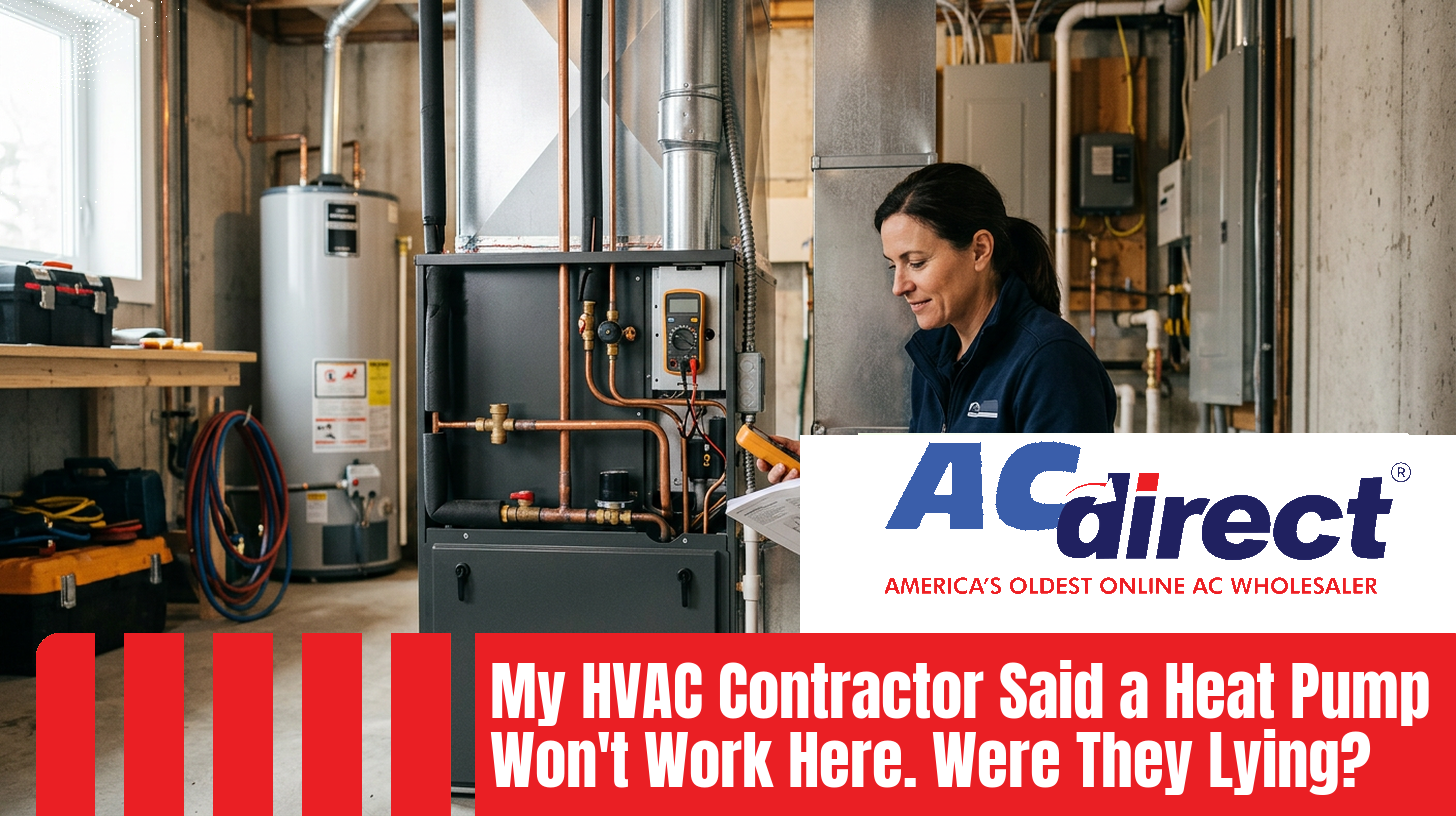
How to tell the difference between honest professional advice and outdated information that steers you toward a more expensive system you might not need.
Something strange keeps happening in HVAC forums, Reddit threads, and kitchen-table conversations across the country. A homeowner asks about installing a heat pump. Their contractor shakes their head and says some version of the same thing: "That won't work here." Maybe they cite the ductwork. Maybe they say it's too cold. Maybe they just steer the conversation toward a furnace without explaining why. And the homeowner, trusting the expert in the room, goes along with it.
Here's the uncomfortable truth: sometimes that contractor is giving you solid, experience-based advice. And sometimes they're repeating information that was accurate in 2005 but hasn't been true for years. The problem is that most homeowners have no way to tell the difference.
This article is not about calling your contractor a liar. Most HVAC professionals are honest people doing hard work. But the heat pump market has changed dramatically in a short time, and not every contractor has kept up. Some were trained on furnaces, sell furnaces, and install furnaces - and a heat pump recommendation means learning a new system, stocking different parts, and sometimes making a smaller margin on the job. That creates a built-in bias, even if it's not intentional.
So let's walk through the most common things contractors say to steer homeowners away from heat pumps, and separate what's real from what's outdated.
This is the single most repeated claim, and it's the one with the biggest gap between old reality and current technology.
Twenty years ago, most residential heat pumps genuinely struggled below freezing. Their single-speed compressors couldn't ramp up output when it got cold, so they leaned heavily on electric backup heat strips - basically expensive space heaters built into the air handler. Your comfort dropped and your electric bill spiked. Contractors who installed those systems and fielded the complaint calls have good reason to be skeptical.
But the technology has fundamentally changed. Modern cold-climate heat pumps use variable-speed inverter compressors that can ramp up to full capacity as temperatures drop instead of cycling on and off. Advanced models use vapor injection technology to maintain heating output at temperatures well below zero. To earn the DOE and Energy Star Cold Climate designation, a heat pump must deliver at least 70% of its rated capacity at 5°F and maintain a COP (Coefficient of Performance) above 1.75 at that temperature. That's a lab-verified standard, not a marketing claim.
Field data from the DOE Cold Climate Heat Pump Challenge (tested by Pacific Northwest National Laboratory) validated median COPs of 1.9 in the 5°F to 17°F range. Even at -13°F, certified cold-climate units outperformed electric resistance heat by roughly 50%. These are real numbers from real installations, not theoretical maximums.
Source: PNNL DOE Cold Climate Heat Pump Challenge field data. Even at -13°F, a certified cold-climate heat pump delivers 50% more heat per unit of electricity than electric resistance heating.
The verdict: If your contractor said this in 2008, they were probably right about the equipment available at the time. If they're saying it in 2026 about modern cold-climate inverter units, they're working from outdated information. Maine, Minnesota, and Alaska all have thriving heat pump markets. Norway, one of the coldest inhabited countries on earth, has more heat pumps per capita than almost anywhere.
This one is more nuanced, and it's not always wrong. But the way most contractors deliver it - as a conversation-ender rather than a solvable problem - is the issue.
Here's what's actually going on. A heat pump delivers air at a lower temperature than a gas furnace. A furnace might blow air at 120°F to 140°F. A heat pump typically delivers air at 90°F to 105°F. That air still heats your home, but to deliver the same total BTUs, the system needs to move more air volume through the ducts. If your ductwork was originally sized for a furnace and nothing else, the airflow might be restricted.
But "might be restricted" is very different from "won't work." The real answer involves a Manual D duct calculation - a standardized engineering assessment that measures whether your existing ductwork can handle the required airflow. Sometimes the ducts are fine. Sometimes a few specific runs need to be upsized. Sometimes the registers (the vents in your walls or floors) are the bottleneck, not the ducts themselves, and swapping them out is a minor expense.
Also worth knowing: ductless mini-split heat pumps bypass the ductwork question entirely. If your ducts genuinely are undersized and replacement is expensive, a ductless or multi-zone mini-split system delivers heat directly to individual rooms with no ducts at all. A contractor who never mentions this as an option may not be giving you the full picture.
Upfront? This can be true. A heat pump system often costs more to purchase than a basic gas furnace and air conditioner combination. But "more expensive" is only half the equation. The other half is what happens to your utility bills for the next 15 years.
A properly sized heat pump handles both heating and cooling - it replaces two pieces of equipment with one. And because it moves heat rather than generating it by burning fuel, the operating cost is typically lower, sometimes dramatically so.
| Heating System | Est. Annual Heating Cost | vs. Cold Climate Heat Pump |
|---|---|---|
| Oil Furnace | $2,800 to $3,400 | $1,800+ more per year |
| Propane Furnace | $2,200 to $2,800 | $1,200+ more per year |
| Electric Resistance Heat | $2,600 to $3,200 | $1,600+ more per year |
| Gas Furnace (96% AFUE) | $1,400 to $1,800 | Comparable in very cold climates |
| Cold Climate Heat Pump | $900 to $1,400 | Lowest operating cost |
Average savings of $300 to $1,000+ annually depending on location and fuel prices. For full equipment and installation cost ranges, see our complete heat pump cost breakdown.
Then there are the incentives. The Inflation Reduction Act offers up to $2,000 in federal tax credits per year for qualifying Energy Star heat pumps. Many states and utilities stack additional rebates on top of that. The DSIRE database tracks every incentive program by state and ZIP code.
A contractor who quotes you the sticker price without mentioning available incentives or calculating long-term operating costs is giving you an incomplete comparison. Ask them to show you total cost of ownership over 10 to 15 years, not just the install price.
This is actually the most potentially legitimate concern on this list - but it still isn't a reason to avoid a heat pump. It's a reason to improve your insulation.
Every heating system works harder and costs more to run in a poorly insulated home. A furnace in a drafty house burns more gas. A heat pump in a drafty house uses more electricity. The insulation problem doesn't favor one technology over the other. What it does affect is sizing. A leaky home needs more heating capacity, which means a larger (or more expensive) heat pump to keep up.
The smart approach: address the biggest insulation gaps first (attic insulation, air sealing around doors and windows, basement rim joists), then size the heat pump for the improved building envelope. You'll need a smaller, less expensive system, and it will cost less to operate every single year.
A good contractor should talk about insulation as a complementary investment, not as a disqualifier. If they're using poor insulation as a reason to sell you a furnace instead, ask them: "Would a furnace somehow work better in a poorly insulated house?" The answer is no. Every heating system benefits from a tighter building envelope.
This isn't necessarily dishonest. Many contractors have relationships with specific distributors and manufacturers. They may get better pricing, better warranty support, or more training on certain equipment lines. That's normal.
Where it becomes a problem is when the brand they carry doesn't offer a strong heat pump lineup, and instead of acknowledging that gap, they steer you away from the technology entirely. If your contractor only installs gas furnaces and basic AC units from one manufacturer, they have a financial incentive to recommend the products they sell - even if a heat pump from a different brand would serve you better.
Not all pushback against heat pumps is wrong. Sometimes a contractor has a legitimate technical reason. The key is knowing what good advice sounds like versus what dismissive or uninformed advice sounds like.
This is the industry standard method for determining how much heating and cooling your specific home needs. It accounts for square footage, insulation, windows, climate zone, and more. Any contractor sizing a system without one is guessing.
Instead of saying "your ducts are too small," they measure airflow and tell you specifically what needs to change - if anything.
A complete comparison includes purchase price, installation cost, expected annual energy costs, available tax credits and rebates, and system lifespan. Not just the install number.
If you live somewhere cold and they say "heat pumps don't work here" without ever mentioning cold-climate rated equipment or dual-fuel hybrid systems, their knowledge may be out of date.
Good contractors show their work. They explain the specific reason a heat pump might or might not be the best fit, with numbers to support it. Vague dismissals without data are a red flag.
- They dismiss heat pumps without asking about your goals, budget, or comfort priorities.
- They say "heat pumps don't work in this area" without referencing any specific temperature data or equipment models.
- They quote a furnace price but refuse to quote a comparable heat pump for comparison.
- They don't mention the federal tax credit or any available rebates.
- They only install one brand and can't explain why that brand doesn't offer a heat pump that fits your needs.
- They haven't performed or offered to perform a Manual J load calculation.
Here's something a good contractor should bring up and a biased one often won't: you don't have to choose between a heat pump and a furnace. A dual-fuel hybrid system uses both.
The heat pump handles heating during mild to moderately cold weather - roughly 80% to 90% of heating days in most climates. When temperatures drop below a set "balance point" (typically somewhere around 0°F to 15°F, depending on the equipment), the gas furnace takes over automatically. You get heat pump efficiency for the vast majority of the year with gas backup for the coldest nights.
Understanding the incentives helps you evaluate the advice. None of this means your contractor is acting in bad faith - but awareness of these factors makes you a better-informed buyer.
Training gaps. Many experienced HVAC technicians built their careers around gas furnaces and standard air conditioners. Heat pump installation, especially for variable-speed inverter systems, requires different training. Some contractors simply haven't invested in that training yet.
Distributor relationships. Contractors often buy equipment from specific distributors at negotiated prices. If their primary distributor doesn't carry strong heat pump options, recommending one means going outside their supply chain - which costs them time, margin, or both.
Comfort with the familiar. A contractor who has installed thousands of furnaces knows exactly how to size them, install them, troubleshoot them, and warranty them. A heat pump represents a learning curve, and some contractors would rather stay in their comfort zone.
Margin differences. In some markets, the markup structure on furnace installs is more favorable than on heat pump installs. This isn't universal, but it's a factor in certain regions.
None of these reasons make the contractor dishonest. But they do mean the recommendation isn't purely about what's best for your home. It's shaped by what's most convenient for their business. That's normal in any industry - but it's why second opinions exist.
If your contractor tells you a heat pump won't work for your home, don't argue. Just ask these questions and listen to how they respond. The quality of the answers tells you everything.
And the fifth question, which you can ask yourself: "Does this contractor install heat pumps regularly, or do they primarily install furnaces?" If the answer is the latter, you owe it to yourself to get a quote from someone who does both.
One reason contractor recommendations carry so much weight is that homeowners traditionally had no other way to buy HVAC equipment. The contractor picked the brand, picked the model, marked it up, and installed it. You paid one price and trusted the process.
That model still works fine when you have a contractor you trust. But if you're getting conflicting advice, or you suspect the recommendation is shaped more by margin than by what's best for your house, buying equipment directly at wholesale changes the dynamic. You choose the system based on your own research. You hire a contractor for the installation labor. The equipment recommendation and the installation service become separate decisions, which gives you more control.
AC Direct carries certified cold-climate heat pumps, standard heat pumps, hybrid-compatible systems, and ductless mini-splits - all at wholesale pricing with no contractor markup on the equipment itself. That means you can compare specs, efficiency ratings, and prices on your own terms, then bring the equipment to any licensed installer.
Not sure what size your home needs? Our sizing guide walks through the basics, and a Manual J calculation from your installer will confirm the right fit.
Probably not. Most contractors aren't deliberately misleading you. But some are working from outdated training, limited product lines, or a business model that favors furnace installations. The technology has moved faster than parts of the industry have, and that gap creates real consequences for homeowners who take every recommendation at face value.
The fix isn't confrontation. It's education. Know what questions to ask. Understand the basics of how modern heat pumps perform. Get a second opinion from a contractor who installs heat pumps regularly. And if you want to separate the equipment decision from the installation decision entirely, buy the system yourself at wholesale and hire a licensed professional to install it.
You deserve to make this decision with complete information - not just the information that's convenient for the person selling you something.
AC Direct carries cold-climate heat pumps, dual-fuel compatible systems, and ductless mini-splits at wholesale prices. No contractor markup on equipment. Ships nationwide.