 and now, NASCAR Racing Sponsor


The Best Heat Pumps for the Southeast in 2026: High Humidity, High Efficiency
-
 By
Michael Haines
By
Michael Haines
- Mar 25, 2026
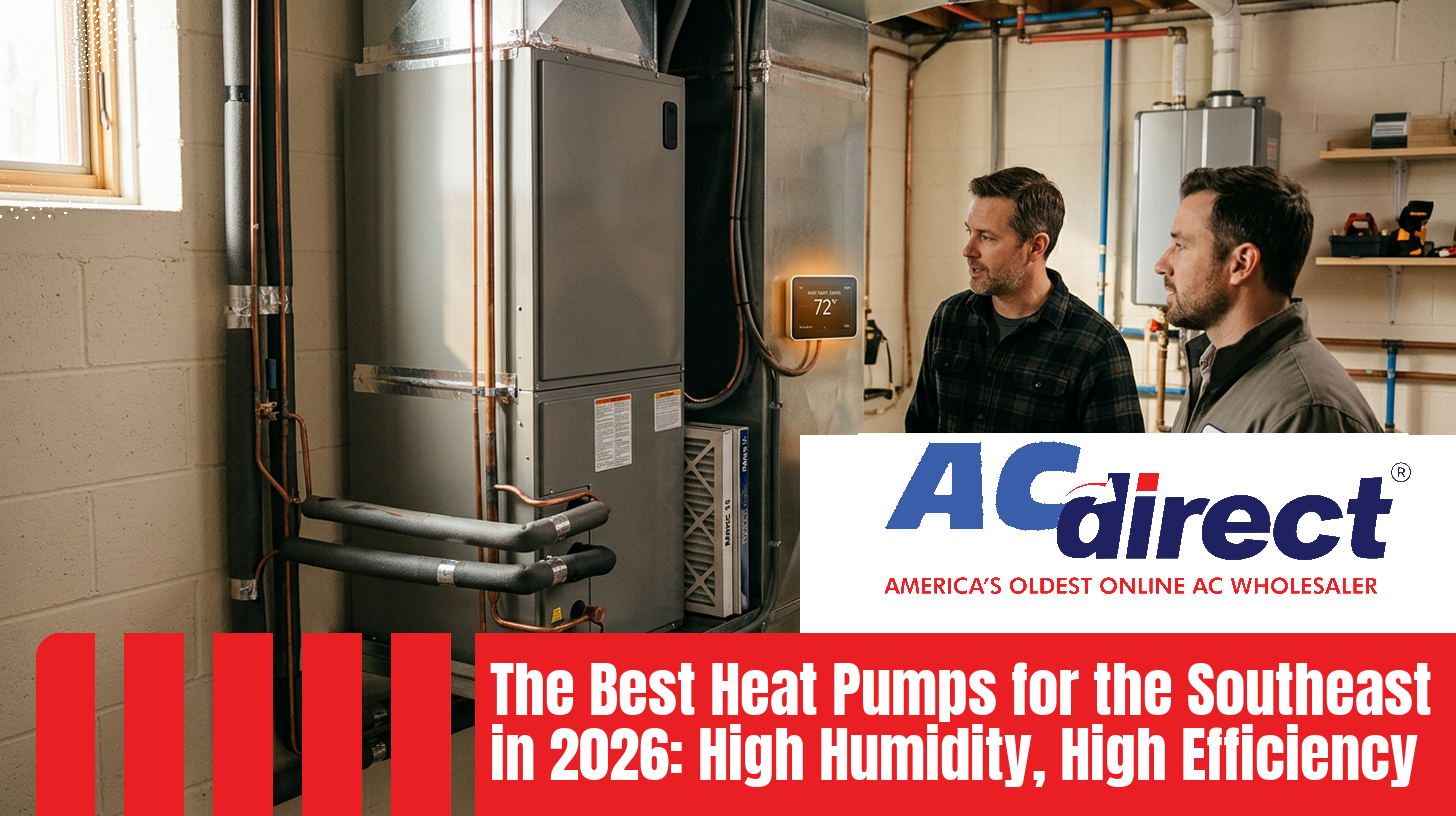
Georgia, the Carolinas, Tennessee, the Florida panhandle - your climate has specific demands. Here's what actually matters when choosing a heat pump for the humid South.
Living in the Southeast means your HVAC system doesn't get a vacation. From April through October, it's running hard against heat and humidity. In winter, temperatures rarely drop below the 30s for more than a handful of nights. That climate profile makes the Southeast one of the best regions in the country for heat pumps - but only if you pick the right one. The wrong unit will leave your house feeling like a damp cave in July, no matter what the thermostat says.
This guide is built specifically for homeowners in Georgia, the Carolinas, Tennessee, and the Florida panhandle. We'll cover the efficiency ratings that actually matter here, why dehumidification should be near the top of your priority list, and which systems available at AC Direct are designed for exactly this climate. No contractor markup, no jargon without explanation.
If you're shopping this spring - and spring is the smartest time to replace before peak summer demand - this is the article to read first.
Most national heat pump guides are written for homeowners in cold climates. They focus heavily on heating capacity at low temperatures - how well the unit performs at 5°F, or even negative temperatures. That matters in Minnesota. It doesn't matter nearly as much in Savannah.
In the Southeast, the priorities flip. Your heat pump will spend the vast majority of its working hours in cooling mode. Your winters are mild enough that even a mid-tier heat pump handles them easily. The real challenge is the combination of sustained high temperatures and relentless humidity from late spring through early fall.
This is why two heat pumps with the same SEER2 rating can feel completely different inside your home. One might cycle on and off quickly, cooling the air but leaving the moisture behind. The other might run at a lower speed for longer stretches, wringing humidity out of the air continuously. That second approach is what you want in the Southeast.
Since January 2023, HVAC efficiency is measured using updated testing methods. You'll see three numbers on every system. Here's what each one means for a Southeast homeowner, in plain language.
| Rating | What It Measures | Minimum (Southeast) | What to Aim For |
|---|---|---|---|
| SEER2 | Seasonal cooling efficiency across a full summer | 14.3 | 16 to 18+ |
| EER2 | Cooling efficiency at peak heat (around 95°F) | 11.7 | 12 to 13+ |
| HSPF2 | Heating efficiency across a full winter | 7.5 | 8.0+ (less critical here) |
Sources: U.S. Department of Energy and ENERGY STAR efficiency criteria for 2025-2026.
SEER2 stands for Seasonal Energy Efficiency Ratio 2. It measures how efficiently the unit cools your home across an entire cooling season, not just at one temperature. Think of it like a car's combined MPG rating. The minimum in the Southeast is 14.3 SEER2 (roughly equivalent to the old 15 SEER). But "minimum" just means "legal to sell." For real savings on a Georgia power bill, you want 16 SEER2 or higher.
This one is underrated and especially important in the Southeast. EER2 measures cooling efficiency at a specific high outdoor temperature - around 95°F. When it's 97 degrees in August and your system is working its hardest, EER2 tells you how efficiently it's doing that job. A unit with a high SEER2 but a mediocre EER2 might perform well on mild days but struggle during the hottest stretches when you need it most.
HSPF2 measures heating efficiency across a winter season. In the Southeast, winters are mild enough that this rating matters less than in northern states. A score of 8.0 or above is perfectly adequate for our climate. You'll naturally get a good HSPF2 if you're buying a high-efficiency cooling unit anyway.
Here's the scenario that frustrates Southeast homeowners more than almost anything else: your thermostat says 74°F, the house technically reached its target temperature, but it still feels clammy. The walls feel damp. The air feels heavy. You're tempted to crank the thermostat down to 70 just to get some relief, which drives your power bill up without fixing the root problem.
The root problem is inadequate dehumidification. And the fix is not a lower thermostat setting. It's a heat pump with the right compressor technology.
A traditional single-speed compressor runs at 100% capacity until the thermostat is satisfied, then shuts off completely. In the Southeast, this creates a problem: the system cools the air quickly but doesn't run long enough to pull out the moisture. Short cooling cycles equal poor dehumidification.
A variable-speed (inverter) compressor adjusts its output continuously. On a humid afternoon, it might run at 40% to 60% capacity for a longer stretch. That extended run time means air passes over the cold evaporator coil again and again, condensing more moisture out of it with each pass. The result is lower humidity, more consistent temperatures, and a home that actually feels comfortable at 76°F instead of needing to be set at 71°F.
Some higher-end systems include a dedicated dehumidification mode that prioritizes moisture removal over temperature reduction. The system slows its fan speed or adjusts compressor output to maximize the time air spends in contact with the cold coil. If you live in a coastal area or anywhere the dew point regularly climbs above 70°F from May through September, this feature is worth seeking out.
Not every feature matters equally in every climate. Here's a checklist specifically for the Southeast, ranked by how much it affects your daily comfort and annual costs.
This is the single most impactful feature for a humid climate. It handles dehumidification, maintains consistent temperatures, reduces noise, and lowers energy use. If your budget allows only one upgrade, make it this one.
Aim for 16 SEER2 or higher and 12 EER2 or higher. The Southeast minimum of 14.3 SEER2 is a floor, not a target. Higher efficiency pays back faster here because your system runs more hours per year than in cooler climates.
An oversized unit short-cycles, which murders dehumidification. An undersized unit runs constantly and never catches up on the hottest days. Your installer should perform a Manual J load calculation for your specific home. Our sizing guide covers the basics.
The industry is phasing out R-410A. New systems use R-32 or R-454B, which have lower environmental impact and can be more efficient. Equally important: if your system ever needs a refrigerant recharge years from now, R-410A will be increasingly expensive and harder to find. Buying a unit with a current refrigerant protects you long-term.
Coastal Southeast homes face salt air exposure. If you're within 15 miles of the coast, look for units with coated condenser coils or stainless steel components. Corrosion shortens the life of an outdoor unit faster than almost anything else.
Equipment and installation costs vary depending on the size of your home, the efficiency level you choose, and whether you're replacing an existing system or starting from scratch. Here's a realistic range for 2026.
| System Type | Typical Installed Cost | Best For |
|---|---|---|
| Basic single-stage (14.3 SEER2) | $4,000 to $6,500 | Tight budget, rental properties |
| Mid-range two-stage (15-16 SEER2) | $5,500 to $8,500 | Good balance of cost and comfort |
| High-efficiency inverter (17-18+ SEER2) | $7,000 to $12,000 | Best comfort, lowest bills, best dehumidification |
| Ductless mini-split (single zone) | $3,000 to $5,000 | Additions, sunrooms, homes without ductwork |
| Ductless mini-split (multi-zone) | $6,000 to $12,000+ | Whole-home ductless, zone control |
When you buy equipment at wholesale through AC Direct and hire your own installer, you typically save 20% to 40% compared to a full-service contractor quote. See our complete heat pump cost breakdown for a deeper dive.
The Inflation Reduction Act continues to offer meaningful incentives for high-efficiency heat pumps. To qualify for the maximum federal credit, your system must meet Consortium for Energy Efficiency (CEE) highest-tier requirements - generally, that means ENERGY STAR certified with above-baseline efficiency ratings.
For the latest eligible models and rebate details, visit the AC Direct rebate page.
AC Direct carries a wide range of heat pump systems suited for the Southeast's cooling-dominated climate. These models feature high SEER2 ratings, inverter compressors for superior dehumidification, and next-generation refrigerants. Here are some standout options across different sizes.
17 SEER2 · R454B refrigerant · Self-adjusting inverter compressor · Excellent dehumidification · Ideal for 1,200 to 1,500 sq ft
View Product17.5 SEER2 · R32 refrigerant · High-efficiency inverter · Strong peak-heat performance · For homes up to 2,500 sq ft
View Product17 SEER2 · R32 refrigerant · Inverter compressor · Variable output for efficient humidity control in large homes
View Product16.7 SEER2 · R454B refrigerant · Inverter driven · Handles both extreme heat and cold snaps · 1,700 to 2,100 sq ft
View Product19 SEER2 · R454B · Learning mode optimizes to your home · Highest efficiency option for smaller spaces or additions
View ProductR32 refrigerant · Variable-speed fans · Budget-friendly option that still exceeds Southeast minimums · Consistent airflow
View ProductLooking for a ductless option? Browse multi-zone mini-split systems or read the full mini-split buyer's guide.
This is where a lot of Southeast homeowners get bad advice. A contractor who doesn't do a proper load calculation might default to oversizing the system "just to be safe." In a hot, humid climate, oversizing is the opposite of safe. An oversized heat pump will cool your house quickly, then shut off before it has removed enough moisture. You end up cold and clammy - the worst combination.
Here's a rough starting point for the Southeast, but these numbers are estimates only. Insulation quality, window count and orientation, ceiling height, and your specific climate zone all affect the real number.
| Home Size | Estimated BTU Needed | Typical System Size |
|---|---|---|
| 1,000 to 1,200 sq ft | 24,000 BTU | 2 Ton |
| 1,200 to 1,500 sq ft | 30,000 BTU | 2.5 Ton |
| 1,700 to 2,100 sq ft | 42,000 BTU | 3.5 Ton |
| 2,000 to 2,500 sq ft | 48,000 BTU | 4 Ton |
| 2,400 to 3,000 sq ft | 60,000 BTU | 5 Ton |
In the Southeast, sizing is typically driven by the cooling load rather than the heating load. Your installing contractor should use a Manual J load calculation (ACCA standard) to determine the precise size for your home.
The HVAC industry is moving away from R-410A refrigerant. If you've bought an air conditioner or heat pump in the last 15 years, it almost certainly uses R-410A. That refrigerant works fine, but it has a high global warming potential, and production is being phased down.
New systems in 2026 primarily use R-32 or R-454B. Both have significantly lower environmental impact. But the practical reason to care about this isn't environmental - it's financial. As R-410A production decreases, the cost of servicing older systems that need a refrigerant recharge will go up. We've already seen this happen with the R-22 phaseout, where recharge costs went from $50 to $300 or more per pound.
Buying a system with R-32 or R-454B today means you're protected from that price escalation for the entire life of the unit. Every system listed above uses one of these newer refrigerants.
If your current system is aging, struggling with humidity, or running up your power bills, replacing it before summer is the strategic move. Here's why spring makes the most sense in our region.
- Installer availability. HVAC contractors are slammed from June through September. In spring, you'll have an easier time booking installation and you won't be waiting in a queue while sweating through a broken system.
- No emergency pressure. When your AC dies on a 95-degree day, you'll accept whatever is available. Shopping in spring means you can compare systems, read reviews, and make a deliberate choice.
- Full summer of savings. A new high-efficiency unit installed in April gives you five to six months of lower cooling bills before the next winter - and in the Southeast, that's where the real savings accumulate.
- Tax credit timing. Installing early in the year means you can claim the federal tax credit on your 2026 return without rushing at year-end.
A few habits that keep a heat pump running efficiently through long, humid Southeast summers:
- Change your air filter every 30 to 60 days in summer. The Southeast's longer cooling season means more air passes through your filter than in cooler climates. A clogged filter restricts airflow, reduces efficiency, and hurts dehumidification.
- Keep the outdoor unit clear. Landscaping, pine straw, and pollen accumulate fast. Maintain at least 2 feet of clearance on all sides for proper airflow.
- Check your condensate drain line. In humid climates, the drain line that carries moisture away from the indoor unit can clog with algae or mold. A clogged line can cause water damage or trigger a system shutdown. Flush it with diluted vinegar every few months.
- Use a programmable or smart thermostat wisely. With a variable-speed heat pump, set a consistent temperature and let the system manage its own output. Dramatic setback schedules (turning it up to 85°F while you're at work) force the system to work harder to remove all the humidity that built up while it was off.
- Schedule annual maintenance. A professional tune-up before summer catches refrigerant leaks, dirty coils, and electrical issues before they become expensive failures in July.
The best heat pump for the Southeast is not necessarily the one with the highest heating capacity or the most extreme cold-weather rating. It's the one that cools efficiently at peak temperatures, dehumidifies relentlessly through long humid seasons, and uses a refrigerant that won't cost you a fortune to service five years from now.
That means: an inverter-driven compressor, a SEER2 rating of 16 or higher, a strong EER2 number, and R-32 or R-454B refrigerant. If your budget can handle it, the comfort difference between a basic single-stage unit and a variable-speed system is dramatic in this climate - and the energy savings close the gap faster here than almost anywhere.
AC Direct ships from the Southeast. This is our backyard. We stock the systems that work in this climate, at wholesale prices, with no contractor markup built in.
AC Direct carries high-efficiency heat pumps from ACiQ, Goodman, and more - all with inverter compressors and next-generation refrigerants designed for the Southeast. Wholesale pricing. Ships nationwide.