

R-410A SDS / MSDS: Safety Data Sheet Reference (Plus PDF Download)
-
 By
Michael Haines
By
Michael Haines
- May 10, 2026
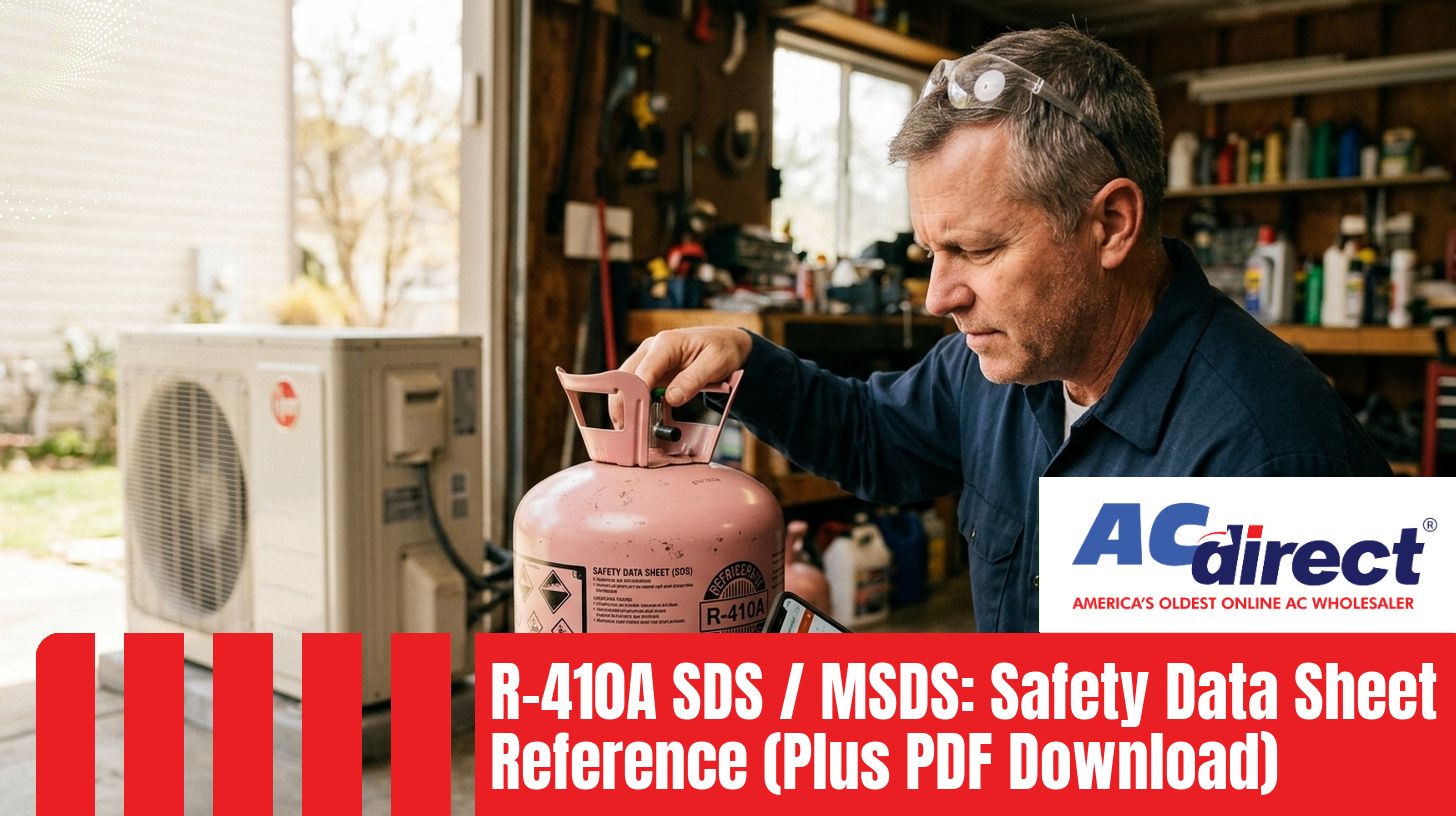
A plain-English walkthrough of the R-410A safety data sheet — what each section means, what to do in an emergency, and what OSHA actually requires you to keep on hand.
Whether you're a homeowner curious about the refrigerant in your AC, a contractor topping off a system, or a shop manager who has to keep paperwork in order, the R-410A Safety Data Sheet (SDS) is the single most important reference document in the room. It's the source of truth for hazards, first aid, fire response, exposure limits, and proper handling. This guide walks through what's in it, where to find a current copy, and what OSHA expects you to do with it.
If you're new to this refrigerant entirely, our companion complete homeowner's guide to R-410A covers the basics. This article focuses specifically on the safety paperwork.
The "MSDS" (Material Safety Data Sheet) terminology was officially replaced by "SDS" (Safety Data Sheet) when OSHA aligned with the Globally Harmonized System (GHS) in 2012. The two terms are still used interchangeably in the field, but any document dated after 2015 should be in the modern 16-section SDS format.
R-410A is sold by multiple manufacturers under different brand names (Puron, Suva 410A, Forane 410A, Genetron AZ-20, and others). The chemistry is identical — a 50/50 blend of R-32 and R-125 — but each manufacturer publishes its own SDS. Always pull the SDS that matches the brand stamped on your cylinder.
If you're researching R-410A because you're weighing repair versus replacement, also check our breakdown of r32 vs r410a (the comparison they're searching) before making a final call.
A modern SDS has 16 standardized sections. Here's what each one tells you and which sections matter most for day-to-day work.
| # | Section | What You'll Find |
|---|---|---|
| 1 | Identification | Product name, manufacturer contact, emergency phone |
| 2 | Hazard Identification | GHS classifications, signal words, pictograms |
| 3 | Composition | R-32 (~50%) and R-125 (~50%) by weight, CAS numbers |
| 4 | First Aid Measures | What to do for skin, eye, inhalation, ingestion exposure |
| 5 | Fire Fighting | Extinguishing media, decomposition products, PPE |
| 6 | Accidental Release | Spill containment and ventilation procedures |
| 7 | Handling & Storage | Cylinder storage temps, valve protection, separation rules |
| 8 | Exposure Controls / PPE | OEL limits, ventilation, gloves, eye protection |
| 9 | Physical & Chemical Properties | Boiling point, vapor pressure, density, solubility |
| 10 | Stability & Reactivity | Incompatible materials, hazardous decomposition |
| 11 | Toxicology | LC50 data, target organs, chronic exposure notes |
| 12 | Ecological Information | Aquatic toxicity, GWP rating |
| 13 | Disposal | Reclaim/recycle requirements per Section 608 |
| 14 | Transport | UN1956, hazard class 2.2 (non-flammable gas) |
| 15 | Regulatory | EPA, TSCA, state right-to-know listings |
| 16 | Other Information | Revision date, prep notes, abbreviations |
For technicians, sections 2, 4, 5, 7, and 8 are the ones to know cold. Everything else is reference material for specific situations.
R-410A is classified by ASHRAE as A1 — non-flammable, low toxicity. That's the safest classification a refrigerant can carry. But "non-flammable and low toxicity" doesn't mean harmless. The two real hazards are:
- Asphyxiation in confined spaces. R-410A is heavier than air and will displace oxygen if it leaks into a basement, mechanical room, or pit. This is the leading cause of refrigerant-related fatalities.
- Frostbite from liquid refrigerant. R-410A boils at roughly -55°F at atmospheric pressure. A liquid spray on skin or in eyes causes immediate cryogenic burns.
Skin contact (liquid): Flush affected area with lukewarm water for at least 15 minutes. Do not rub. Do not use hot water. Seek medical attention for any blistering or numbness.
Eye contact: Flush with clean water for at least 15 minutes, holding eyelids open. Get immediate medical attention.
Ingestion: Extremely unlikely with a gas, but if liquid is somehow swallowed, do not induce vomiting. Get medical attention.
R-410A itself does not burn. However, when exposed to open flame or surfaces above approximately 482°F, it decomposes into hazardous products including hydrogen fluoride (HF), carbonyl fluoride, and hydrogen chloride. These are corrosive and toxic.
- Extinguishing media: Use whatever is appropriate for the surrounding fire — dry chemical, CO₂, foam, or water spray.
- Cylinders in a fire: Cool exposed cylinders with water spray from a protected position. Pressure relief devices may activate. Evacuate if a cylinder is engulfed in flame.
- PPE for responders: Self-contained breathing apparatus (SCBA) and full protective gear are required.
For more on the flammability question specifically — including how R-410A compares to the new A2L refrigerants — see our deep look at whether R-410A is flammable and how safe it really is.
Under OSHA's Hazard Communication Standard (29 CFR 1910.1200), any workplace that stores or handles R-410A has specific obligations. This applies to HVAC contractors, supply houses, manufacturing plants, and even maintenance shops at apartment complexes.
Each cylinder brand requires its own SDS. Electronic copies are acceptable as long as employees can access them without barriers (no passwords, no manager approval).
Training must cover hazards, PPE, the location of SDSs, and emergency procedures. Document the training with names and dates.
A simple binder or digital folder listing chemicals on site, labeling procedures, and training records satisfies this requirement for most small shops.
Cylinders must carry the original GHS label with product name, signal word, hazard statements, and pictograms. Damaged or missing labels must be replaced before use.
One quick note on what's changing in the field: R-410A equipment manufacturing ended January 1, 2025, and new systems now use either R-454B or R-32 — both classified A2L (mildly flammable). The SDS for those refrigerants reads differently, particularly in sections 2, 5, and 7. If you're stocking new A2L cylinders, do not assume your existing R-410A safety procedures cover them. Pre-2025 R-410A overstock equipment remains legal to install, and our team can walk you through current options. Call to talk to an R-410A expert before making a buying decision — pricing on overstock is moving fast.
Yes, in practice. "MSDS" was the old format; "SDS" is the modern 16-section version OSHA adopted in 2012. Any document dated after 2015 should be the SDS format. The terms are used interchangeably in the trade, but request the current SDS rather than a legacy MSDS when possible.
Yes. The chemistry is identical across brands, but each manufacturer (Honeywell, Chemours, Arkema, National Refrigerants, etc.) publishes its own SDS with its own contact info, format, and minor language differences. Pull the one that matches the brand on your cylinder.
Digital is acceptable under OSHA as long as employees can access it instantly during a shift without needing a password, manager, or working internet. Many shops keep both — a digital library on a shared drive plus a printed binder in the shop.
Asphyxiation in a confined, unventilated space. R-410A is heavier than air, displaces oxygen, and is odorless. Frostbite from liquid contact is the second most common injury. Cardiac sensitization from massive inhalation is rare but documented, which is why epinephrine is contraindicated during first aid.
Yes. The EPA AIM Act prohibited new R-410A residential equipment manufacturing as of January 1, 2025, but R-410A refrigerant remains legal to purchase, own, and use for servicing existing systems indefinitely. New equipment manufactured before the cutoff is still legal to install, and the EPA has temporarily deprioritized enforcement of the original installation deadline. If you want to compare costs and availability, our r410a price page tracks current overstock inventory.
Directly from your refrigerant supplier or the manufacturer's website. Suppliers are legally required to provide it free of charge. If you bought a cylinder and didn't receive an SDS, call the supplier — they're obligated to send one.