 and now, NASCAR Racing Sponsor


What Is R-410A Refrigerant? Properties, Uses & Phase-Out Status
-
 By
Michael Haines
By
Michael Haines
- May 9, 2026
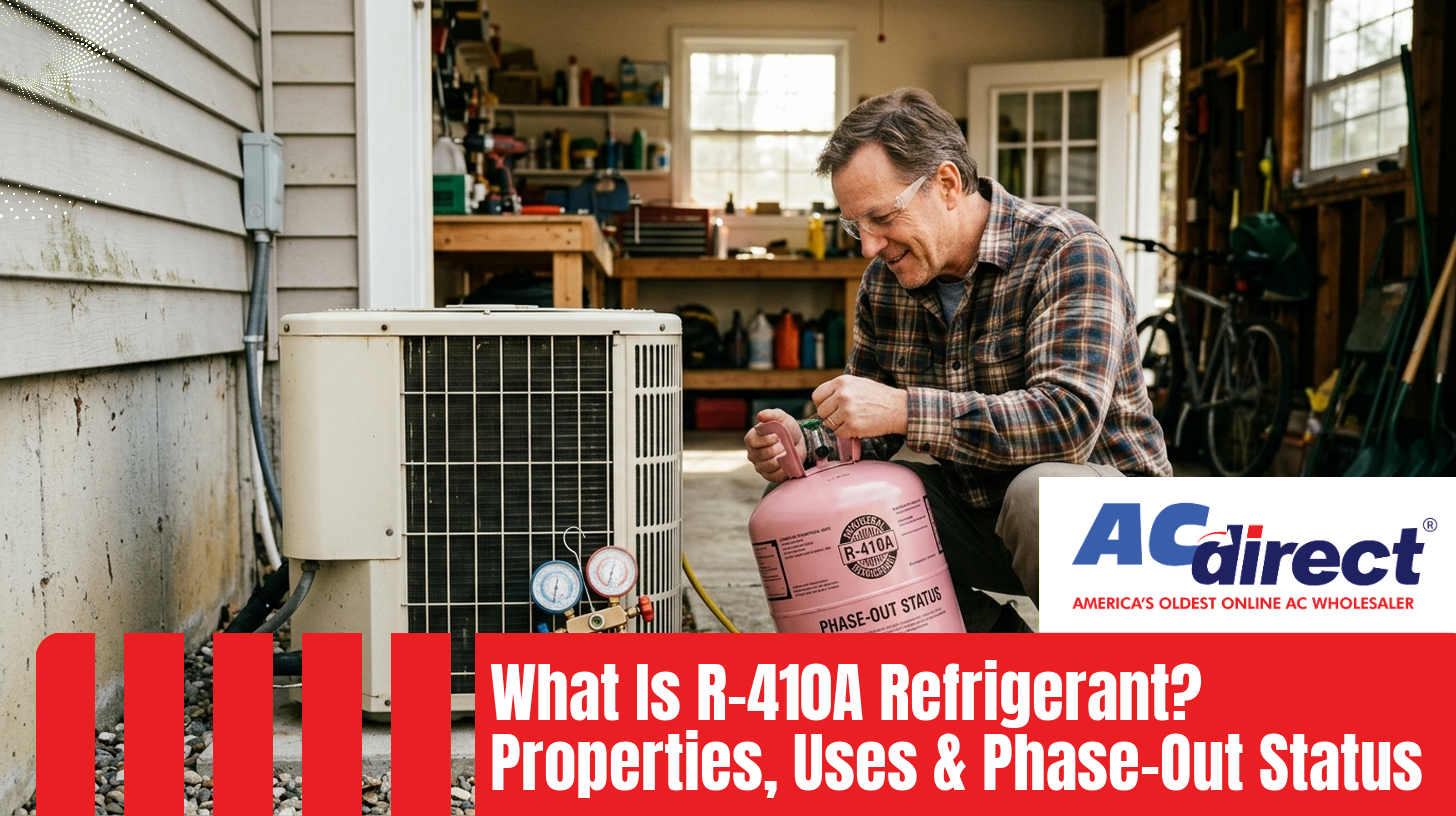
A plain-English breakdown of the refrigerant in millions of American homes — what it's made of, where it lives, and what its 2026 phase-out status actually means for you.
If you own a central air conditioner or heat pump installed after about 2010, there is an excellent chance R-410A is the refrigerant flowing through its copper lines. You may have noticed it stamped on the data plate of your outdoor unit, or heard your HVAC tech mention it during a service call. And lately, you have probably heard it described as "phased out" — which has a lot of homeowners worried they own obsolete equipment.
Here is the short version: R-410A is not banned, your existing system is fine, and even brand-new R-410A equipment manufactured before January 1, 2025 is still legal to install in 2026. For the long version, including what R-410A is actually made of and how it ended up in nearly every American home, keep reading. For a deeper end-to-end overview, see our complete homeowner's guide to R-410A.
R-410A is not a single chemical. It is a 50/50 blend of two hydrofluorocarbons (HFCs):
- R-32 (difluoromethane) — 50% by weight
- R-125 (pentafluoroethane) — 50% by weight
Engineers blended the two because each component contributes something the other lacks. R-32 carries heat efficiently. R-125 brings down the flammability of the mixture. Together, they form what is called a near-azeotropic blend, meaning the two components evaporate and condense at almost the same temperature — so the mixture behaves like a single refrigerant inside your AC system.
R-410A is classified by ASHRAE as an A1 refrigerant: low toxicity, no flame propagation. That A1 rating is one reason it was so widely adopted — it was considered the safe, easy choice for residential equipment.
Refrigerants do not "make cold." They move heat. R-410A is the working fluid that picks up heat from inside your house and dumps it outside (in cooling mode), or — in the case of a heat pump — picks up heat from outside and brings it indoors (in heating mode).
Here is the cycle in four steps:
Liquid R-410A enters the indoor coil at low pressure and boils into vapor as it absorbs heat from your home's air. Your air handler blows the now-cooled air through the ducts.
The vapor travels outside to the compressor, which squeezes it to high pressure and high temperature. R-410A operates at notably high pressures — discharge readings of 370 to 420 PSIG on a 70°F day are typical.
The hot, high-pressure vapor releases its heat to outdoor air and condenses back into a liquid. This is the heat that "rejected" out of your house.
The liquid passes through a metering device, which drops its pressure dramatically and prepares it to evaporate and absorb heat all over again.
That cycle runs continuously while your system is on. The R-410A itself is never consumed — it stays sealed inside the system for the life of the equipment, unless there's a leak.
R-410A became the default residential refrigerant after R-22 (Freon) was phased out, with adoption ramping through the late 2000s and dominating the market by 2010. You will find R-410A in:
If your system is more than a year old and was installed in the United States, R-410A is the most likely refrigerant inside it. For homeowners shopping today, AC Direct still carries pre-cutoff inventory — see our current r410a air conditioning system selection.
R-410A is the technical name, but chemical companies sell it under various trade names. If you see any of these on a refrigerant cylinder or invoice, they all refer to the same 50/50 blend:
| Trade Name | Manufacturer | What It Is |
|---|---|---|
| Puron | Carrier (originator) | Original brand name; often used generically by older techs |
| SUVA 410A | Chemours (formerly DuPont) | Identical R-410A blend |
| Forane 410A | Arkema | Identical R-410A blend |
| Genetron AZ-20 | Honeywell | Identical R-410A blend |
| EcoFluor R410A | Various | Identical R-410A blend |
All R-410A is chemically identical regardless of brand name. The trade name only tells you who packaged it.
One quick warning: do not confuse R-410A with R-22 ("Freon"). R-22 was the previous generation refrigerant phased out in 2020. The two are not interchangeable, run at very different pressures, and require different system components.
This is where most homeowners get confused, and understandably so — the regulatory situation has shifted multiple times. Here is the current state of affairs:
Three things are true in 2026:
- Your existing R-410A system is fine. You can keep operating and servicing it for as long as it lasts. Refrigerant for service work is not going away.
- New R-410A equipment manufactured before January 1, 2025 is still legal to install. The EPA has temporarily deprioritized enforcement of the original installation cutoff while a final rule is pending in early 2026. This is why retailers like AC Direct can still sell pre-cutoff inventory.
- Equipment manufactured after January 1, 2025 uses new refrigerants. Most major brands (Carrier, Trane, Goodman, Rheem, Lennox, MRCOOL) moved to R-454B. Daikin and LG chose R-32. Both are legitimate paths — see our breakdown on r32 vs r410a (the comparison they're searching).
For the full story on why this transition happened, our companion article on why R-410A is being phased out covers the global warming potential math and the AIM Act timeline in detail.
Service refrigerant is getting more expensive as production quotas tighten. Homeowners typically pay $40 to $90 per pound for R-410A installed by a technician, and a full recharge usually requires 2 to 4 pounds per ton of cooling capacity. Wholesale 25-lb cylinders run $75 to $200 ($4 to $8 per pound). For comparison, the new replacement refrigerant R-454B has seen wholesale price spikes of up to 42% over R-410A, and complete new A2L systems are running 15% to 30% more expensive than equivalent R-410A units.
R-410A is classified A1 (non-flammable, low toxicity). The new replacements R-454B and R-32 are A2L (mildly flammable, low toxicity), which is why new equipment includes leak detectors and other safety hardware. If you want a deeper look at how these classifications work, see our breakdown of whether R-410A is flammable and how it compares safety-wise.
Yes. Puron is Carrier's trade name for R-410A. The chemical composition is identical to any other R-410A on the market. Older HVAC technicians sometimes use "Puron" as a generic term for R-410A the same way people say "Freon" when they mean any refrigerant.
No. R-454B and R-32 are not drop-in replacements. They use different compressor oils, run at different pressures, and require A2L-rated safety components. Mixing refrigerants damages the system and voids warranties. R-410A systems get serviced with R-410A — which remains legal and available.
Because "phased out" applies to manufacturing, not installation of pre-existing inventory. Equipment built before January 1, 2025 is legal to install in 2026 and beyond under the EPA's current enforcement guidance. Once that overstock sells through, the market will be entirely R-454B and R-32.
For its entire useful life — typically 12 to 20 years for residential equipment. The EPA does not restrict the use of HFCs in existing systems. Your tech can continue to service and recharge it indefinitely, although per-pound refrigerant costs will likely keep climbing as production quotas shrink.
It's a 50/50 mix of two HFC gases: R-32 and R-125. R-32 does most of the heat-moving work, and R-125 keeps the blend non-flammable. Combined, they behave as a single refrigerant inside your AC.
It has a Global Warming Potential (GWP) of 2,088, which is high — that's why regulators moved the industry to lower-GWP options like R-454B (GWP 466) and R-32 (GWP 675). However, in a properly maintained sealed system, R-410A never enters the atmosphere. The environmental concern is leaks and end-of-life disposal, both of which are managed through EPA rules requiring certified technicians for handling.
AC Direct still carries pre-2025 R-410A inventory at wholesale pricing — legal to install, fully warrantied, and significantly cheaper than equivalent new A2L systems. Limited supply. Call 1-855-573-0509 to talk to an R-410A expert.