 and now, NASCAR Racing Sponsor


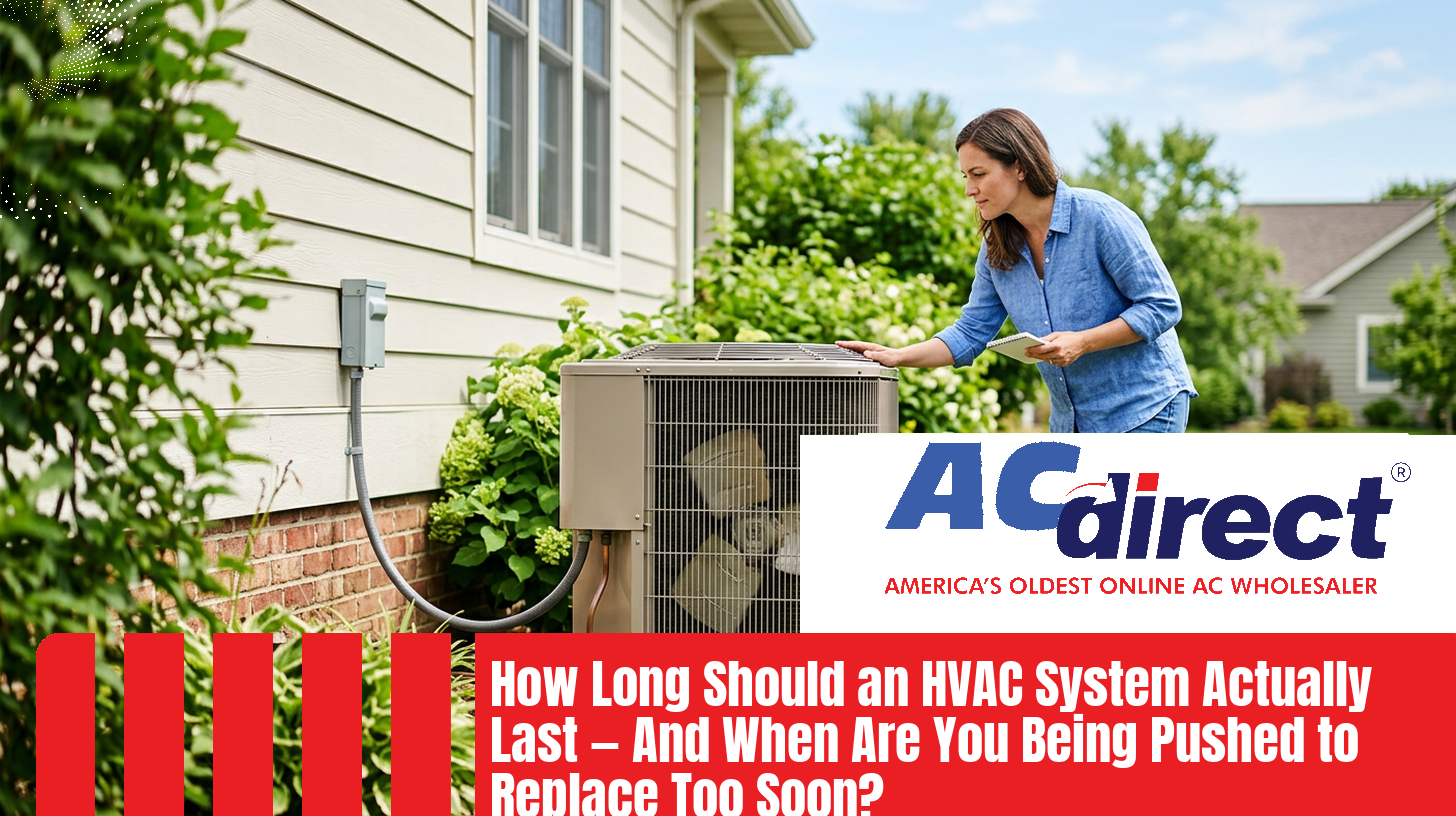
How Long Should an HVAC System Actually Last — And When Are You Being Pushed to Replace Too Soon?
-
 By
Michael Haines
By
Michael Haines
- Mar 21, 2026
Real lifespan data, the math behind repair vs. replace, and how to spot a contractor who's more interested in your wallet than your comfort.
Somewhere right now, a homeowner is staring at a $1,200 repair quote for a 12-year-old air conditioner and wondering if they're about to make a terrible decision either way. Fix it and waste money on a dying system? Replace it and spend thousands on something they didn't actually need yet? The internet is full of conflicting advice, and the technician standing in the garage has a financial incentive to sell new equipment. It's a stressful spot to be in.
We see this question constantly - on Reddit's r/hvacadvice, in customer calls, in emails from people who just want a straight answer. So here it is: a data-backed guide to how long HVAC equipment really lasts, when repair still makes sense, when replacement is genuinely the smarter move, and how to tell if someone is rushing you into a decision you don't need to make yet.
No scare tactics. No vague "it depends." Just numbers and honest guidance.
Let's start with the baseline. These are the ranges that manufacturers, industry groups like the Air Conditioning Contractors of America (ACCA), and field data consistently support. They assume reasonable maintenance - filter changes, annual tune-ups, keeping the outdoor unit clear.
These ranges reflect industry consensus from ACCA and U.S. Department of Energy guidelines. Systems in extreme climates or those running year-round (like heat pumps in the South) may trend toward the lower end.
A few things stand out in that chart. Electric furnaces last a long time because they have fewer moving parts and no combustion. Central AC units and air-source heat pumps tend to have shorter lives because they work harder - the compressor is the mechanical heart of both systems, and it's constantly pressurizing and cycling refrigerant through temperature extremes.
But here's the important part: these are ranges, not expiration dates. A well-maintained central AC can absolutely reach 18 or 20 years. A neglected one might start failing at 8. Maintenance isn't a nice-to-have. It's the single biggest factor in whether your system hits the bottom or the top of that range.
If your system is dying prematurely, one or more of these factors is almost always involved:
This is the big one. A clogged filter forces the blower motor to work harder. Dirty coils reduce heat transfer, so the compressor runs longer and hotter. Unchecked refrigerant leaks make the system strain to produce the same output. Over years, these small neglects compound into premature component failure. According to Energy Star, regular maintenance can extend system life significantly and keep efficiency from degrading.
An oversized system cycles on and off constantly - called "short cycling." Each startup is the hardest moment for a compressor, and doing it dozens of extra times per day wears components fast. An undersized system runs nonstop trying to keep up, which creates its own wear problems. Proper sizing requires a Manual J load calculation, not a rough guess based on square footage alone.
Even the best equipment fails early if it's installed poorly. Refrigerant lines charged incorrectly, ductwork with major leaks, an outdoor unit sitting in a spot where it floods or gets buried in debris - these installation shortcuts create problems that show up years later and get blamed on the equipment.
A heat pump in Phoenix running 10 months a year will wear faster than one in Portland running 6 months. That's not a defect. It's just physics. If you live somewhere with extreme summers, extreme winters, or both, expect to land closer to the lower end of the lifespan range.
This is where most homeowners get stuck, and it's where a lot of bad advice gets handed out. There are two common frameworks for this decision, and both have value when used honestly.
The simplest version: if a single repair costs more than 50% of what a full replacement would cost, replace the system. For example, if a new system would cost $6,000 installed and the repair quote is $3,200, you're over that threshold. This rule works well for systems that are already past the midpoint of their expected lifespan.
But it's too blunt for younger systems. A $2,500 compressor replacement on a 5-year-old unit might technically be 40% of replacement cost, but the repaired system could run another 10 years easily. Context matters.
Here's a more useful approach: multiply the repair cost by the age of the system. If the result exceeds $5,000, replacement starts to make more financial sense.
| System Age | Repair Cost | Age × Cost | Verdict |
|---|---|---|---|
| 5 years | $600 | $3,000 | Repair - plenty of life left |
| 8 years | $500 | $4,000 | Repair - still under threshold |
| 10 years | $450 | $4,500 | Borderline - consider other factors |
| 12 years | $500 | $6,000 | Replace - over threshold, aging system |
| 15 years | $400 | $6,000 | Replace - even moderate repairs add up |
| 8 years | $1,800 | $14,400 | Replace - major failure on aging unit |
This formula works as a starting point, not a final answer. Also factor in efficiency gains, refrigerant type, repair history, and available tax credits.
Notice what the $5,000 rule does that the 50% rule doesn't: it accounts for age. A $500 repair on a 5-year-old system is obviously worth doing. That same $500 repair on a 15-year-old system? The math says you're approaching the point where that money is better spent toward new equipment.
There's one variable that can override any repair-vs-replace formula: which refrigerant your system uses.
If your air conditioner or heat pump was installed before 2010, there's a strong chance it uses R-22 (commonly called Freon). R-22 was fully phased out of production in the United States. It is no longer manufactured or imported. The only supply left is reclaimed from decommissioned systems, and prices reflect that scarcity - often $100 to $200+ per pound. A system that needs a refrigerant recharge with R-22 can easily cost $500 to $1,500 just for the refrigerant, not including the labor to find and fix the leak.
Not every contractor who recommends replacement is trying to rip you off. Sometimes the recommendation is genuinely correct. But there are specific patterns that should make you pause and get a second opinion.
A thorough HVAC evaluation takes time. If a technician spends a few minutes looking at your system and immediately declares it dead, that's a red flag. A proper diagnosis involves checking refrigerant pressures, testing electrical components, inspecting the heat exchanger, and more. Quick condemnations often serve one purpose: getting you to say yes before you think it through.
Even when replacement is the better long-term choice, a trustworthy technician should explain what the repair would look like and what it would cost. If the only option presented is a brand-new system, especially one from a specific brand they're pushing hard, be skeptical. You deserve to see both paths and make an informed decision.
"Your heat exchanger could crack and leak carbon monoxide at any moment." "This compressor could blow and damage your entire home." Are these things possible? In extreme cases, theoretically. But if a technician is using scary language to pressure an immediate decision without giving you time to research or get a second quote, that's a sales tactic, not a diagnosis.
A professional contractor provides a written quote with a clear breakdown: equipment cost, labor cost, materials, permits, and warranty terms. If someone is quoting you a single lump-sum number verbally and wants an answer today, slow down. Ask for it in writing. A contractor who won't put their quote on paper is a contractor you should walk away from.
"This price is only good today." "If you wait, the problem will get worse and cost more." Maybe. But a good contractor understands that a major purchase deserves comparison shopping. Industry experts universally recommend getting at least three quotes. Any contractor who pressures you not to do that is prioritizing their sale over your interests.
To be fair, there absolutely are situations where replacing your system is the right financial and practical decision. Here's when the evidence points toward new equipment:
- The system is 15+ years old and needing a major repair. A failed compressor on a 16-year-old AC is not worth a $2,000 fix when the rest of the system is also aging. The $5,000 rule math makes this clear.
- It uses R-22 refrigerant. As covered above, you're investing in a dead-end supply chain.
- Repair frequency is accelerating. One repair per year for the last three years, each costing $300 to $600? That pattern rarely reverses. You're likely approaching the end of useful life.
- Energy bills are climbing without explanation. If your utility rates haven't changed much but your heating or cooling bills have jumped 20 to 30% over the last few years, system efficiency is degrading. Replacing a 20-year-old system can reduce energy consumption by 20 to 40%, according to Energy Star.
- The system can't keep your home comfortable anymore. Rooms that won't cool, uneven temperatures throughout the house, humidity that won't come down - these can signal ductwork issues, but they can also mean the equipment has lost meaningful capacity.
- You're doing other major home work anyway. If you're already replacing ductwork, upgrading insulation, or finishing a renovation, bundling in a new HVAC system can make both the installation and the overall project more cost-effective.
One of the strongest arguments for replacement - when the timing is right - is the efficiency gap between old and new equipment. The numbers are meaningful.
Older AC units installed before 2010 often have SEER ratings (Seasonal Energy Efficiency Ratio) of 10 or lower. The current federal minimum is 14 SEER in most regions, and many modern systems deliver 16 to 20+ SEER. That's not a small difference. A jump from SEER 10 to SEER 17 means the new system uses roughly 40% less electricity to produce the same cooling.
On the heating side, an older gas furnace might run at 80% AFUE (Annual Fuel Utilization Efficiency), meaning 20 cents of every dollar you spend on gas goes up the flue as waste heat. A modern high-efficiency furnace runs at 95 to 98% AFUE. Or, if you switch to a heat pump, you could be getting 2 to 3 units of heat for every unit of electricity, blowing past what any furnace can achieve.
| Equipment Type | Typical Old System | Modern Replacement | Efficiency Gain |
|---|---|---|---|
| Central Air Conditioner | 8-10 SEER | 16-20+ SEER | Up to 40% less electricity |
| Gas Furnace | 80% AFUE | 95-98% AFUE | 15-18% less gas used |
| Air Source Heat Pump | 8 HSPF (old) | 10-13 HSPF (new) | 25-40% more efficient heating |
SEER measures cooling efficiency. AFUE measures furnace fuel efficiency. HSPF measures heat pump heating efficiency. In all cases, higher is better. Source: U.S. Department of Energy.
The average homeowner upgrading from a system that's 15 to 20 years old can expect to save 20 to 40% on heating and cooling costs. On a $200-per-month energy bill, that's $480 to $960 per year. Not a fortune in year one, but over a 15-year system life, it adds up to $7,000 to $14,000 in cumulative savings.
The Inflation Reduction Act created meaningful tax credits for energy-efficient HVAC equipment. These aren't rebates you have to wait for - they're dollar-for-dollar federal tax credits you claim when you file.
Check the IRS website for current eligibility requirements, and look into your state's specific programs. Many states and local utility companies offer additional rebates that stack on top of the federal credit. For qualifying AC Direct products, see our current rebate and incentive page.
If you've decided replacement is the right move, when you do it affects both cost and experience.
If your system is over 12 years old and showing signs of decline - longer run times, rising bills, occasional hiccups - start researching now, even if it's still running. Get quotes during the off-season. Compare equipment. That way, when the time comes, you're making a planned purchase instead of a panic purchase. The difference in cost and satisfaction between those two scenarios is enormous.
Here's something most homeowners don't realize: when a contractor quotes you $8,000 for a new system, a significant portion of that number is markup on the equipment itself. Contractors buy equipment at wholesale and sell it to you at retail as part of their installation package. That markup can be 30 to 50% or more on the equipment alone.
AC Direct exists to give you a different option. We sell the same equipment - the same brands, same model numbers, same warranties - at wholesale prices, directly to homeowners and contractors. You purchase the equipment from us at wholesale, then hire a local contractor to install it. The contractor charges you for labor only, which is where their expertise genuinely lives.
On a system that retails for $6,000 through a contractor, the equipment alone might be $3,500 to $4,000 at wholesale. That's $2,000 or more back in your pocket, which you can put toward a higher-efficiency unit, better thermostat, or just savings. It doesn't mean contractors are doing anything wrong. It just means there's a more transparent way to buy.
Browse our full selection of complete heat pump and AC systems, or check out our complete cost breakdown guide to understand what you should expect to pay.
Before you sign anything, run through this list:
- How old is the system? Under 10 years, repair almost always makes sense. Over 15, replacement is worth serious consideration. In between, use the $5,000 rule.
- What refrigerant does it use? R-22 means replace. R-410A or newer means refrigerant isn't a deciding factor.
- How often has it needed repairs recently? One repair in five years is normal. Three repairs in two years is a pattern.
- Have energy bills been rising? A 20%+ increase with no rate change suggests efficiency loss.
- Did you get at least three quotes? If not, you don't have enough information yet.
- Is the quote in writing with a detailed breakdown? Equipment, labor, materials, permits, warranty terms - all of it.
- Have you checked available tax credits and rebates? These can shift the math significantly in favor of upgrading.
- Are you being pressured to decide today? Unless it's a genuine safety emergency, you have time. Use it.
Your HVAC system is not a ticking time bomb the moment it hits double-digit age. A well-maintained gas furnace can absolutely serve you for 20 years. A central AC can make it to 15. The decision to repair or replace should be driven by math, not fear - the $5,000 rule, refrigerant type, repair frequency, and efficiency gap all matter more than age alone.
When replacement does make sense, you have more control over the process and the cost than most people realize. Buy equipment at wholesale. Get multiple quotes for installation. Claim every tax credit and rebate available. And never let anyone rush you into a five-figure decision on the spot.
AC Direct sells the same name-brand HVAC equipment contractors use, at wholesale prices, shipped directly to your door. No middleman markup. Pair with any licensed local installer.