
 and now, NASCAR Racing Sponsor


Inverter Air Conditioner Repair and Common Problems
-
 By
Michael Haines
By
Michael Haines
- Jul 6, 2026
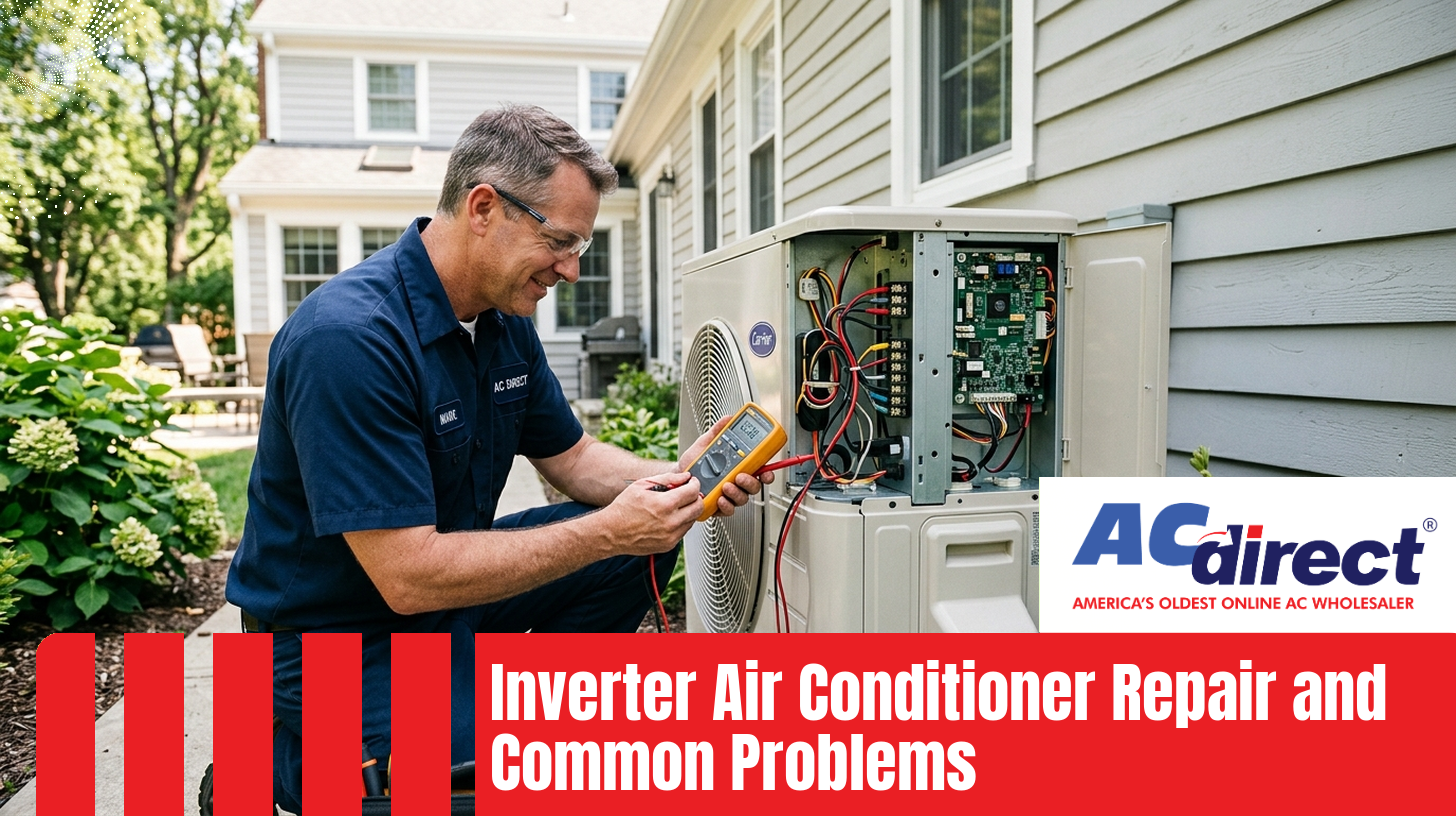
What actually fails on a variable-speed unit, what error codes are telling you, and when to call a licensed technician.
Inverter air conditioners are among the most reliable HVAC units you can buy, but when they need repair the process is different from a standard single-stage unit. The three most common failure points are the control board (inverter board / VFD), the compressor drive circuit, and the sensors feeding data into the board. Diagnosing any of these correctly requires electronic testing, not just gauges.
That is the honest premise of this guide. Variable-speed units earn their efficiency by running an electronic brain that constantly adjusts the compressor. When that brain, or the parts talking to it, has a problem, the fix lives in the electronics. If you want the underlying technology explained plainly, our inverter air conditioner guide covers how the AC-to-DC-to-variable-AC conversion works and why it matters here.
Most inverter service calls fall into a short list: control board faults, compressor drive issues, failing thermistors or pressure sensors, refrigerant charge problems, and the ordinary airflow issues that hit every AC (dirty coils, weak blower motors, clogged filters). What changes on an inverter is how these problems present and how they are confirmed.
The inverter board (sometimes called a VFD, variable frequency drive) converts DC bus voltage into the variable AC signal that drives the compressor. It is sensitive to voltage surges, brownouts, moisture, and heat. When it fails you may see the compressor refusing to start, running at a fixed speed, or the whole unit shutting down and posting a code.
Even when the board is fine, the IGBTs (the power transistors that switch DC into simulated three-phase AC for the compressor) can degrade. Symptoms include intermittent starts, tripping on overcurrent, or the compressor humming without spinning up. This is not a capacitor swap. It is an electronic diagnosis on a live high-voltage bus that can exceed 300 volts DC.
Inverter units use thermistors on the suction line, discharge line, outdoor coil, and indoor coil, plus pressure sensors and an electronic expansion valve (EEV) that meters refrigerant electronically. A single drifting sensor can make the system throttle back, dehumidify poorly, or shut off entirely, even though nothing is mechanically wrong.
Inverter units still get refrigerant leaks, dirty condenser and evaporator coils, failed fan motor capacitors, and clogged drain lines. These are the routine issues that show up on every system. The efficient variable-speed operation does reduce start-stop wear on the compressor, which is one reason inverter units routinely last 15+ years with proper maintenance.
Every inverter unit posts fault codes on the indoor unit display, the wall controller, or a service LED on the outdoor board. Codes are brand-specific and model-specific. There is no universal decoder, but the categories are consistent across manufacturers.
| Category | What It Usually Indicates | Typical Cause |
|---|---|---|
| Communication faults | Indoor and outdoor units cannot talk | Wiring issue, bad connection, failed control board |
| Sensor faults | Thermistor or pressure sensor reading out of range | Failed sensor, damaged wire, corroded connector |
| Compressor / drive faults | Overcurrent, over-temperature, or drive failure | IGBT failure, inverter board, seized compressor, low voltage |
| Refrigerant / pressure faults | High or low system pressure trip | Charge issue, dirty coils, blocked airflow, EEV problem |
| Fan motor faults | Indoor or outdoor fan not turning at commanded speed | Failed ECM motor, control board, capacitor (on non-DC motors) |
| Voltage faults | Incoming power outside acceptable range | Brownout, wiring issue, panel problem, surge damage |
Read the code, write it down, then look it up in the manual that came with your unit or on the brand's technical page. A code tells a technician where to start testing. It does not always tell you which part to replace. A voltage fault code, for example, can be caused by a bad utility feed, damaged wiring, a failed rectifier, or a swollen DC bus capacitor. Same code, four different repairs.
The right call depends on age, refrigerant, and which part failed. In general, inverter units under 8 to 10 years old with a single failed component are worth repairing. Units at 12+ years, on R-410A, with a compressor or board failure are usually better candidates for replacement, especially given the refrigerant transition.
Per the EPA Technology Transitions rule under the AIM Act, new residential HVAC units installed after January 1, 2025 use A2L refrigerants (R-32 or R-454B, both with much lower GWP than R-410A). Existing R-410A units can still be serviced with reclaimed R-410A indefinitely, but new R-410A equipment is no longer produced. If your old R-410A unit needs a major repair, that changes the math.
- A sensor, capacitor, contactor, or fan motor has failed. These are inexpensive, quick fixes.
- The unit is under manufacturer warranty. Parts are covered; you pay labor only.
- The system is less than 10 years old and everything else is healthy.
- A refrigerant leak in an accessible location can be repaired and recharged.
- The compressor has failed on a 10+ year old unit.
- The inverter board and compressor drive have both failed (a common surge-damage pattern).
- You are on R-410A, out of warranty, and looking at multiple repairs.
- The unit is undersized, oversized, or was installed poorly to begin with.
If replacement is the answer, browse the inverter AC units category for current Goodman, Daikin, and MRCOOL options at wholesale pricing. The Price Promise applies to Goodman and Daikin.
Board-level diagnosis on an inverter unit is not a homeowner job. The DC bus inside an inverter board can hold over 300 volts DC even after the unit is powered off. Capacitors need to be safely discharged before anything is touched. Add A2L refrigerants (mildly flammable) and precision electronic components, and this is licensed-technician territory.
A qualified technician diagnosing an inverter unit will:
- Read fault codes and cross-reference them against the service manual for that model.
- Verify incoming line voltage under load, not just at rest.
- Test thermistors against a resistance-temperature chart, not by feel.
- Check DC bus voltage and safely bleed capacitors before touching boards.
- Confirm refrigerant charge by superheat and subcool, not gauge readings alone.
- Inspect the EEV operation and communication between indoor and outdoor units.
Skipping steps is how an inexpensive sensor call turns into a costly and unnecessary board replacement. If you are getting a diagnosis that jumps straight to "you need a new board" without any testing described, get a second opinion.
Inverter units reward maintenance more than any other type of AC. The compressor and electronics are precise, and the efficiency gains you paid for depend on clean coils, correct charge, and stable power. Two habits protect the unit and the warranty.
Goodman, Daikin, and MRCOOL all require product registration within a set window after installation to activate the full parts warranty. Miss the window and you may drop from a 10-year to a 5-year parts warranty. Registration is free, takes a few minutes, and is done on the manufacturer's website using the model and serial numbers on the outdoor unit label.
Have the outdoor unit checked in spring and the indoor components in fall (or the reverse if you are heat-pump heavy). A tune-up should include coil cleaning, drain line clearing, electrical connection check, capacitor test, refrigerant charge verification via superheat/subcool, and a fault-history readout from the control board. That last one catches issues before they become failures.
Voltage spikes kill inverter boards. If your area has frequent storms or brownouts, a whole-home surge protector on the electrical panel is cheap insurance. So is a dedicated HVAC surge protector at the disconnect. Neither is required, both extend the life of the electronics you already paid for.
- Change the indoor filter on schedule. A clogged filter starves the coil and pushes the system into fault codes.
- Keep 2 feet clear around the outdoor unit. Airflow restriction shows up as high-pressure faults.
- Do not power-cycle a unit repeatedly to clear a code. Read the code, note it, and call service.
- Keep the installation paperwork, model/serial numbers, and warranty registration in one folder.
They are not harder, but the diagnostic process is different. Standard single-stage units are largely mechanical and electrical. Inverter units add electronic boards, variable-speed drives, and multiple sensors. A qualified technician handles both, but board-level diagnosis on an inverter requires specific training and test equipment that not every contractor invests in.
With proper installation, twice-yearly maintenance, and stable incoming power, inverter units routinely last 15 or more years. The variable-speed compressor sees far fewer start-stop cycles than a single-stage unit, which is the main reason for the longer service life. Neglecting maintenance or ignoring fault codes cuts that lifespan significantly.
No. Inverter control boards carry a DC bus voltage that can exceed 300 volts DC and stays energized after the unit is powered off until the capacitors are safely discharged. Board diagnosis and replacement is licensed-technician work. The one DIY category AC Direct supports is MRCOOL DIY mini split installation, not electronic repair.
Repair cost depends entirely on the failed component and whether the unit is under warranty. Sensors, capacitors, and contactors are inexpensive and quick. Inverter boards and compressor drives are more involved. Rather than quote numbers here, get a written diagnosis from a licensed technician that identifies the specific part and the test result that confirmed it.


