

MRCOOL DIY Ceiling Cassette Installation Guide
-
 By
Michael Haines
By
Michael Haines
- Apr 11, 2026
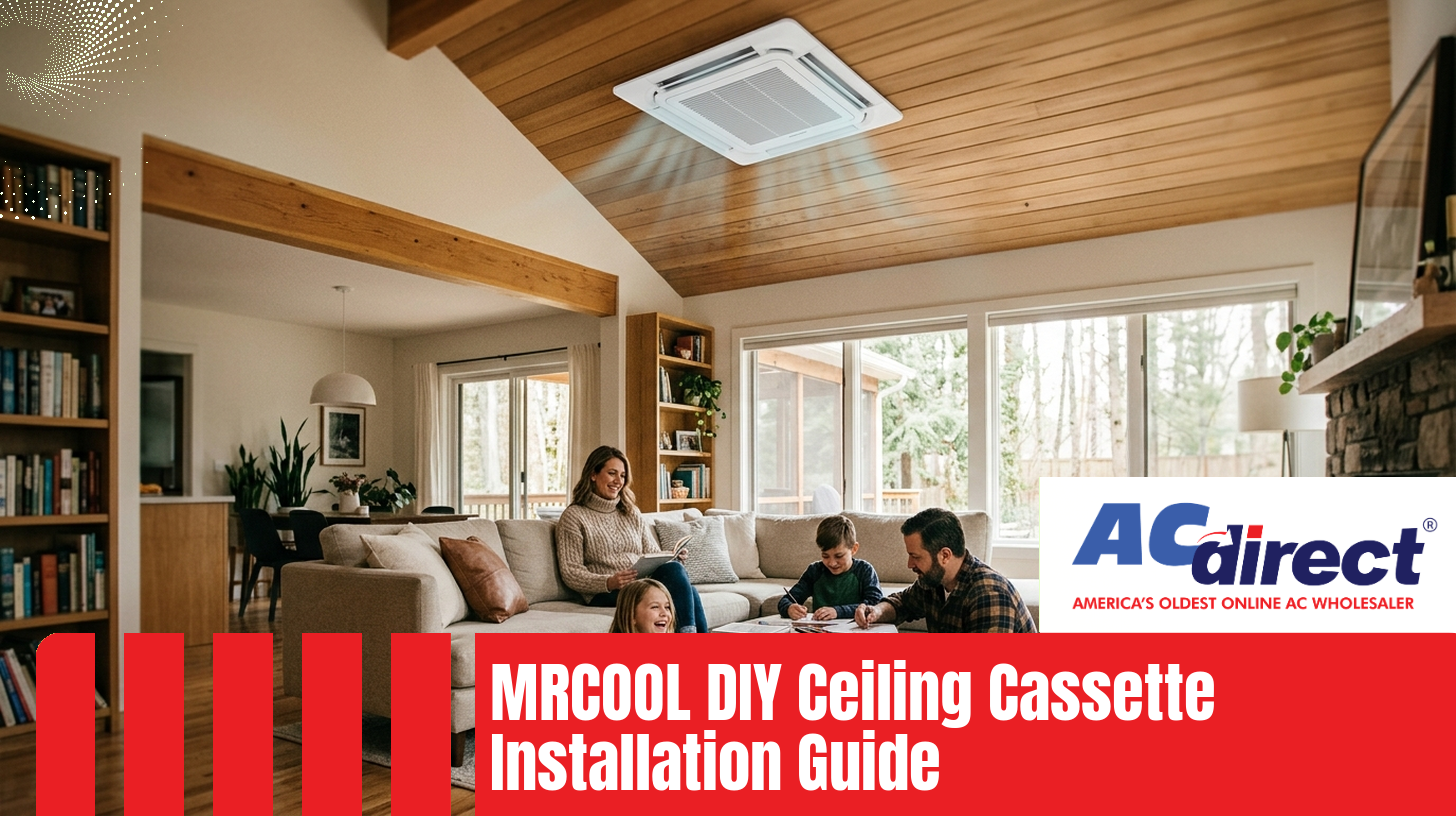
A practical, homeowner-friendly walkthrough for installing the only DIY ceiling cassette engineered to fit between standard 16-inch joists.
Tired of a bulky wall unit interrupting your living room? The MRCOOL DIY Ceiling Cassette tucks the entire indoor head into the ceiling, leaving only a clean white grille flush with the drywall. One owner put it well: fitting the unit felt like "a game of Tetris," but the moment that first blast of cold air hit the room "without a giant white box ruining my wallpaper," every second of stress was worth it.
This guide walks through the actual installation - the cuts, the suspension, the drain pump, the line set, and the grille - in plain language. If you want the full system overview before you start, our parent guide on how to install a MRCOOL DIY mini split covers the broader system from condenser to controls.
A wall-mount head is faster and cheaper to install, but it lives on your wall forever - a white plastic box at eye level. A ceiling cassette disappears into the ceiling plane, with only a thin decorative grille visible. For finished basements, bedrooms, sunrooms, and any space where aesthetics matter, the cassette wins on looks and floor flexibility.
Tradeoffs to know before you commit:
- More demanding install. You're working overhead, cutting drywall, and lifting a unit into a tight cavity.
- Joist accuracy matters. Houses framed off-spec can turn the install into a fight. Verify your joist spacing before ordering.
- Built-in condensate pump. Cassettes can't drain by gravity alone in most cases, so the unit ships with a pump (more on this below).
- Higher unit cost. Cassette air handlers run roughly $1,410 to $1,714 depending on capacity, versus a few hundred for a wall head.
If you want to compare the cassette against a traditional wall head install, our writeup on how to install a MRCOOL DIY single-zone system walks through the wall-mount workflow side by side.
Nothing exotic. If you've done any drywall or electrical work, you probably own most of this already.
| Category | Tools |
|---|---|
| Layout & Cutting | Stud finder, tape measure, level, drywall saw, 3½" hole saw |
| Mechanical | Drill/driver, screwdrivers, adjustable wrenches, torque wrench |
| Electrical | Wire strippers, voltage tester, electrical tape |
| Sealing | Insulation tape, exterior caulk |
| Safety | Safety glasses, dust mask, sturdy step ladder, second pair of hands |
One thing you do not need: a vacuum pump or refrigerant gauges. The Quick Connect® line set is pre-charged with R-454B (5th Gen) or R-410A (4th Gen), so refrigerant handling stays sealed inside the system.
This is the step that scares people, and rightly so - it's irreversible. Take your time.
Find two parallel ceiling joists and confirm they're spaced at standard 16 inches on-center. The cassette body is designed to slide between them. If your home is older or framed unevenly, double-check before cutting.
You need at least 7.9 inches between the unit's faceplate and any wall. Ceiling drywall thickness must not exceed 0.625 inches (5/8"); thicker assemblies will interfere with the grille seating flush.
The ceiling opening should measure approximately 51.2 inches in length, sized to match the cassette body. Use the paper template included with the unit and trace it carefully. Measure twice. Cut once.
Score with a utility knife first, then finish with a drywall saw. Wear eye protection - drywall dust falling from above is no joke. Have a partner support the cutout so it doesn't drop and tear paint or molding.
The cassette suspends from threaded rods anchored to the joists or to blocking installed between them. The unit is heavier than it looks - get help.
MRCOOL ships the suspension bolts and brackets with the unit. You'll typically install four threaded rods, one at each corner of the cassette body, anchored above the joists with structural blocking. Adjust the rod nuts to bring the cassette body up until the lower flange sits flush with the ceiling drywall surface.
Use a level on the cassette body in both directions. A cassette that's tilted even slightly will cause condensate to pool in one corner, eventually overwhelming the drain pump. This is the single most common cause of "my new ceiling cassette is leaking" calls.
Ceiling cassettes sit above the conditioned space, so condensate has to be lifted up and out rather than dripping down. Every MRCOOL DIY ceiling cassette includes a built-in condensate pump for exactly this reason.
- Lift the drain line first, then slope it down. Run the discharge tube vertically a few inches above the cassette, then slope it continuously downward toward your discharge point at roughly 1/4" per foot.
- Avoid sags. Any low spot in the drain line collects water, grows biofilm, and eventually blocks. Support the line every 3 to 4 feet.
- Discharge somewhere sensible. Outside through a wall penetration, into a utility sink, or into an existing drain. Never into a wall cavity.
- Insulate the drain line indoors. Cold condensate in warm humid attics will sweat and drip. Foam pipe insulation solves it.
This is where MRCOOL DIY shines compared to traditional ductless installs. The Quick Connect® line set is pre-charged with refrigerant and uses self-sealing fittings - no vacuum pump, no gauges, no EPA certification required to handle it.
Line sets come in 16-foot, 25-foot, 35-foot, and 50-foot lengths. Pick the shortest length that works without forcing tight bends. Excess line set should be coiled in long, gentle loops above the ceiling - never kinked or wound tight.
- Plan your path. The line set has to travel from the cassette, through your ceiling/wall cavity, and out to the condenser pad. Identify the route before you cut anything.
- Drill the exterior penetration. A 3½-inch hole saw makes the through-wall opening. Slope the hole slightly downward toward the outside to prevent water intrusion.
- Connect to the cassette first. Hand-tighten the Quick Connect fittings, then torque to spec with a torque wrench. As one experienced DIYer put it, "the line set connections to both the condenser and head unit are very important." Under-torque leaks; over-torque damages the fitting.
- Connect to the condenser. Same process at the outdoor unit. Maintain required clearances: 12 inches from the wall (6 inches if wall-mounted), 24 inches on the right and top, and 79 inches in front.
- Open the service valves. Once both ends are torqued, open the valves on the condenser to release the factory pre-charge into the system.
- Seal the wall penetration. Caulk the exterior, foam the interior, then cover with a line set cover for a clean finish.
Need a longer line set than what came with your bundle, or thinking about pairing this cassette with a larger condenser? Browse pre-charged DIY systems to compare options.
The decorative grille is the part everyone sees. Take five minutes to get it right.
A small ribbon cable runs from the cassette body to the grille (it powers the swing louver and the elevation function). Plug it in before you raise the grille.
The grille hangs from short safety chains or hooks first, so you have both hands free to make connections.
Drive the four corner screws evenly, in a cross pattern, until the grille sits flat and flush with the ceiling. If you see a gap, stop and adjust the cassette suspension - don't crush the grille against an out-of-plane unit.
The included remote has an elevation button that lowers the filter panel up to 4.9 feet for cleaning - no ladder, no tools. Run it once after install to confirm the harness is seated correctly.
Most homeowners can complete this install in a long Saturday with a partner. But two scenarios are worth a phone call before you start:
- Your joists aren't 16" on-center. Older homes sometimes use 24" or irregular spacing. The cassette won't fit without modification.
- You're not comfortable with 230V wiring. A licensed electrician should handle the dedicated circuit and breaker for the condenser.
Have a sizing question or unsure which bundle fits your room? Call 866-862-8922 to talk to a DIY expert at AC Direct, or view AC Direct's MRCOOL DIY collection to compare bundles by zone count and BTU.
The DIY ceiling cassette is offered in 9K, 12K, and 18K BTU capacities, covering roughly 200 to 800 square feet depending on insulation, ceiling height, and climate. If you need more capacity than a single 18K can deliver, our writeup on the MRCOOL DIY 24,000 BTU options walks through where the larger systems fit.
| Capacity | Typical Coverage | Voltage | Refrigerant (5th Gen) |
|---|---|---|---|
| 9,000 BTU | 200-400 sq ft | 230V | R-454B |
| 12,000 BTU | 400-600 sq ft | 230V | R-454B |
| 18,000 BTU | 600-800 sq ft | 230V | R-454B |
For cold-climate installs, the Hyper Heat ceiling cassette bundles maintain heating output down to -22°F, which means they'll keep producing usable heat through real winter. See our recommended MRCOOL DIY systems if you want to compare standard versus Hyper Heat bundles.
Will the MRCOOL DIY ceiling cassette really fit between my joists?
If your ceiling is framed at standard 16 inches on-center, yes. The unit body is engineered specifically for that spacing, which makes it unusual in the cassette market. Always verify your joist spacing in the actual install location before ordering - older homes can vary.
Do I need to handle refrigerant or rent a vacuum pump?
No. The Quick Connect® line set is pre-charged from the factory with R-454B (5th Gen) or R-410A (4th Gen). The fittings self-seal as you connect them. Open the service valves on the condenser at the end and the system charges itself.
How big a hole do I cut in the ceiling?
Approximately 51.2 inches in length, sized to fit between 16" on-center joists. Use the paper template that ships with the unit. Drywall thickness must not exceed 0.625 inches (5/8") for the grille to seat flush.
How do I clean the air filter once it's in the ceiling?
The remote has an elevation function that lowers the filter panel up to 4.9 feet from the ceiling, so you can clean it standing on the floor with no tools and no ladder. Pop the filter out, rinse it, let it dry, and send the panel back up.
What warranty does the unit carry?
For the original registered owner: 7 years on the compressor and 5 years on parts. Some 18K models offer a limited lifetime warranty with registration. Register the unit promptly after install to lock in coverage.
Can I install this in a cold climate?
Yes, if you choose the Hyper Heat variant. The DIY Hyper Heat ceiling cassette bundles are rated to deliver heating down to -22°F, which makes them workable for northern and mountain climates where standard heat pumps lose capacity.
The MRCOOL DIY Ceiling Cassette is the most realistic path to a ceiling-mounted mini split for a homeowner installer. The fit-between-joists design, pre-charged Quick Connect line set, and built-in condensate pump remove the three things that historically forced people to hire an HVAC contractor for cassette work. Take your time on the cuts, get the unit level, torque the line set fittings to spec, and you'll have a clean, quiet, nearly invisible heating and cooling solution that runs for years.
Ready to pick out a system? Shop MRCOOL DIY mini splits at AC Direct, or call 866-862-8922 if you want to talk through sizing with someone who installs these every week.