 and now, NASCAR Racing Sponsor


MRCOOL DIY vs Contractor Install: Real Labor Cost Breakdown ($2,000+ Saved)
-
 By
Michael Haines
By
Michael Haines
- Apr 28, 2026
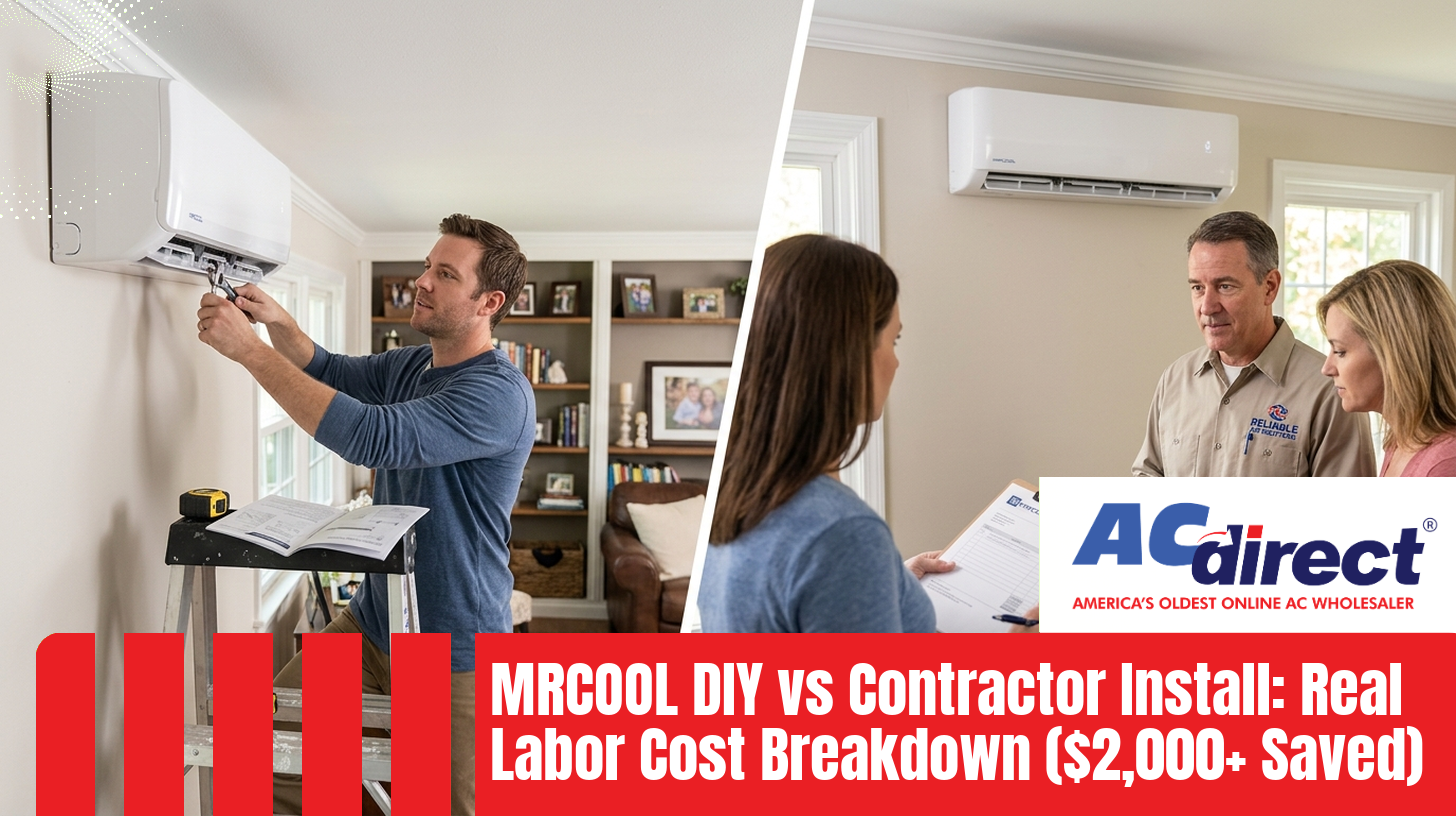
Why homeowners are saving $2,000 to $4,800 on mini split installation, what contractors actually charge for, and when paying a pro is still the smart move.
Sarah needed AC for her garage workshop. The first three HVAC contractors quoted her between $5,200 and $6,800 for a 12,000 BTU mini split, installed. She almost gave up on the project. Then she found MRCOOL DIY, bought the 12K unit for $1,549, paid an electrician $220 to run a new circuit, and spent 4.5 hours on a Saturday installing it herself. Total out-of-pocket: under $1,800. Total savings versus the cheapest pro quote: roughly $4,800.
Sarah is not unusual. Owner reports across HVAC forums and review sites tell the same story over and over again. So what exactly are contractors charging for, and where does that money go? This is the line-item breakdown most installers would rather you not see. For the full equipment-and-operating cost picture, see our parent guide on MRCOOL DIY mini split cost: equipment, operating, and total savings.
Before we compare DIY to pro install, let's anchor the numbers. Here's what real homeowners are paying in 2025-2026 for comparable single-zone systems:
| Path | Equipment | Labor | Total Installed |
|---|---|---|---|
| Mitsubishi / Daikin / LG (12K, pro install) | $1,800 to $3,000 | $2,400 to $3,800 | $4,200 to $6,800 |
| Single-zone 18K BTU (pro install) | $1,500 to $2,800 | $2,300 to $3,700 | $3,800 to $6,500 |
| MRCOOL DIY 12K (4th Gen) | $1,100 to $1,549 | $200 to $400 (electrician only) | $1,300 to $1,950 |
| MRCOOL Easy Pro 9K | ~$1,050 | $0 to $400 | ~$1,400 |
Equipment pricing from Mini Split Sizer, HVAC Base, The Furnace Outlet, and MRCOOL Direct (2025-2026).
The math is hard to ignore. The same 12,000 BTU cooling capacity costs three to four times more when a contractor handles it. So what are you actually paying for when you write that bigger check?
Contractors are not gouging customers (mostly). The professional install premium is real and it covers real costs. The catch: most of those costs are tied to traditional mini split designs that MRCOOL has engineered around.
A standard mini split from Mitsubishi, Daikin, or LG arrives with empty refrigerant lines. Before the system can run, an EPA 608-certified technician has to:
- Pull a vacuum on the line set with specialized equipment to remove all air and moisture
- Hold that vacuum for a set time to verify there are no leaks
- Charge the system with R-410A or R-454B refrigerant, weighed precisely
- Document the work for warranty and EPA compliance
That is skilled, regulated, time-consuming labor. MRCOOL DIY systems eliminate every step on that list with their pre-charged Quick Connect line sets. The refrigerant is already in the lines, sealed at the factory, and you simply hand-tighten the fittings together. No vacuum pump, no gauges, no EPA license required.
Most contractor quotes show one number for "installation." Here's what is hiding inside that number on a typical $2,500 to $3,500 single-zone labor charge:
| Line Item | Typical Cost | Eliminated by MRCOOL DIY? |
|---|---|---|
| Refrigerant evacuation and vacuum hold | $350 to $500 | Yes - pre-charged at factory |
| Line set flaring, brazing, leak check | $300 to $500 | Yes - Quick Connect fittings |
| Refrigerant charging and weigh-in | $200 to $350 | Yes - factory sealed |
| EPA 608 certified labor premium | $200 to $400 | Yes - no certification needed |
| Mounting indoor and outdoor units | $300 to $500 | No - you do this yourself |
| Wall pass-through, drilling, sealing | $150 to $300 | No - you do this yourself |
| Electrical hookup and disconnect | $300 to $500 | No - hire electrician $200-$400 |
| Truck roll, overhead, profit margin | $400 to $600 | Yes - no contractor involved |
Add it up. The refrigerant-related work alone, plus the certification premium and overhead, accounts for $1,400 to $2,250 of a typical labor invoice. That entire chunk evaporates when you choose MRCOOL DIY. The mounting, drilling, and physical install work? That stays on your plate, but it's the stuff most homeowners can comfortably handle in an afternoon. Our step-by-step MRCOOL DIY installation guide walks through every part of the physical install.
The savings range depends on system size, region, and how aggressive your local contractors price. Here is what real owners are reporting:
One owner case study from The Furnace Outlet documents an all-in DIY cost of $3,150 against pro quotes of $6,200 to $7,800 - a real savings of nearly $4,000 on a multi-zone setup. These are not cherry-picked outliers. They are the median experience for homeowners who follow the install instructions and hire an electrician for the dedicated circuit. If those numbers look good to you, browse pre-charged DIY systems to see what fits your space.
DIY is not the right answer for everyone. There are real situations where paying a contractor makes sense, and we're not going to pretend otherwise.
MRCOOL DIY line sets come pre-charged in 16-foot or 25-foot lengths. If your indoor and outdoor units need to be more than 25 feet apart, or if you need complex routing through finished walls and an attic, a custom-fabricated line set with field charging may be the only option. That's traditional mini split territory.
Mounting an outdoor condenser, drilling through exterior walls, and lifting indoor heads onto wall brackets is moderate physical work. If you have mobility issues, balance concerns, or no help available, paying for installation is a reasonable choice.
Some HOAs and municipalities require licensed-contractor installation for warranty or insurance reasons. Check before you buy. Most jurisdictions allow homeowner DIY HVAC work, but a few do not.
5th Gen MRCOOL DIY systems can support up to 6 zones, but the install complexity scales with zone count. A 5- or 6-zone install is a 1-2 day project even for experienced DIYers. If you're new to this kind of work and starting with a 5-zone system, the math may favor a contractor.
Run your own math with this simple framework. Get three contractor quotes for your specific system size and configuration, then plug in:
Average your three contractor quotes. Example: ($5,200 + $5,800 + $6,400) / 3 = $5,800
Look up current MRCOOL DIY prices for your size. Example: 18K single-zone = $1,800.
Add $300 (electrician) + $100 (incidentals) = $400. Total DIY cost: $1,800 + $400 = $2,200.
$5,800 (pro avg) minus $2,200 (DIY total) = $3,600 saved. That's a real number for a real install.
Want to see how operating costs compare across system sizes after install? Our breakdown of MRCOOL DIY operating cost by size covers monthly running costs in detail.
AC Direct ships MRCOOL DIY systems nationwide at wholesale pricing. Pre-charged line sets, no EPA license, no vacuum pump, no contractor markup. Questions? Call 866-862-8922 to talk to a DIY expert.
A typical MRCOOL DIY single-zone install runs $1,300 to $1,950 all-in (equipment plus electrician), versus $3,800 to $6,800 for the same capacity professionally installed in a name-brand mini split. Real-world owner reports show savings between $1,500 and $4,800 depending on system size, market, and contractor pricing.
Correct. MRCOOL DIY systems use pre-charged Quick Connect line sets that are sealed at the factory. You hand-tighten the fittings together with two wrenches and open the service valves to release the refrigerant. No vacuum pump, no manifold gauges, no EPA 608 license. You will need basic tools: a drill, a level, a hole saw, and standard wrenches.
Most homeowners complete a single-zone install in 4 to 8 hours. One documented owner report describes a 12,000 BTU install completed in 4.5 hours by someone with no prior HVAC experience. Multi-zone systems take longer - plan on one to two days for 3 or more zones.
The electrical circuit. Most MRCOOL DIY systems need a dedicated 115V or 240V circuit, and unless you already have one available at the install location, hire a licensed electrician. Typical cost is $200 to $400. This is also a code and safety issue - it's worth doing right.
No. The 4th Generation hits 22 SEER2 efficiency, and the 5th Generation reaches up to 23.6 SEER2 with the new R-454B refrigerant - competitive with or better than many premium brands. Hyper Heat models are rated for reliable heating down to -22°F. Warranties run 7 years on the compressor and 5 years on parts. The DIY part refers to installation, not build quality.
No. MRCOOL DIY systems are explicitly designed and warrantied for homeowner installation. That's the whole product line. As long as you follow the included instructions, the 7-year compressor and 5-year parts warranty stays intact. This is the opposite of most HVAC equipment, which requires licensed-contractor install for warranty coverage.