

Finding a Licensed Installer for Your New Unit
-
 By
Michael Haines
By
Michael Haines
- Jul 7, 2026

A practical guide to finding qualified HVAC contractors who install customer supplied equipment, with a vetting checklist and the exact questions to ask.
Many licensed HVAC contractors happily install customer supplied equipment, and finding one is straightforward once you know what to look for. Search local trade directories, ask for proof of license and insurance, confirm they have hands-on experience with inverter units and your specific brand, and get a written labor quote that spells out exactly what is included.
Buying your equipment direct is a smart move that has become common over the last decade. The install side of the industry has adjusted to it. If you want the full picture on the technology behind these units before we get into installer selection, our inverter air conditioner guide is a good primer.
Labor only installs (sometimes called "install only" or "customer supplied equipment") are a normal part of the residential HVAC market. Plenty of licensed contractors quote them every week. Some prefer to supply the equipment themselves, and that is their business model, but a large share of the industry is comfortable installing a unit you already own.
Here is why the labor only path is more common than most homeowners assume:
- Smaller shops and independent techs often work labor only. They compete on craftsmanship rather than equipment markup, and a homeowner walking in with a boxed unit is a straightforward job for them.
- Newer contractors building a book of business take labor only work to fill their calendar and earn referrals.
- Specialists in specific brands (Daikin, Goodman, MRCOOL) are usually happy to install what they already know inside and out.
- The pandemic-era supply crunch pushed a lot of contractors to accept customer supplied equipment because they could not get product themselves. Many kept doing it after seeing the workflow was fine.
If the first contractor you call declines the job, that is not a signal that something is wrong with your approach. It just means their business model requires supplying the equipment. Move on to the next one.
The most reliable installers are rarely the ones with the largest ad budget. A mix of trade directories, licensing databases, and word of mouth turns up better candidates than a generic web search. Start with sources that pre-filter for licensing and insurance, then verify credentials yourself before scheduling a site visit.
Every state that licenses HVAC contractors publishes a searchable online database of active license holders. Search "[your state] HVAC contractor license lookup." This is the single best starting point because it confirms the contractor is legally allowed to do the work before you ever pick up the phone.
Organizations like ACCA (Air Conditioning Contractors of America) and the local chapters of trade groups publish member directories. Members typically carry current continuing education and hold current licensing. These are not the only qualified contractors, but they tend to be well vetted.
Goodman, Daikin, and MRCOOL all list dealers on their websites. A brand-listed installer likely has product training on the equipment you bought, which is genuinely useful. Just know the list is not a quality ranking. It reflects business relationships, not workmanship. Use it as a source of names to vet, not a shortlist of pre-approved winners.
Google Maps and community-specific forums (Nextdoor, local Facebook groups, homeowner association boards) surface contractors your neighbors have actually used. Look for reviews that describe specific work rather than generic "great service" comments. Reviews that mention brand names, inverter setups, or line set work are the most useful.
Electricians and plumbers who work in the same neighborhoods often know which HVAC contractors do good work. If you have a trades relationship already, ask.
Once you have three to five candidates, run each of them through the same checklist. This takes about ten minutes per contractor and eliminates most of the risk of hiring the wrong person. Do not skip steps because a contractor seems friendly on the phone. The paperwork either exists or it does not.
| What to Verify | How to Verify It | Why It Matters |
|---|---|---|
| Active state HVAC license | State licensing board website | Legal requirement in most states; protects your permit and warranty |
| General liability insurance | Ask for current certificate of insurance (COI) | Covers property damage during install |
| Workers compensation insurance | Same COI | Protects you if a tech is injured on your property |
| EPA Section 608 certification | Ask which techs are certified | Federally required to handle refrigerant |
| A2L refrigerant training | Ask directly, look for recent training dates | Required for R-32 and R-454B units now standard on new units, per the EPA AIM Act |
| Brand-specific experience | Ask how many Goodman, Daikin, or MRCOOL units they installed last year | Familiarity with brand-specific wiring and controls |
| Local permit pulling | Ask if they pull the permit or expect you to | Permits protect resale value and warranty |
| Written labor quote | Request before scheduling | Prevents scope creep and surprise charges |
A contractor who hesitates on any of these is not automatically disqualified, but they should be able to answer clearly. Refusal to provide insurance certificates is a hard stop.
Inverter units are different from single-stage equipment in ways that matter during installation. The compressor is controlled by a variable-frequency drive, the electronics are sensitive to static discharge and grounding issues, and communication wiring between indoor and outdoor units is not interchangeable with old thermostat cable. An installer who understands these differences will produce a better result.
Ask each candidate the following. Their answers tell you more than their years-in-business number.
You want a number, not a vague "plenty of them." A contractor doing regular inverter work should have a specific answer. If they installed only one or two, they are still learning the technology on your dime.
New Goodman and MRCOOL ducted units use R-454B, and Daikin mini splits use R-32. Both are A2L (mildly flammable) refrigerants requiring specific handling procedures. Techs need updated training, tools, and leak detection equipment. Under the EPA AIM Act, new residential units installed after January 1, 2026 must use these lower-GWP refrigerants.
Modern inverter units use dedicated communication cables, not standard thermostat wire. A contractor who does not immediately mention shielded cable, proper grounding, or the manufacturer's wiring diagram is not doing inverter work regularly.
Manual J is the industry-standard method for sizing a system to the actual heat gain and loss of your home. A contractor who sizes by square footage alone or by "matching what you had before" is guessing. For inverter units, correct sizing matters even more because oversized units short cycle and undersized units run the electric backup constantly.
Split system efficiency ratings only apply when the indoor coil, outdoor unit, and (for heat pumps) air handler are certified as a matched combination by AHRI. A good installer confirms the AHRI reference number matches what you purchased before starting the job.
Inverter control boards are more sensitive than the mechanical relays in old units. A contractor who has diagnosed one before will describe checking ground potential, communication signal integrity, and voltage across the DC bus. A contractor who says "we just swap the board" is not the one you want.
A written quote should read like a scope of work, not a single lump sum. Every reasonable installer breaks down what is included so both sides know what "the job" means. If a quote is one line and one number, ask for detail before you sign.
A fair labor quote typically covers:
- Removal and disposal of the old equipment, including responsible refrigerant recovery from the old system.
- New refrigerant line set if the existing one is not compatible, or flushing and pressure testing if reusing.
- Electrical connections from the disconnect to the new outdoor unit, and from the air handler to the indoor supply.
- Condensate drain and float safety switch.
- Communication wiring between indoor and outdoor components, per the manufacturer's specification.
- Vacuum, pressure test, and charge verification using a micron gauge and digital scales.
- Startup and commissioning, including verifying superheat and subcooling values on the manufacturer's charging chart.
- Permit fees, or clear language about who pulls the permit and pays the fee.
- Warranty registration with the manufacturer, which usually must be completed within 60 days of installation to secure the full parts warranty.
- A written labor warranty. One year is standard; two years is better.
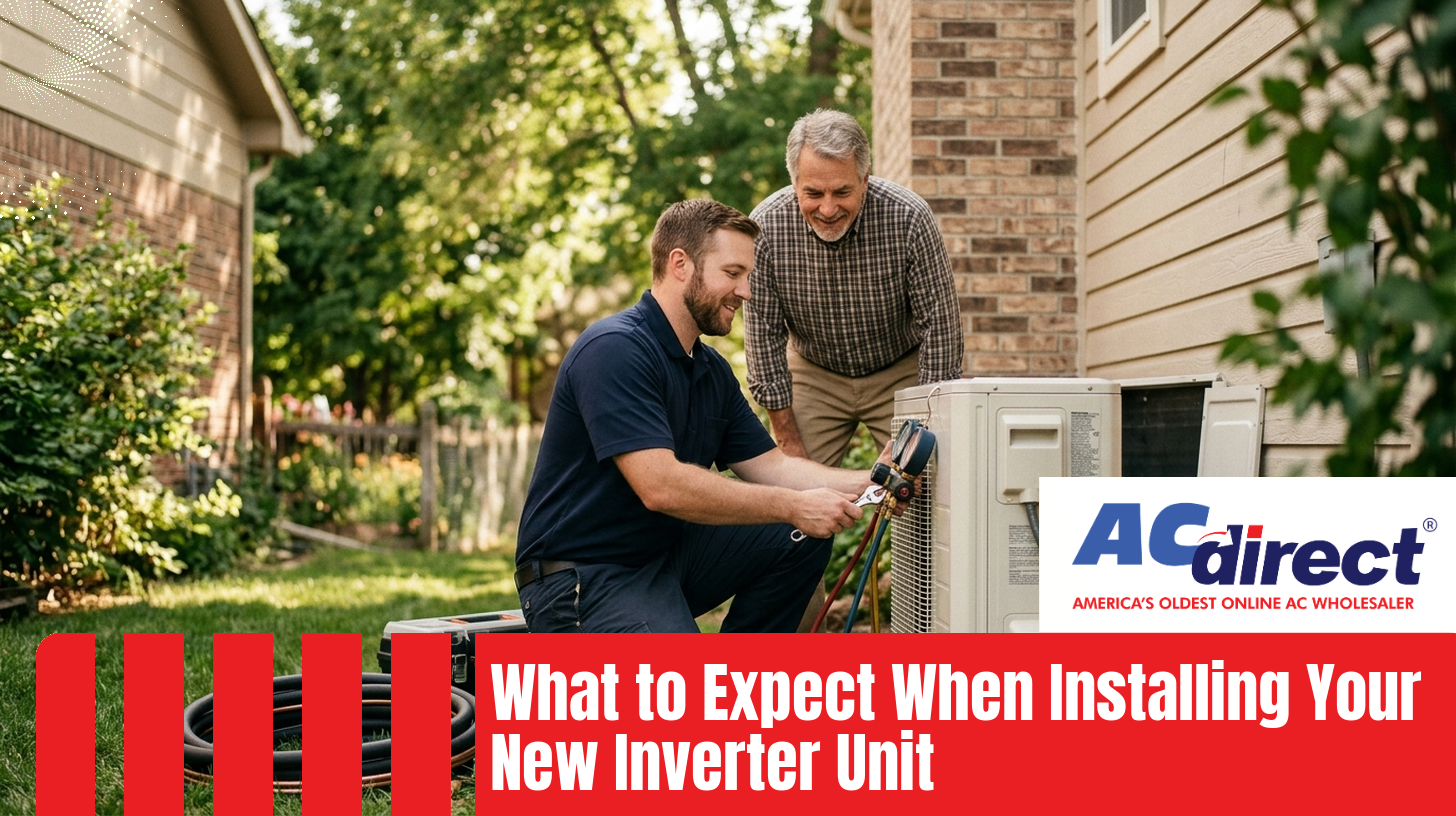
For a walkthrough of what a professional install actually looks like day-of, see what to expect when installing your new inverter unit.
Most contractors are competent professionals. The ones who are not tend to give themselves away early. Watch for these signals during the quoting stage and walk away rather than negotiate.
A contractor who wants cash only and no paper trail is telling you they are not carrying insurance, not paying taxes, or not licensed. All three are your problem, not theirs, if something goes wrong.
"You do not need a permit for this" is almost never true for a full system replacement. Unpermitted work can void your homeowners insurance, complicate a future sale, and void the manufacturer warranty. If a contractor pushes back on permits, they are protecting themselves from inspection, not saving you money.
Anything not in writing does not exist. A contractor who will not put the scope and price on paper is leaving room to add charges later.
Some contractors will decline a labor only job. That is fair. Others will try to talk you out of the equipment you already own by suggesting it is inferior, will not be warrantied, or will not perform. That is a sales tactic, not a technical assessment. Goodman, Daikin, and MRCOOL are all mainstream, AHRI-certified brands with full manufacturer warranties that transfer to the homeowner regardless of who supplied the unit.
By 2026, per the U.S. Department of Energy efficiency standards and EPA refrigerant rules, almost every new residential unit is running R-32 or R-454B. A contractor who cannot explain how they handle A2L refrigerant is not equipped for current equipment.
The manufacturer parts warranty typically requires registration within 60 days of installation. A contractor who is unclear on this step, or expects you to handle it yourself without providing installation date documentation, may be setting up a warranty gap.
If you have not yet picked out your unit, AC Direct carries the full lineup of Goodman, Daikin, and MRCOOL inverter equipment at wholesale pricing. Every model ships with the documentation your installer needs, including AHRI matched-system references and warranty registration information. Browse inverter AC units to see what fits your home.
Will an installer void my warranty if I supplied the equipment?
No. Goodman, Daikin, and MRCOOL manufacturer warranties are tied to the equipment and the homeowner, not to who purchased it. What matters is that the unit is installed by a licensed HVAC contractor and registered with the manufacturer within the required window, typically 60 days from the installation date.
Do I need a permit if I bought the unit myself?
Yes, in almost every jurisdiction. Permitting requirements are based on the work being performed, not where the equipment came from. A full system replacement, condenser swap, or new line set installation almost always requires a mechanical permit and an inspection. Your installer should pull the permit as part of the job.
How do I know if an installer has real inverter experience?
Ask specific questions. How many inverter units did they install last year, which brands, and have they completed A2L refrigerant training. A contractor with genuine experience will answer clearly and often mention specific manufacturer training programs. Vague or defensive answers usually mean the tech is still learning the technology.
What if the first few contractors decline the job?
Keep calling. Some contractors only install equipment they supply, and that is their business model. It is not a comment on you or your equipment. In most metro areas, a handful of calls will turn up several installers who take labor only work. Smaller shops and independent techs are your best bet.
Should the installer register my warranty, or should I?
Either works, but the installation date and installer information are required at registration. The cleanest path is for the installer to register it as part of the job. If they will not, ask for a signed invoice with the installation date and their license number so you can register the unit yourself with the manufacturer directly.