

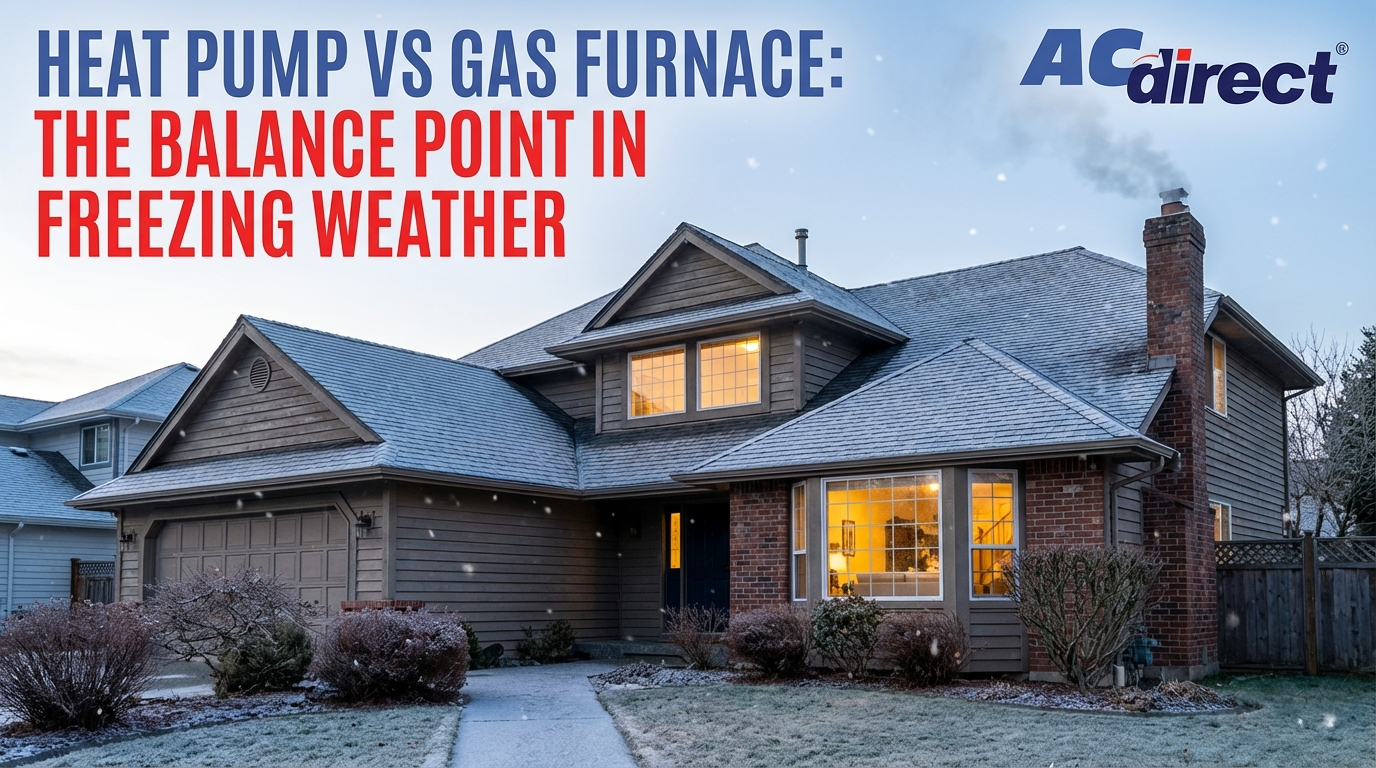
Heat Pump vs Gas Furnace: The Balance Point In Freezing Weather
-
 By
Michael Haines
By
Michael Haines
- Jan 21, 2026
If you live in the South, you’ve probably seen winter weather that looks harmless on paper, then turns into a real problem once ice takes down power or temperatures sit below freezing for longer than usual. That’s the moment a lot of homeowners realize they do not actually know how their heating system behaves when it gets genuinely cold.
Even if you think of your home as “heat pump country,” your heating and cooling setup is still one system with shared parts, shared controls, and shared failure points. Your blower, ducts, thermostat, and electrical circuits all matter because they are tied to your ac unit. When winter hits hard, the thing that stops comfort is often electrical, airflow-related, or equipment limits, not a sudden lack of fuel.
-
A heat pump can keep heating below freezing, but comfort often drops because supply air temperature is lower than furnace heat.
-
“Balance point” is the outdoor temperature where a heat pump can no longer keep up on its own.
-
Many “heat pump blowing cold air” complaints are due to defrost cycle behavior or backup heat issues, not a total system failure.
-
The “heat pump vs gas furnace efficiency” question varies with temperature, electricity rates, gas prices, and how tight your home is.
-
Dual-fuel can reduce operating cost swings and improve comfort during prolonged freezes, especially during cold snaps in Dallas and Atlanta.
Why Heat Pumps Can Feel Like They Are Blowing Cold Air
Let’s start with the complaint that drives most panic searches: heat pump blowing cold air.
A heat pump does not create heat the way a furnace does. It moves heat from outside air into the home. When it’s 45°F outside, that’s easy. When it’s 25°F outside, there is less heat available to move, and the unit has to work harder to extract it.
That shows up in three very specific ways that homeowners notice right away.
First, the air coming out of your vents may be warm, but not hot. A furnace might deliver supply air that feels obviously hot to your hand. A heat pump can deliver air that is warm enough to heat the home, but it can still feel lukewarm. That “feels cold” perception is one reason people swear something is wrong.
Second, defrost cycles can create short bursts of cooler air. When the outdoor coil frosts up, the system has to defrost. During defrost, the heat pump temporarily reverses its operation to melt ice off the outdoor coil. Many systems use backup heat during defrost to avoid blowing cool air, but if the backup heat is not working or not sized properly, you may feel that temperature swing.
Third, airflow and duct issues get exposed. A heat pump relies heavily on steady airflow. If the blower is weak, the filter is clogged, the ductwork is leaking, or return air is restricted, the system can struggle and feel worse than it should, especially when it is near its limits.
None of that means a heat pump is “bad.” It means you need to understand where its comfort edge is, and that leads to the balance point.
What The Balance Point Actually Means
The balance point is the outdoor temperature where your home’s heat loss equals the heat pump’s heat output.
Above the balance point, the heat pump can keep up without help.
At or below the balance point, the heat pump cannot keep up on its own, so the system needs backup heat or the indoor temperature starts drifting downward.
There are two balance points worth knowing.
One is the equipment balance point. That’s where the heat pump’s capacity drops enough that it cannot meet the home’s demand.
The other is the economic balance point. That’s where the cost to run the heat pump becomes higher than the cost to run a furnace or other backup heat.
In the South, the equipment balance point is often the one that surprises people first. A home in Dallas might go most winters never brushing up against it. Then one extended freeze hits and suddenly the thermostat is stuck at 66°F even though it is “running.”
Atlanta has its own version of this. Many homes do fine until a cold air damming event or a system with lots of moisture and wind pushes the system into longer runtimes. That is when the comfort conversation changes from “efficient” to “effective.”
Heat Pump vs Gas Furnace Efficiency Changes With Temperature
If you are comparing heat pump vs gas furnace efficiency, the truth is not one universal winner. It changes with conditions.
A heat pump is often the most cost-effective option in mild cold because it moves heat, not generates it. When outdoor temperatures are moderate, the heat pump can deliver multiple units of heat for each unit of electricity it consumes. That’s why so many Southern homes are built around heat pumps.
But as outdoor temperatures drop, the heat pump has to work harder. Capacity drops, run time increases, and in some systems the unit depends more on backup heat. Backup heat is where costs can spike, especially if the backup is electric resistance heat strips.
A gas furnace is different. It generates heat through combustion. As long as it’s supplied with gas and has electrical power for controls and the blower, it can deliver strong heat output consistently, even when outdoor temperatures drop into the teens.
So in real-world terms, the efficiency question becomes a temperature and cost question.
If you have lower electric rates and milder winters, a heat pump can be a great fit.
If your region sees stretches under 30°F with high electric costs, or your home needs a lot of heat to stay comfortable, a gas furnace often wins on comfort and can win on operating cost during those cold stretches.
This is also why dual fuel is so popular when people want the best of both.
Why Dual Fuel Makes Sense In The South
Dual fuel means your system uses a heat pump for milder outdoor temperatures and switches to a gas furnace when it gets colder or when the system determines the heat pump is no longer the better option.
This is not “two systems.” It’s a coordinated system with controls that choose the heating source.
In places like Dallas and Atlanta, dual fuel can make a lot of sense for four reasons.
One, comfort. When the furnace runs, the supply air is hotter, and the home tends to feel warmer faster.
Two, operating cost stability. When the heat pump is efficient, you use it. When it is not, you do not force it to grind through conditions where it is less effective.
Three, fewer “surprise” cold mornings. Heat pumps are capable, but they can be slower to recover a big temperature setback. If your home drops overnight during a freeze, a furnace stage can bring it back faster.
Four, long-duration cold snaps. Even in the South, you can get a weekend system that holds temperatures down long enough for the home to cool and for pipes and comfort issues to show up. Dual fuel gives you more options.
If you are shopping equipment, the category you want to start with is gas furnace options. If you are comparing across a wider range, home furnace listings help you see what fits different homes and budgets.
The Comfort Difference People Underestimate
A lot of homeowners do not care what the system is doing behind the scenes. They care what it feels like.
A heat pump can maintain temperature steadily in mild cold, but it often does it with lower supply air temperature. That can create two common reactions:
-
“It’s running all the time.”
-
“It feels drafty.”
A furnace can cycle on and off more distinctly and blow hotter air during its cycles. Some people interpret that as “stronger heat.”
Neither approach is automatically better. It depends on the home, duct design, insulation, and what temperatures you are dealing with.
But if you are near or below the balance point, the furnace style of heat is often what feels right to people. That’s why, during cold snaps, search volume spikes on terms like winter storm forecast, snow forecast, weekend weather forecast, and it quickly turns into heating questions once the temperature and power risks become real.
What Actually Triggers Backup Heat On A Heat Pump
This is the part that causes confusion, and it matters if you are trying to avoid high bills and cold nights.
Backup heat can come on for several reasons.
It can come on when the heat pump cannot keep up with demand, and the thermostat senses the indoor temperature falling behind the setpoint.
It can come on during defrost cycles to keep the air from feeling cold.
It can come on because the thermostat is set up to force it, such as when you crank it up several degrees quickly.
It can also occur when controls are mismatched, wired incorrectly, or programmed poorly.
That last one is the one that burns homeowners. A heat pump can be installed and still run “fine” most of the year, then the cold snap hits and the controls are not switching correctly, backup heat runs too often, or the system never stages the way it should.
If you have ever had a winter bill that made you feel sick, this is often why.
The Balance Point In Dallas And Atlanta Is Not The Same
Dallas and Atlanta both get cold snaps, but they are not identical.
Dallas tends to see sharper temperature drops and wind that can increase heat loss. Depending on the home, a heat pump may start to feel weaker in the high 20s, especially if the home is leaky or the ductwork is not tight.
Atlanta can see long stretches of damp cold with occasional ice events. That can stress outdoor units through frosting and longer defrost cycles. Atlanta also has a lot of homes where ductwork and airflow issues show up when the system has to run longer.
The balance point in a tight, well-insulated home is going to be lower than in a drafty home. That’s why two neighbors can have the same brand of heat pump and totally different experiences.
If you want the practical takeaway without getting lost in equipment charts, it is this: the balance point is personal to the house.
A Simple Way To Think About When A Furnace Becomes The Better Move
You do not have to be an engineer to make a sane decision.
If your heat pump keeps the house comfortable without relying heavily on backup heat, and your bills are normal, you may not need to change anything.
If you are seeing the same pattern every winter where temperatures below about 30°F turn into long run times, comfort complaints, and big electric usage, that is when dual fuel and a gas furnace start to make sense.
If you have a home that loses heat fast, the heat pump is going to spend more time near its limit. That makes the balance point higher. In those homes, a furnace can make the difference between “fine” and “miserable” during a freeze.
What About Power Outages
This is where people get caught off guard.
A heat pump needs electricity. A furnace also needs electricity for controls and the blower, even if the fuel is gas. During a storm that brings ice and outages, both systems can be impacted. The difference is that a furnace can sometimes be supported more realistically with backup power because the electrical demand can be lower than a full heat pump’s demand.
That does not mean you can run either system safely without thinking. It means you should understand your equipment’s electrical needs and have a plan that follows code and safety practices.
If you have ever typed something like “Will my gas furnace work in a power outage?” you are asking the right question. The answer is still that it depends on electricity being available, but backup power options can keep a furnace running if it is connected properly and sized correctly.
The Reason “Heat Pump Blowing Cold Air” Spikes During Freezes
When it is 50°F outside, most heat pumps behave in a way that homeowners barely notice.
When it is 25°F outside, every weakness is more visible. Defrost cycles are more frequent. The system runs longer. If backup heat is not staged correctly, you feel it. If airflow is restricted, you feel it.
That is why cold snaps drive panic searches, and why it makes sense to get clarity before you are in the middle of the storm.
This also ties into something simple: if you are watching a weekend winter storm track and you see freezing rain risk, treat that as a possible power outage scenario too. Ice breaks trees. Trees take out lines. That is how it usually goes.
When Replacing Makes Sense Instead Of “Hoping It Holds”
If your system is already unreliable, a major freeze is the worst time to gamble.
If you are seeing repeated ignition issues, blower issues, control problems, or the heat pump simply does not keep the home warm once it dips into the 20s, it is reasonable to plan replacement rather than waiting for an emergency.
Emergency replacements cost more, take longer, and give you fewer choices. That is not a sales line. It is how winter demand works.
If you want to keep the heat pump concept but improve cold performance, dual fuel is usually where the conversation lands for Southern homes that get hit with these sudden cold events.
If you want consistent heat output and strong recovery, a furnace-centered approach can be the right call, with the heat pump still handling milder days depending on the setup.
A Short Reality Check On Electric Resistance Backup Heat
Electric resistance heat strips can be useful. They can also be expensive to run.
When they turn on, they are basically a large electric heater inside your air handler. That is why some homeowners see huge spikes in electric bills when the temperature drops.
If your backup heat is electric strips and it is running a lot, it does not mean your system is “broken.” It can mean the house is losing heat faster than the heat pump can replace it at those temperatures.
That is another place where dual fuel can reduce surprises, because the backup heat becomes gas-based rather than electric resistance.
What To Ask Your Installer So You Don’t Get A Mismatch
You do not need a long checklist. You need the right few questions.
Ask what outdoor temperature the system is expected to carry the home without backup heat.
Ask what control strategy is used to switch to backup heat and whether that strategy is based on outdoor temperature, indoor recovery rate, or both.
Ask what your backup heat actually is: electric resistance strips or a gas furnace stage.
Ask whether the thermostat and control wiring supports the staging you are paying for.
Those questions alone can prevent a lot of “why is my bill insane” surprises.
FAQ
Why Does My Heat Pump Feel Like It Is Blowing Cold Air?
A heat pump often delivers air that feels less hot than a furnace, especially near freezing temperatures. Defrost cycles and backup heat settings can also create short bursts of cooler air.
What Is The Balance Point For A Heat Pump?
The balance point is the outdoor temperature where your home’s heat loss matches the heat pump’s heating output. Below that temperature, backup heat is typically needed to maintain indoor comfort.
Is A Heat Pump Or Gas Furnace More Efficient?
Heat pump efficiency is usually strong in milder cold, while a gas furnace delivers consistent heat output in deeper cold. The better choice depends on outdoor temperature, energy prices, and how much heat your home loses.
What Is Dual Fuel Heating?
Dual fuel is a system that uses a heat pump in milder temperatures and switches to a gas furnace when it gets colder or when the heat pump is no longer the better option for comfort or cost.
Why Do My Bills Jump During Freezing Weather With A Heat Pump?
In many homes, backup heat strips run more during freezing weather, and electric resistance heat can use a lot of power. The system may be doing what it was designed to do, but operating cost changes fast at lower temperatures.
Final Thoughts
If you live in the South, freezing weather is not a daily thing, which is exactly why it catches people off guard. A heat pump can be a great system for most winter days, but it has limits, and those limits show up fast once temperatures drop into the 20s and stay there.
The balance point is not a theory. It is the line where comfort changes and costs can shift. If your home routinely struggles below 30°F, or you keep seeing the same pattern of long runtimes, lukewarm vent air, and expensive backup heat, that is when a furnace or dual fuel setup can stop being a “nice upgrade” and start being a practical move.
The smartest plan is the one that prevents the emergency. If a cold snap is coming and your system is already acting up, handle it before you are stuck making decisions under pressure.