 and now, NASCAR Racing Sponsor


Heat Pumps in the Midwest and Northeast: What Works When It Gets Truly Cold
-
 By
Michael Haines
By
Michael Haines
- Mar 26, 2026
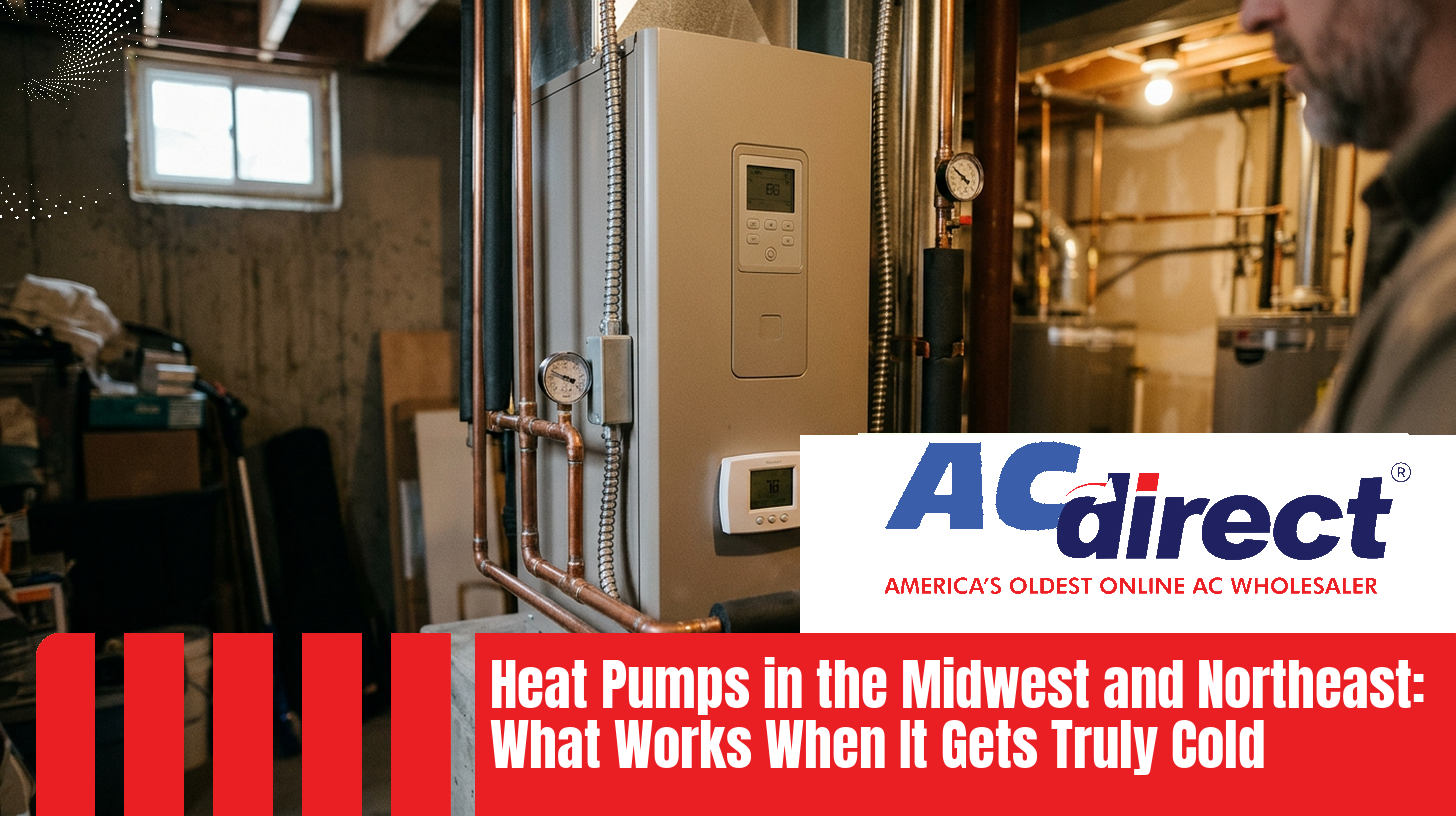
Climate zones 5 and 6 bring real winters. Here's what the data says about modern heat pump performance in Ohio, Michigan, Minnesota, New York, and Pennsylvania - and how to pick the right system for your home.
If you live in Ohio, Michigan, Minnesota, New York, or Pennsylvania, you already know what a real winter feels like. You know the sound of a furnace running nonstop at 2 a.m. You know the sting of opening that January gas bill. And you have probably heard someone say, with total confidence, that heat pumps simply cannot handle this kind of cold. That claim made sense fifteen years ago. It does not hold up anymore.
Modern cold-climate heat pumps are engineered specifically for the conditions found in climate zones 5 and 6 - the zones that cover most of the Midwest and Northeast. They maintain 70 to 80 percent of their rated heating capacity at -13°F. They run on inverter compressors that ramp up output as temperatures drop. And they are outselling gas furnaces nationally for the third year running.
This article breaks down what actually works in your climate, what the real numbers look like, where the savings come from, and how to avoid the mistakes that lead to those horror-story electric bills people post about online. Everything here is based on field data and manufacturer specifications, not marketing claims.
The U.S. Department of Energy divides the country into climate zones based on heating and cooling demand. Most of the Midwest and Northeast falls into zones 5 and 6, which means:
- Zone 5 covers much of Ohio, Pennsylvania, southern Michigan, and downstate New York. Design temperatures (the coldest conditions your system should handle) typically range from 0°F to 10°F.
- Zone 6 covers northern Michigan, Minnesota, upstate New York, and parts of New England. Design temperatures can drop to -10°F or colder.
These are not mild climates. Polar vortex events can push actual temperatures well below design conditions for days at a time. Any heat pump installed here needs to be explicitly rated for cold-climate operation - not just marketed as "efficient." The distinction matters more than most people realize.
The most common misconception is that there is "no heat" in cold air. Thermodynamically, that is incorrect. Heat energy exists in air at any temperature above absolute zero, which is roughly -460°F. A 5°F winter night contains an enormous amount of thermal energy. The engineering challenge is extracting it efficiently.
Here is the simplified version of how it works:
The system chills its refrigerant to a temperature well below the outdoor air - say, -20°F. Now even 5°F air is warmer than the refrigerant, so heat flows naturally into it. This is basic physics: heat always moves from warmer to cooler.
An inverter-driven compressor pressurizes the refrigerant, raising its temperature dramatically. What started as a tiny amount of captured warmth becomes enough thermal energy to heat your home.
The hot refrigerant passes through the indoor coil, transferring heat to the air moving through your ductwork (or directly into the room with a ductless system). The refrigerant cools down and cycles back outside to repeat the process.
The key technology that makes this work in zone 5 and 6 winters is the variable-speed inverter compressor. Unlike older single-speed compressors that were either fully on or fully off, an inverter compressor modulates its output continuously. When temperatures drop, it ramps up to 120% capacity. On a mild 40°F day, it coasts at 30%. It never short-cycles. It never wastes energy slamming on and off. And critically, it fights harder precisely when conditions are worst.
Efficiency is measured by COP - Coefficient of Performance. A COP of 2.5 means you get 2.5 units of heat for every 1 unit of electricity consumed. For comparison, a gas furnace tops out at about 0.95 (it can never exceed 1.0 because some energy always goes up the flue). An electric space heater is permanently stuck at 1.0.
Here is what field-validated data shows for modern cold-climate heat pumps across the temperature range you will actually experience in the Midwest and Northeast:
Source: U.S. Department of Energy states modern cold-climate heat pumps deliver two to four times the energy they consume. Field validation by the DOE Cold Climate Heat Pump Challenge confirmed median COPs of 1.9 in the 5°F to 17°F range.
Notice that even at -13°F - a temperature that would make most Midwesterners stay home from work - a certified cold-climate heat pump still produces 50% more heat per unit of electricity than electric resistance heating. It never drops below 1.0. It never becomes less efficient than a space heater. The efficiency curve slopes downward as temperatures drop, but it does not fall off a cliff.
Every home has a balance point - the outdoor temperature where your home's heat loss exactly matches the heat pump's output. Above the balance point, the heat pump handles everything on its own. Below it, supplemental heat is needed to keep up.
For older heat pumps, the balance point was often around 30 to 35°F - meaning backup heat kicked in almost constantly throughout a Midwest winter. That is why people remember heat pumps as expensive to run in cold weather. The backup electric resistance strips were doing most of the work, and resistance heat is the most expensive way to heat a home.
Modern cold-climate inverter systems have pushed the balance point dramatically lower. Depending on the model and how well your home is insulated, a properly sized cold-climate heat pump can have a balance point between 5°F and -5°F. That means the heat pump handles the heating load alone for the vast majority of winter hours, even in zone 6.
This is the fear that stops a lot of Midwest and Northeast homeowners from pulling the trigger. You have seen the Reddit posts: "My electric bill doubled after installing a heat pump." Those stories are real, but they almost always trace back to one of three preventable problems.
If a heat pump was sized based only on the cooling load (which is what happens in warmer climates), it will be too small to handle winter heat loss in zone 5 or 6. The result: the system leans heavily on electric resistance backup strips, and your bills climb fast. In cold climates, the heating load must drive the sizing decision, not the cooling load.
A standard heat pump that works fine in North Carolina will struggle in Cleveland. Without inverter technology and a compressor rated for sub-zero operation, the unit cannot ramp up output when temperatures drop. It hits its balance point too early, and backup heat takes over. Always verify the unit carries an ENERGY STAR Cold Climate certification.
Heat pumps deliver air at a lower temperature than a gas furnace - typically 90 to 105°F instead of 120 to 140°F. If your ductwork has leaks, is undersized, or runs through an uninsulated attic or crawlspace, you lose a larger percentage of that heat before it reaches your living space. A duct assessment before installation is not optional in cold climates. It is essential.
Sizing a heat pump for cold climates is more conservative than for mild ones. You need enough capacity to cover the heating load, not just the cooling load. Here are rough starting points, but your contractor's Manual J calculation will refine these based on insulation, window quality, ceiling height, and your specific design temperature.
| Home Size | Estimated Heating BTU | Typical System Size |
|---|---|---|
| 1,000 - 1,200 sq ft | 24,000 - 30,000 BTU | 2 - 2.5 Ton |
| 1,200 - 1,500 sq ft | 30,000 - 36,000 BTU | 2.5 - 3 Ton |
| 1,500 - 2,000 sq ft | 36,000 - 48,000 BTU | 3 - 4 Ton |
| 2,000 - 2,500 sq ft | 48,000 - 60,000 BTU | 4 - 5 Ton |
| 2,500 - 3,000 sq ft | 60,000+ BTU | 5 Ton or multi-system |
For detailed sizing guidance, see our heat pump sizing guide. The ACCA (Air Conditioning Contractors of America) publishes the Manual J standard that qualified installers follow.
If you already have a gas furnace and are not ready to go all-electric, a dual fuel (hybrid) system might be the smartest path forward. Here is how it works: a heat pump handles all heating above a set switchover temperature - typically somewhere between 5°F and 25°F, depending on your preference and local gas prices. When temperatures drop below that point, the gas furnace kicks in automatically.
The result is that the heat pump covers 80 to 95 percent of your heating hours (the milder portion of winter where it is most efficient), and the furnace handles the small number of extreme cold hours where gas may be cheaper per BTU than electricity in your area.
This approach is especially popular in Michigan and Minnesota, where natural gas is relatively cheap but winters push below -10°F often enough that homeowners want a safety net. You get the efficiency of a heat pump for the vast majority of the year without worrying about those handful of polar vortex nights. Read our full hybrid heat pump breakdown for configuration details.
A cold-climate heat pump installation in 2025 and 2026 typically ranges from $6,000 to $18,000 before incentives, depending on system size, brand, and complexity. That is the full installed cost - equipment, labor, and any ductwork modifications. Through AC Direct, you purchase the equipment at wholesale pricing and have your contractor install it, which removes the typical dealer markup on the hardware itself.
Homeowners switching from electric resistance heating (baseboard heaters, electric furnaces) to a cold-climate heat pump typically see a 30 to 60 percent reduction in heating costs. Savings compared to oil or propane are also significant, though the exact number depends on local fuel prices. Compared to natural gas, the savings depend heavily on your electricity rate and gas rate - in some areas the heat pump wins clearly, in others a dual fuel setup makes more economic sense.
| Heating System | Est. Annual Cost | vs. Cold Climate HP |
|---|---|---|
| Oil Furnace | $2,800 - $3,400 | $1,600+ more per year |
| Propane Furnace | $2,200 - $2,800 | $1,000+ more per year |
| Electric Resistance | $2,600 - $3,200 | $1,400+ more per year |
| Natural Gas Furnace (96% AFUE) | $1,200 - $1,800 | Comparable in some markets |
| Cold Climate Heat Pump | $900 - $1,400 | Lowest cost in most scenarios |
| Dual Fuel (HP + Gas) | $800 - $1,200 | Often the lowest overall |
For a detailed breakdown of upfront and long-term costs, see our complete heat pump cost guide.
The Inflation Reduction Act provides a 30% federal tax credit on qualifying heat pump installations, including labor, with no upper limit through the Residential Clean Energy Credit. On top of that, many Midwest and Northeast states offer their own rebates. Use the DSIRE database to look up incentives specific to your state and utility.
Check the AC Direct rebate page for current qualifying models and links to federal and state programs.
The HVAC industry is in the middle of a major shift away from R-410A refrigerant toward lower global warming potential (GWP) alternatives like R-32 and R-454B. New federal regulations are phasing out R-410A production, which means the supply of R-410A will shrink and its price will rise over the coming years.
If you buy a heat pump today that uses R-32 or R-454B, you are buying into the future standard. Servicing will be easier and cheaper for the full life of the system. If you buy an R-410A unit (still available but increasingly less common in new models), you may face higher refrigerant costs if a repair requires a recharge five or ten years from now.
Most of the cold-climate models from major manufacturers have already transitioned to the newer refrigerants. This is not something you need to stress about - just be aware of it when comparing units, and lean toward R-32 or R-454B when you have the option.
AC Direct carries a range of cold-climate certified heat pumps built for zone 5 and 6 winters. These are inverter-driven systems with sub-zero operating ratings and next-generation refrigerants. Here are several options at different sizes and price points.
19 SEER2 · 80% capacity at -22°F · Learning mode optimizes to your home · R454B · Ideal for smaller homes or zone additions
View Product17 SEER2 · Heats to 5°F and beyond · R454B · Self-adjusting inverter compressor · Good for 1,200 - 1,500 sq ft
View Product16.7 SEER2 · Heats to -22°F · R454B · One of the most cold-resilient ducted options available
View Product17.5 SEER2 · R32 refrigerant · High-efficiency inverter · Sized for homes up to 2,500 sq ft
View Product17 SEER2 · R32 · Inverter compressor · Variable output for consistent cold-weather performance
View ProductR32 refrigerant · Variable-speed fans · Budget-friendly entry into cold-climate heating · Consistent airflow
View ProductPrefer ductless? Browse multi-zone mini-split systems or read our complete mini-split buyer's guide. Mini-splits are an excellent option for homes without ductwork or for adding heating to specific zones.
On cold, humid days you may notice your outdoor unit steaming, or feel briefly cool air from your vents for a few minutes. This is the defrost cycle, and it is completely normal. When humid air contacts the cold outdoor coil, moisture freezes on it. Modern systems use demand defrost - sensors detect actual ice buildup rather than running on a fixed timer - and briefly reverse the cycle to melt it off. The whole process takes 3 to 10 minutes and happens automatically.
If you are coming from a gas furnace, defrost mode is the most unfamiliar part of owning a heat pump. But it is not a problem to solve. It is the system maintaining itself. We have a full guide on distinguishing normal defrost from an actual problem if you want more detail.
- Elevate the outdoor unit. Mount it at least 12 to 24 inches above your typical snow accumulation line. A buried outdoor unit cannot exchange heat properly. Wall brackets or "snow feet" stands solve this.
- Keep 2 feet clear around the unit. After storms, brush snow away from the sides and top. Do not let drifts pack against it.
- Hold a steady thermostat setpoint. Heat pumps work most efficiently maintaining a consistent temperature rather than cycling through large setbacks. If you are used to dropping your thermostat 10 degrees at night with a gas furnace, adjust that habit. A 2 to 3 degree setback is fine, but large swings force the backup heat to catch up.
- Do not cover the outdoor unit in the off-season. Covers trap moisture and invite rodents. The unit is built to live outside year-round.
- Schedule annual maintenance. Coil cleaning, refrigerant checks, and filter changes keep efficiency high and prevent small issues from becoming expensive ones.
- Verify your ductwork before installation. Leaky ducts in an unconditioned attic or crawlspace will undermine the best heat pump on the market. Seal and insulate ductwork as part of the installation project.
Climate zones 5 and 6 are not edge cases anymore. They are exactly the conditions that cold-climate heat pumps were designed to handle. The technology has been field-validated in Alaska and Norway. It maintains meaningful efficiency well below zero. And with the current federal tax credit covering 30% of installed cost plus available state rebates, the economics have never been better.
The key is getting three things right: choose a certified cold-climate model with inverter technology, size it based on your heating load (not cooling), and make sure your ductwork is sealed and adequate. Do that, and a heat pump will keep your home comfortable through a Midwest or Northeast winter at a fraction of what you are paying now - whether you go all-electric or pair it with your existing furnace in a dual fuel setup.
AC Direct carries cold-climate heat pumps from ACiQ, Goodman, and more - at wholesale prices, shipped directly to you or your contractor. No dealer markup on equipment.