 and now, NASCAR Racing Sponsor


AC for a Garage, Workshop, or Addition: The Right System for Unconditioned Spaces
-
 By
Michael Haines
By
Michael Haines
- Mar 23, 2026
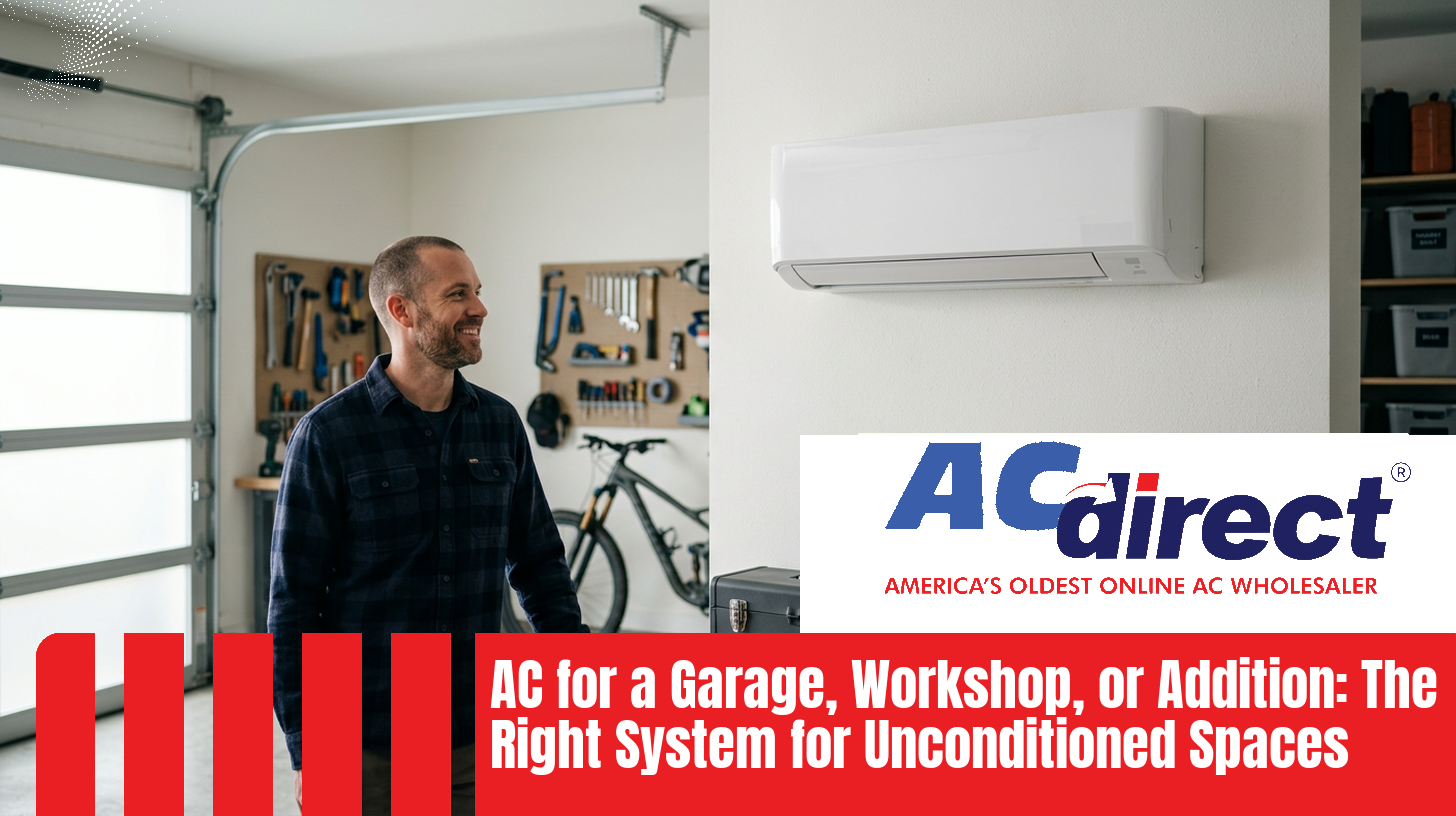
Your garage hits 130°F in July. Your sunroom addition freezes by November. A single-zone mini-split fixes both problems for less than you think.
There is a room in your house that your central HVAC system pretends does not exist. Maybe it is the detached garage where you tinker on weekends. Maybe it is the bonus room above the garage that bakes in summer. Maybe it is the sunroom addition that seemed like a great idea until January arrived and the space became uninhabitable. Whatever the room, the problem is always the same: it is not connected to your ductwork, so it is either brutally hot or painfully cold, and you have been dealing with it by running a portable AC unit, a space heater, or just avoiding the room entirely for half the year.
That is an incredibly common situation, and it has a straightforward fix. A single-zone mini-split can heat and cool one room independently, without ductwork, without tearing open walls, and without overloading your existing HVAC system. These units are the single most popular solution on contractor forums and homeowner communities for exactly this scenario.
This guide covers everything you need to know: how to size the system, what insulation matters, what it actually costs to run, and which models make sense for garages, workshops, and additions in 2026.
When a room is not connected to your home's ductwork, you have a handful of options: a window unit, a portable AC, extending your existing ductwork, or a mini-split. Here is why mini-splits win for garages, workshops, and additions almost every time:
Running new ducts from your central system to a detached garage or a room addition is expensive, invasive, and often impractical. It can also overtax your existing system, leaving every room in the house slightly less comfortable. A mini-split needs only a small hole in the wall (about 3 inches) for the refrigerant lines and wiring. That is it.
A mini-split heat pump does not just cool. It reverses direction in winter and heats the space too. For a garage workshop, this means one purchase solves both your July sweat problem and your January frozen-fingers problem.
You are only conditioning the space you are actually using. Your garage mini-split runs when you are out there working and shuts off when you are not. You are not paying to cool or heat 2,000 square feet of house just to make 400 square feet of garage comfortable.
This matters more than people expect, especially in workshops. Most modern mini-split indoor units operate between 19 and 32 decibels, which is quieter than a library. Compare that to a window unit rattling away at 50+ decibels while you are trying to concentrate on a table saw cut.
This is the part that nobody wants to hear, but it is the single most important factor in whether your mini-split works well or wastes electricity. An uninsulated garage is essentially an outdoor space with a roof. Pumping conditioned air into it without insulation is like running a garden hose into a bucket with no bottom.
You do not need to turn your garage into a sealed laboratory. But some basic steps make a dramatic difference:
- Insulate the walls. Standard R-13 fiberglass batts in 2x4 stud walls are affordable and straightforward for a weekend project.
- Insulate the ceiling. Heat rises. If you have an uninsulated garage ceiling (especially with attic space above), you are losing a huge amount of energy upward.
- Seal the garage door. The garage door is the biggest energy hole. An insulated garage door, or even a retrofit insulation kit for your existing door, makes a noticeable difference. Weather stripping around the edges helps too.
- Seal gaps and cracks. Foam sealant around pipes, wiring penetrations, and the gap between the sill plate and foundation stops air leaks.
For sunroom additions and bonus rooms, the insulation situation is usually better since these spaces were typically built with at least some insulation. But it is worth checking, especially in older additions.
Sizing is where most people either overthink it or get bad advice. The goal is to match the unit's BTU capacity to the actual cooling and heating load of your specific space. Too small and the unit runs constantly without reaching your target temperature. Too big and it "short-cycles," turning on and off rapidly, which wastes energy, creates uneven temperatures, and wears out the compressor faster.
| Space Size | Starting BTU Range | Common Applications |
|---|---|---|
| 150 to 300 sq ft | 9,000 BTU | Small workshop, home office addition, sunroom |
| 300 to 500 sq ft | 12,000 BTU | Single-car garage, medium workshop, large bonus room |
| 500 to 700 sq ft | 18,000 BTU | Two-car garage, large workshop, in-law suite addition |
| 700 to 1,000 sq ft | 24,000 BTU | Oversized garage, commercial workshop, large addition |
| 1,000 to 1,400 sq ft | 36,000 BTU | Three-car garage, large commercial workspace |
These are starting points. Adjust upward for poor insulation, high ceilings, large windows, hot climates, or heat-generating equipment. Adjust downward for well-insulated spaces in moderate climates. Our detailed mini-split sizing guide walks through the calculation step by step.
A bare-bones square footage estimate is just the starting point. Several factors common in garages and workshops mean you may need more capacity than a normal room of the same size:
- Poor or no insulation. An uninsulated metal garage needs significantly more cooling power than an insulated one. This can easily add 30 to 50% to your BTU requirement.
- High ceilings. Many garages have 10 to 12 foot ceilings. More air volume means more BTUs needed.
- Large garage door. Even when closed, a garage door is a massive surface area with relatively poor insulation. Opening it regularly during the day makes things worse.
- Heat-generating equipment. Welders, kilns, grow lights, server racks, and even multiple power tools add heat load to the space.
- Direct sun exposure. A south-facing or west-facing garage wall that bakes in afternoon sun adds significant heat gain.
- Climate zone. A garage in Phoenix needs more cooling capacity than the same garage in Portland.
A surprisingly common piece of bad advice is "just get the biggest unit you can afford so it cools down faster." This sounds logical but actually creates problems. An oversized mini-split cools the space down so quickly that it shuts off before it has properly dehumidified the air. The result is a clammy, damp-feeling space that never quite feels right. It also causes the compressor to cycle on and off more frequently, which shortens the life of the equipment.
Modern inverter-driven mini-splits handle this better than older fixed-speed units because they can ramp down to low output rather than cycling off entirely. But proper sizing still matters. If you are uncertain, our sizing guide has you covered.
One of the biggest fears homeowners have about adding a mini-split to a garage is the electricity bill. That is a fair concern. But the reality is better than most people expect, especially if the system is properly sized and the space has some insulation.
Mini-split efficiency is measured in SEER2 (Seasonal Energy Efficiency Ratio 2) for cooling and HSPF2 (Heating Seasonal Performance Factor 2) for heating. As of 2025, the federal minimum for new residential single-zone mini-splits is a SEER2 of 15.2, but many units available today range from 17 to 22+ SEER2. Higher numbers mean lower operating costs.
| Cooling Method | Est. Monthly Cost (Summer) | Notes |
|---|---|---|
| Mini-Split (18 SEER2) | $30 to $55 | Most efficient option |
| Mini-Split (15.2 SEER2) | $40 to $65 | Federal minimum efficiency |
| Window Unit (12 EER) | $55 to $85 | Common budget choice |
| Portable AC Unit | $75 to $120 | Least efficient; single-hose models worst |
| Electric Space Heater (Winter) | $90 to $160 | COP of 1.0, always |
| Mini-Split Heat Mode (Winter) | $35 to $70 | COP of 2.0 to 3.5 depending on temp |
Based on U.S. average residential electricity rate of approximately $0.16/kWh. Rates vary significantly by state. Check your utility bill for your actual rate. Source: U.S. Department of Energy.
The heating comparison is where mini-splits really shine. If you are currently heating your garage with a plug-in electric space heater, you are getting exactly 1 unit of heat for every 1 unit of electricity (a COP of 1.0). A mini-split heat pump delivers 2 to 3.5 units of heat for every 1 unit of electricity, depending on the outdoor temperature. That is 2 to 3.5 times more heat for the same electric bill.
Not every mini-split is built the same way. For garages, workshops, and additions, a few features matter more than they would in a standard bedroom installation.
This is non-negotiable in 2026. An inverter compressor adjusts its speed to match the demand rather than cycling fully on and off. In a garage that might swing from 60°F in the morning to 100°F by afternoon, the ability to ramp up and down smoothly means better comfort and lower bills. All of the units AC Direct carries in the current lineup use inverter technology.
If you plan to use the space in winter, make sure the unit is a heat pump, not cooling-only. Most modern mini-splits are heat pumps by default, but always confirm. If you are in a cold climate where winter temperatures regularly drop below 15°F, look for models rated for low-ambient heating. These use vapor injection or enhanced compressor designs to maintain meaningful heat output in seriously cold weather. Our article on modern heat pump technology goes deeper on this.
Garages and workshops expose equipment to dust, sawdust, chemicals, and temperature swings that a bedroom unit never sees. Some manufacturers offer coated coils (sometimes called "Blue Fin" or "Gold Fin") that resist corrosion better. This is a worthwhile feature for any shop environment.
Being able to turn on the mini-split from your phone 30 minutes before you head out to the garage is genuinely useful. Many current models include Wi-Fi connectivity and app control. Some integrate with smart home platforms. For a detached garage, this means you can pre-cool or pre-heat the space without walking out there first.
This is one of the most debated topics on every homeowner forum. Here is an honest breakdown.
A licensed HVAC contractor will mount the indoor and outdoor units, run and connect the refrigerant lines, perform a vacuum and leak test, charge the system with refrigerant (if needed), and handle the electrical connections. Total installation cost for a single-zone mini-split typically runs $800 to $2,500, depending on complexity, line set length, and whether new electrical work is needed.
Some mini-split systems come with pre-charged line sets, meaning the refrigerant is already sealed inside the lines and you do not need specialized tools or an EPA certification to handle it. For a handy homeowner, mounting the units and running the lines is very doable. The part that trips people up is the electrical work. Most mini-splits require a dedicated 220V or 240V circuit with a disconnect box. If that circuit does not already exist in your garage, you need a licensed electrician to run one. This is not optional - it is a safety and code requirement.
Indoor unit goes high on an interior wall, typically 7 feet or higher. Outdoor unit sits on a pad or wall bracket outside, ideally in shade and away from debris. Keep the line set run as short as possible.
A dedicated circuit (typically 20 to 30 amp, 240V) from your panel to the outdoor unit, with a disconnect box. Hire an electrician if this is not already in place.
A 3-inch hole through the wall for the refrigerant lines, drain hose, and communication wire. Angle slightly downward toward the outside for drainage.
Connect the line sets between indoor and outdoor units, make electrical connections, and test the system. Pre-charged systems simplify this step significantly. Systems that are not pre-charged require a vacuum pump and manifold gauges.
Here is what a complete single-zone mini-split project typically costs in 2026, from equipment through installation. AC Direct's wholesale pricing can save you significantly on the equipment side compared to buying through a contractor's markup.
| Component | Budget Range | Mid-Range | Premium |
|---|---|---|---|
| Equipment (unit + line set) | $1,200 - $1,800 | $1,800 - $2,800 | $2,800 - $4,000 |
| Professional Installation | $800 - $1,200 | $1,200 - $1,800 | $1,800 - $2,500 |
| Electrical (if new circuit needed) | $300 - $600 | $300 - $600 | $300 - $600 |
| Total Before Incentives | $2,300 - $3,600 | $3,300 - $5,200 | $4,900 - $7,100 |
The Inflation Reduction Act provides a federal tax credit of up to 30% of total project cost (equipment + installation), capped at $2,000 per year for qualifying heat pump systems. That can knock $1,000 to $2,000 off your total. Many states and local utilities offer additional rebates that stack on top of the federal credit.
To find out exactly what is available in your area, the Database of State Incentives for Renewables and Efficiency (DSIRE) is the most comprehensive resource. AC Direct also maintains a rebate page with current details on qualifying equipment.
When you shop for a mini-split, you will see several efficiency ratings on the spec sheet. Here is what they mean in plain language, so you can compare models without needing an engineering degree.
| Rating | What It Measures | 2026 Federal Minimum | Good Target |
|---|---|---|---|
| SEER2 | Seasonal cooling efficiency (whole summer average) | 15.2 | 17 to 22+ |
| EER2 | Cooling efficiency at peak conditions (95°F day) | 12.0 | 13 to 15+ |
| HSPF2 | Seasonal heating efficiency (whole winter average) | 8.0 | 9.0 to 11+ |
Higher numbers always mean more efficient. A unit with SEER2 of 20 will cost roughly 25% less to operate per year in cooling mode than a unit with SEER2 of 15.2, all else being equal. Source: U.S. Department of Energy.
The HVAC industry is transitioning away from R-410A refrigerant to lower-impact alternatives like R-32 and R-454B. As of 2025, new equipment is required to use these newer refrigerants. This is actually good news for buyers: R-32 and R-454B systems tend to be slightly more efficient, and you will not be stuck with a system that uses a refrigerant being phased out. Every current-production unit at AC Direct complies with the new standards.
Yes, with the right model. A standard mini-split heat pump works well for heating down to roughly 20 to 25°F. Below that, heating capacity drops and you may need supplemental heat. If you live in a climate where winter temperatures regularly hit single digits or below, look for cold-climate rated models that maintain meaningful heat output to -13°F or even -22°F.
For a deeper dive on cold-weather heat pump performance, including efficiency data by temperature, check our guide on heat pumps in winter and our hybrid heat pump breakdown.
Mini-splits are low maintenance, but "low" does not mean "zero." A few simple habits keep the system running efficiently for its full lifespan:
- Clean the indoor unit filters every 2 to 4 weeks. Most models have washable filters that slide out easily. In a dusty garage or workshop, clean them more often.
- Keep the outdoor unit clear. Remove leaves, snow, or debris from around the condenser. Maintain at least 12 inches of clearance on all sides.
- Check the condensate drain. A clogged drain line causes water to back up and potentially drip inside. Flush it once a season with diluted vinegar.
- Schedule a professional checkup once a year. A technician can check refrigerant levels, clean the coils, and inspect electrical connections. This is especially worthwhile in shop environments with more dust and particulates.
If you have a garage, workshop, sunroom, or addition that your central HVAC cannot reach, a single-zone mini-split is the most practical, efficient, and cost-effective way to make that space comfortable year-round. The technology is mature, the efficiency numbers are strong, and current federal incentives make the math better than it has ever been.
Start with insulation. Size the unit properly. Buy at wholesale and skip the contractor markup on equipment. That is the formula for a comfortable garage without a painful electric bill.
AC Direct carries single-zone mini-split systems from top manufacturers at wholesale prices. No middleman markup. Ships nationwide to your door or your contractor's shop.