 and now, NASCAR Racing Sponsor


Mini-Split vs. Window AC: When the Cheaper Option Actually Costs More
-
 By
Michael Haines
By
Michael Haines
- Mar 15, 2026
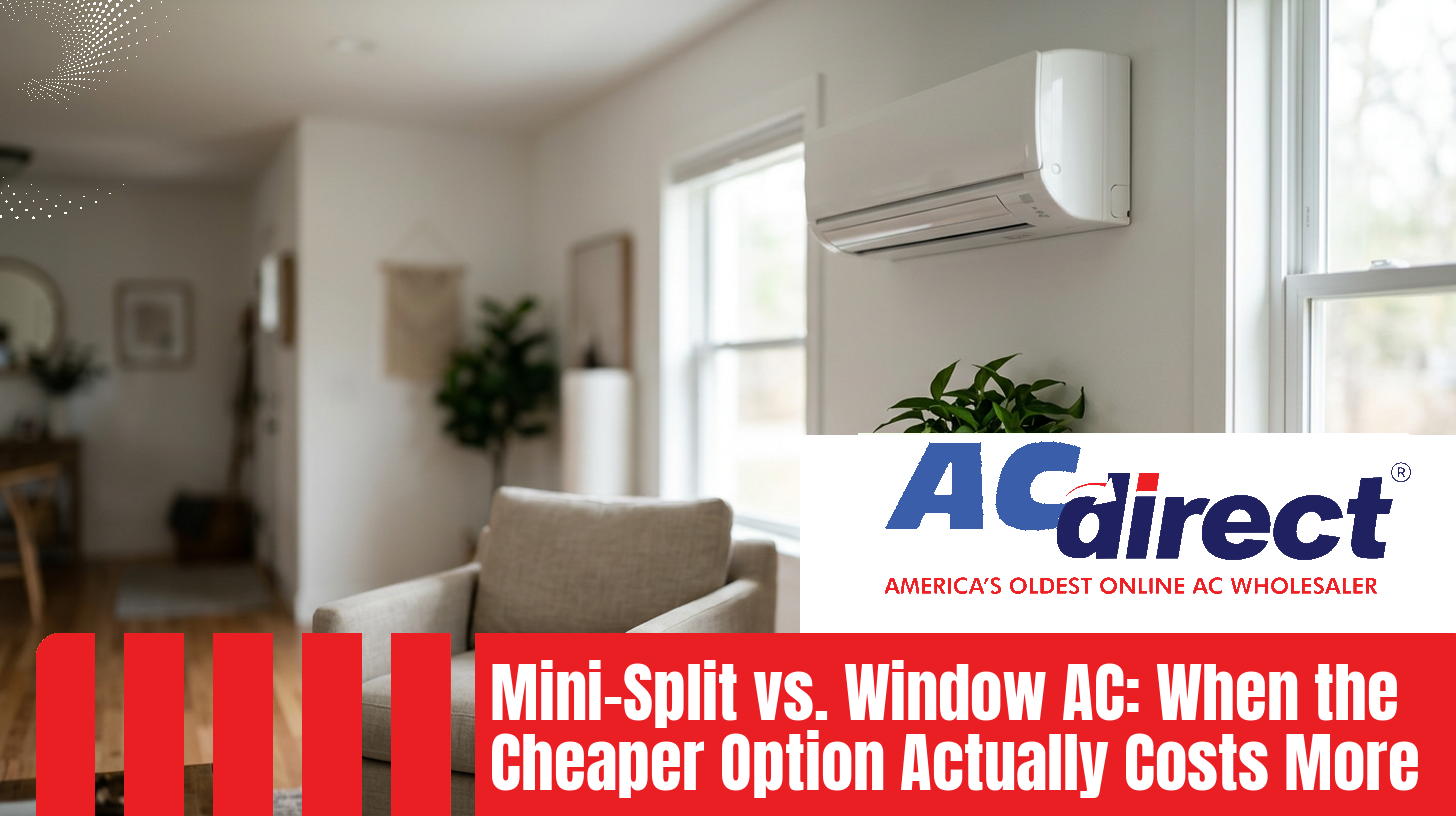
The $400 window unit looks like a bargain until you run the numbers over five years. Here's the real math on upfront cost, efficiency, comfort, and what you actually end up paying.
Somewhere right now, a homeowner is staring at two browser tabs. One has a $350 window AC unit from a big-box store. The other has a $2,800 mini-split system. The window unit is in the cart. The mini-split tab is about to get closed. And honestly, that decision might end up costing them thousands of dollars more over the next several years. Not because the window AC is a bad product. It does exactly what it promises. But because the real price of cooling a room is not the number on the receipt. It is the number on every electric bill for the next five, eight, or ten summers.
This article is the comparison we wish someone had written for every Reddit thread where budget-conscious homeowners are trying to figure out the right call. We are going to lay out real numbers: equipment cost, energy cost, comfort differences, lifespan, noise, resale value, and the federal incentives that can change the math dramatically. No brand wars. Just data.
If you already know you want a mini-split, our sizing guide will help you pick the right one. If you are still on the fence, keep reading.
Before we get into cost, let's make sure we are comparing the same thing. A window AC and a mini-split both cool rooms. But they do it very differently, and those differences affect everything from your electric bill to how well you sleep at night.
A window air conditioner is a self-contained box that sits in your window frame. It pulls warm indoor air across a refrigerant coil, absorbs the heat, and dumps it outside. The compressor, fan, coils, and controls are all in one unit. Installation is simple: open window, insert unit, plug it in. That simplicity is its biggest selling point.
The trade-off? Window ACs are single-speed machines. The compressor is either running at full blast or it is off. That cycling between on and off creates temperature swings, noise spikes, and wasted energy every time the compressor kicks back on.
A mini-split (also called a ductless system) separates the noisy, hot parts from the quiet, cool parts. The compressor and condenser sit outside. A slim indoor air handler mounts on the wall, ceiling, or floor inside. The two are connected by a small refrigerant line that runs through a 3-inch hole in the wall. No window blockage. No ductwork needed.
Most mini-splits use inverter technology, which means the compressor runs at variable speeds instead of cycling on and off. Think of it like cruise control versus slamming between the gas pedal and the brake. The result is more consistent temperature, lower energy use, and dramatically less noise.
One more thing: almost every mini-split is a heat pump. That means it cools in summer and heats in winter. A window AC does one job. A mini-split does two.
Let's not pretend this is close. If all you have is $400 and you need cold air tonight, a window unit is the answer. Nobody is arguing that point.
| System Type | Equipment Cost | Installation Cost | Total |
|---|---|---|---|
| Window AC (5,000-12,000 BTU) | $150 - $800 | $0 (DIY) | $150 - $800 |
| Single-Zone Mini-Split | $800 - $2,500 | $500 - $2,500 | $1,500 - $5,000 |
| Multi-Zone Mini-Split (2-4 rooms) | $2,000 - $8,000 | $2,000 - $7,000 | $4,000 - $15,000+ |
The average window AC purchase is around $400. The average single-zone mini-split installation lands around $3,000. That is a $2,600 gap on day one. For a lot of people, the conversation stops here. But it shouldn't, because this is where the cheaper option starts getting expensive.
This is where the math flips. Efficiency is measured in SEER (Seasonal Energy Efficiency Ratio) for seasonal performance and EER (Energy Efficiency Ratio) for performance at a specific temperature. Higher numbers mean less electricity for the same cooling output.
SEER and EER are not directly interchangeable, but for comparison purposes, a window AC at 8-12 EER is roughly equivalent to 8-12 SEER. A mid-range mini-split at 20 SEER uses about 40-60% less electricity for the same cooling output.
What does that efficiency gap look like in dollars? Let's use the national average electricity rate of $0.17 per kWh, running 8 hours a day for 4 months (a typical cooling season).
And remember: the mini-split also heats. If you currently use electric space heaters, baseboard heat, or a fuel-fired system to heat even one room, the mini-split's heating capability can save hundreds more per year. That is a savings category where the window AC contributes exactly zero.
This is the number that actually matters. Not what you pay at the register. What you pay, total, over the realistic life of the equipment.
| Cost Category | Window AC | Mini-Split |
|---|---|---|
| Equipment + Installation | $400 | $3,000 |
| Annual Energy (Cooling Only) | $130/yr | $90/yr |
| Lifespan | 5-8 years | 15-20 years |
| Replacement Cost (10 yrs) | $400 (replace once) | $0 (still running) |
| Heating Savings (if applicable) | $0 | $200-$500/yr |
| Federal Tax Credit (30%, up to $2,000) | $0 | -$900 to -$2,000 |
| 10-Year Total (Cooling Only) | $2,100 | $1,900 - $2,100 |
| 10-Year Total (With Heating Savings) | $2,100+ | $900 - $1,500 |
These are estimates for a single-room comparison. Actual numbers depend on your climate zone, electricity rate, insulation quality, and usage patterns. The key takeaway: the gap narrows fast, and often reverses entirely once you factor in incentives and heating.
Even in the most conservative scenario - cooling only, no tax credits, low electricity rates - a mini-split roughly breaks even with a window AC over 10 years. The moment you add heating capability or claim the federal tax credit, the mini-split pulls ahead by a significant margin.
Money is important. But you also have to live with this thing every day. Here is where the two options diverge sharply.
A window AC typically runs between 50 and 60 decibels indoors. That is roughly the volume of a normal conversation. Some cheaper models push into the mid-60s, which is closer to a running dishwasher. Every time the compressor kicks on, there is a noticeable sound spike.
A mini-split's indoor unit runs between 19 and 40 decibels on low settings. Nineteen decibels is quieter than a whisper. The compressor is outside, so you hear almost nothing indoors. For bedrooms, nurseries, home offices, or anywhere you care about quiet, the difference is night and day.
Window ACs cycle on and off. The room gets cold, the compressor shuts down, the room warms up, the compressor kicks back on. You get temperature swings of 3 to 5 degrees through the day. Mini-splits with inverter compressors hold temperature within about 1 degree of your setpoint by continuously adjusting output. Less sweat. Less reaching for a blanket. Less arguing about the thermostat.
A window AC blocks your window. Permanently, for the season. It blocks natural light, looks bulky from outside, and some HOAs or landlords do not allow them at all. A mini-split's indoor unit mounts high on the wall (or on the ceiling, or as a floor console) and requires only a 3-inch hole to the outside. Your windows stay fully usable.
A window AC means your window cannot fully close or lock for the entire cooling season. That is a real concern for ground-floor apartments and homes. A mini-split does not affect your window locks at all.
A window air conditioner typically lasts 5 to 8 years. Some die sooner. Very few make it past 10. The compressor and other components are built to a lower durability standard because the price point demands it.
A properly installed and maintained mini-split lasts 15 to 20 years. Some last longer. That means in the time you go through two or three window units, one mini-split is still running. Every replacement window AC costs another $300 to $800 and a trip to the store. The mini-split just needs a filter cleaning every few weeks and an occasional professional checkup.
The Inflation Reduction Act created a significant financial incentive for heat pump systems, which includes most mini-splits. Window ACs do not qualify for these credits. That is a major advantage that many homeowners are not aware of.
For a $3,000 mini-split installation, the federal tax credit alone can put $900 back in your pocket. Stack a state rebate on top and the effective cost drops to $1,500 or less. Suddenly that "$2,600 gap" between a window unit and a mini-split is under $1,000, and the mini-split pays it back through energy savings in a few years. For current rebate details and eligible models, visit the AC Direct rebate page.
We are not here to tell you a window AC is never the answer. There are real situations where it makes more sense:
- You are renting. If you cannot modify the building (or do not want to invest in someone else's property), a window unit is the practical choice.
- You need cooling for one summer only. Temporary housing, a single brutal season, a room you are about to renovate - a window AC handles short-term needs well.
- Your budget is truly limited right now. If $400 is what you have and heat-related discomfort is affecting your health, buy the window unit. Comfort now matters. You can upgrade later.
- You are cooling a space you rarely use. A guest room that sees action two weeks a year does not justify a $3,000 installation.
For everyone else - homeowners cooling rooms they use daily, people who also need heating, anyone staying in their home for three or more years - the mini-split is almost always the better financial and comfort decision once you look at the full picture.
BTU tells you how much cooling capacity a unit has. It does not tell you how efficiently it delivers that cooling. A 12,000 BTU window AC at 8 EER and a 12,000 BTU mini-split at 20 SEER both cool the same space, but the mini-split uses roughly 60% less electricity doing it. Always look at SEER or EER alongside BTU.
Bigger is not better. An oversized AC cools the room quickly but shuts off before it removes enough humidity. The result: a cold, clammy room that feels uncomfortable. Match the unit to the room. Our sizing guide walks through the calculation.
Handling refrigerant requires EPA certification. Improper electrical work is a safety hazard. And most manufacturers will void your warranty if the unit was not installed by a licensed professional. The savings from DIY can evaporate fast if something goes wrong.
Neither a window AC nor a mini-split can overcome terrible insulation. If your room is poorly sealed, fix the leaks first. A $50 roll of weatherstripping can make a $400 window AC perform noticeably better, and it makes a mini-split even more efficient.
Whether you go window AC or mini-split, getting the right size for your room is critical. Here is a rough starting point based on room square footage:
| Room Size | BTU Needed | Window AC Option | Mini-Split Option |
|---|---|---|---|
| 150 - 250 sq ft | 6,000 BTU | Small window unit | 9,000 BTU mini-split (oversized slightly for efficiency) |
| 250 - 400 sq ft | 8,000 - 10,000 BTU | Medium window unit | 9,000 - 12,000 BTU mini-split |
| 400 - 550 sq ft | 12,000 BTU | Large window unit | 12,000 BTU mini-split |
| 550 - 800 sq ft | 14,000 - 18,000 BTU | XL window unit (limited options) | 18,000 BTU mini-split |
| 800 - 1,200 sq ft | 18,000 - 24,000 BTU | Not practical with window units | 24,000 BTU mini-split or multi-zone |
For spaces over 600 sq ft, window ACs start struggling. This is where mini-splits or multi-zone systems become not just more efficient but the only realistic option.
If you are a homeowner who plans to stay in your home for three or more years, cools (or heats) a room you use regularly, and wants lower long-term costs with better comfort - a mini-split is the better investment. The federal tax credit and state rebates make the upfront gap smaller than most people assume, and the efficiency savings accumulate every single month.
If you are renting, in a temporary situation, or genuinely need the lowest possible cost today - a window AC still makes sense. No judgment. Get cool, stay safe, and upgrade when the time is right.
A $400 window AC is not cheap if you are replacing it every five years, paying 40 to 60% more for electricity every month, missing out on $2,000 in tax credits, and getting no heating value from it. The cheaper option on the receipt is often the more expensive option to own. Run the numbers for your situation - the math usually speaks for itself.
AC Direct sells mini-split systems at wholesale prices - the same equipment contractors install, without the contractor markup. Single-zone, multi-zone, wall-mount, ceiling cassette, and floor console options from major manufacturers. Ships nationwide.