 and now, NASCAR Racing Sponsor


Multi-Zone Mini-Split Systems: How to Cool (and Heat) Your Whole Home Without Ducts
-
 By
Michael Haines
By
Michael Haines
- Mar 16, 2026
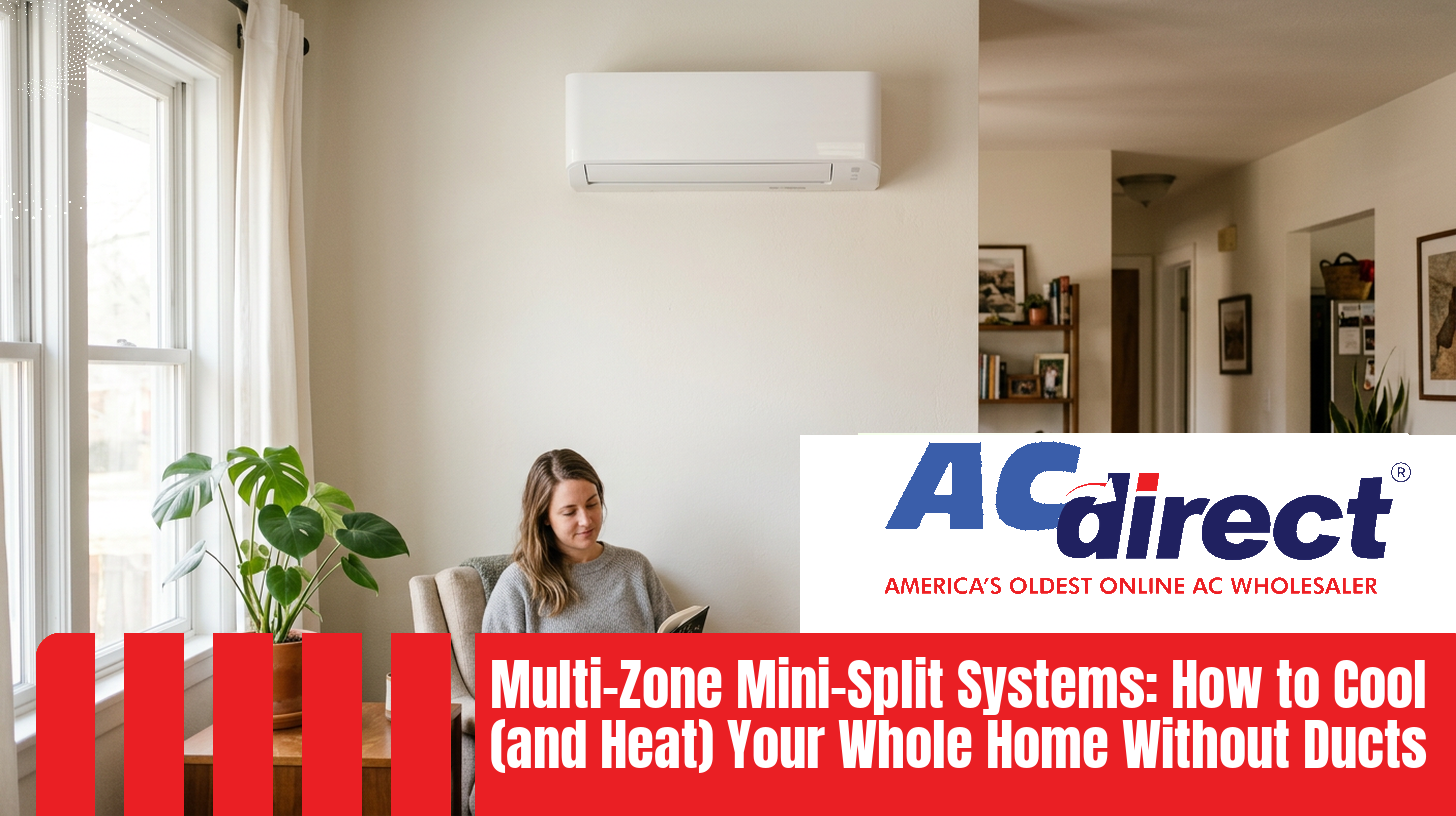
No ductwork? No problem. Here's how thousands of homeowners are ditching window units and space heaters for room-by-room climate control that actually works.
Somewhere on Reddit right now, a homeowner is posting some version of the same question: "My house has no ductwork. What are my options?" Maybe it's a 1920s bungalow that was built before central air existed. Maybe it's a converted garage, a finished attic, or a sunroom addition that the original HVAC system was never designed to reach. The answer used to be window units in the summer and space heaters in the winter. That answer was always uncomfortable, inefficient, and sometimes dangerous.
Today the answer is a multi-zone mini-split system. One outdoor unit, multiple indoor units, individual temperature control in every room, and not a single inch of ductwork required. These systems have moved well past the "niche product" stage. The global ductless HVAC market is projected to exceed $45 billion by 2026, and a huge share of that growth is residential homeowners solving the exact problem you might be dealing with right now.
This guide covers how multi-zone mini-splits actually work, what they cost, how to size them, and what to watch out for. Real numbers, no sales pitch.
A mini-split is an air conditioning and heating system with two main components: an outdoor unit (the compressor/condenser) and one or more indoor units (the air handlers). They're connected by a thin bundle of refrigerant lines, electrical wiring, and a condensate drain - collectively called the "line set" - that runs through a small 3-inch hole in your wall. No ducts, no dropped ceilings, no major renovation.
A single-zone system connects one outdoor unit to one indoor unit. It conditions one room.
A multi-zone system connects one outdoor unit to multiple indoor units - typically two to five. Each indoor unit operates independently with its own thermostat or remote. You can keep the bedroom at 68°F while the living room runs at 74°F. One person's comfort preference doesn't override anyone else's.
And here's the part that still surprises people: these are not just cooling systems. Every modern mini-split is a heat pump. It cools in summer by extracting heat from inside your home and pushing it out. In winter, it reverses - pulling heat from the outdoor air and moving it in. Cold-climate models can do this effectively even at temperatures as low as -13°F.
You don't need an engineering degree to understand the basics. A mini-split moves heat rather than generating it. That single difference is why it's so much more efficient than a furnace or space heater.
In cooling mode, the indoor unit blows room air across a coil filled with cold refrigerant. The refrigerant absorbs the heat and evaporates into a gas.
The outdoor unit compresses the refrigerant gas, raising its temperature significantly. This is where the system's electricity goes - powering the compressor.
The hot, pressurized gas passes through the outdoor coil where a fan blows ambient air across it, carrying the heat away. The refrigerant cools and turns back into a liquid.
An expansion valve drops the refrigerant's pressure and temperature back down, and it flows back to the indoor units to absorb more heat. In heating mode, the entire process runs in reverse.
Older HVAC systems ran at one speed: full blast. They cycled on, blasted cold air until the thermostat was satisfied, then shut off completely. This constant on-off cycling wastes energy and creates temperature swings.
Modern mini-splits use inverter-driven compressors, which operate like a dimmer switch instead of a light switch. The compressor adjusts its speed continuously to match exactly how much heating or cooling each room needs. It ramps up during a hot afternoon and coasts at minimal output overnight. The result is tighter temperature control, quieter operation, and significantly lower electricity bills.
These systems aren't limited to one type of homeowner. But certain situations make them an especially strong fit:
- Homes without existing ductwork. Older homes, historic properties, and many post-war builds were designed for radiators or baseboard heat. Installing ductwork after the fact is invasive and expensive - often $10,000 or more. A mini-split skips all of that.
- Home additions and converted spaces. Sunrooms, finished basements, attic conversions, above-garage apartments, and ADUs (accessory dwelling units) frequently have no connection to the main HVAC system. A mini-split solves this without overloading your existing equipment.
- Rooms that are always too hot or too cold. That one bedroom that bakes in the afternoon sun? The bonus room over the garage that's freezing in winter? A mini-split provides targeted relief without reworking your whole system.
- Homeowners replacing window units. Window ACs are loud, inefficient, block your view, and create security vulnerabilities. A mini-split replaces all of them with a single permanent system.
- Workshops, garages, and outbuildings. Any space where running ductwork from your main system isn't practical or possible.
This is where real numbers matter more than marketing claims. Mini-split efficiency is measured by two ratings:
- SEER2 (Seasonal Energy Efficiency Ratio) - measures cooling efficiency. Higher is better.
- HSPF2 (Heating Seasonal Performance Factor) - measures heating efficiency. Higher is better.
According to the U.S. Department of Energy, ductless mini-splits can save homeowners 30% or more on energy bills compared to window units or electric resistance heating, particularly in older homes. The savings come from three places: inverter efficiency, zero duct losses (traditional ducted systems lose 25-30% of conditioned air through leaky ducts), and room-by-room control that means you're not heating or cooling empty rooms.
| System Type | Typical SEER2 Range | Est. Annual Energy Cost | Duct Losses |
|---|---|---|---|
| Window AC + Space Heaters | 8 - 12 | $2,400 - $3,200 | N/A |
| Older Central AC (10+ years) | 10 - 13 | $1,600 - $2,200 | 25 - 30% lost |
| New Standard Central System | 14 - 16 | $1,200 - $1,700 | 15 - 25% lost |
| Multi-Zone Mini-Split | 18 - 23+ | $800 - $1,300 | 0% - No ducts |
Energy cost estimates assume average U.S. electricity rates. Actual savings depend on your local utility rates, home insulation, and usage patterns. Homes in high-rate areas (Northeast, California) will see even larger differences.
Let's talk real numbers. There's a wide range depending on how many zones you need, the efficiency level you choose, and installation complexity.
| Configuration | Typical Retail Range | Notes |
|---|---|---|
| Single Zone (1 indoor unit) | $2,000 - $5,000 installed | One room - garage, addition, bonus room |
| 2-Zone System | $4,500 - $8,000 installed | Two rooms with independent control |
| 3-Zone System | $6,000 - $10,000 installed | Common for mid-size homes without ducts |
| 4-5 Zone System | $8,000 - $12,000 installed | Whole-home coverage for larger spaces |
These are typical retail installed prices. When you buy equipment at wholesale through AC Direct and hire your own installer, the equipment cost drops significantly. You're paying for the install labor, not a contractor's markup on the hardware.
The Inflation Reduction Act made energy-efficient heat pumps - including mini-splits - significantly more affordable. Here's what's currently available:
For a 3-zone mini-split system that costs $7,000 in equipment and installation, a $2,000 federal tax credit plus a state or utility rebate can bring your effective cost down to the $4,000 - $5,000 range. That changes the payback math dramatically. Check the Database of State Incentives for Renewables & Efficiency (DSIRE) for rebates in your zip code, and visit the ENERGY STAR website to confirm which models qualify.
Getting the size right is the single most important decision in a mini-split installation. An oversized system short-cycles (turns on and off too frequently), wastes energy, and does a poor job controlling humidity. An undersized system runs constantly and can't keep up on the hottest or coldest days.
Mini-split capacity is measured in BTUs (British Thermal Units). Each indoor unit needs to be matched to its room size, and the outdoor unit needs enough total capacity to handle all the indoor units running simultaneously.
| Room Size | Estimated BTU Needed | Common Indoor Unit Size |
|---|---|---|
| 150 - 300 sq ft | 6,000 - 9,000 BTU | 9K unit |
| 300 - 500 sq ft | 9,000 - 12,000 BTU | 12K unit |
| 500 - 700 sq ft | 12,000 - 18,000 BTU | 18K unit |
| 700 - 1,000 sq ft | 18,000 - 24,000 BTU | 24K unit |
| 1,000 - 1,200 sq ft | 24,000 - 30,000 BTU | Consult sizing calc |
These are rough guidelines only. Your installer should perform a Manual J load calculation for precise sizing. Our mini-split sizing guide walks through the process in more detail.
Picture a 1,600 square-foot older home with no ductwork - three bedrooms, a living room, and a kitchen that opens to a dining area. Here's what a typical multi-zone design might look like:
One of the biggest concerns homeowners raise is aesthetics - "I don't want a big white box on my wall." Fair enough. But wall-mounted units are just one option. Multi-zone systems can mix and match different indoor unit styles across rooms:
- Wall-mounted: The most common and usually the most affordable. Mounted high on the wall, they distribute air across the room effectively. Modern designs are sleeker than they used to be.
- Ceiling cassette: Recessed into the ceiling with only a slim grille visible. Great for rooms where wall space is limited or you want a less visible installation.
- Floor-mounted: Sits near the floor, similar to a baseboard heater. Good for rooms with large windows or limited wall space.
- Slim ducted (concealed): Installed in a closet, attic space, or soffit and connected to short duct runs. The indoor unit is completely hidden. This option works well for homeowners who want the benefits of ductless efficiency with the invisible appearance of traditional vents.
Most multi-zone outdoor condensers can connect to any combination of these styles, so you can put a wall mount in the bedroom and a ceiling cassette in the living room on the same system.
This is one of the most common questions on Reddit, and the answer is encouraging. Modern mini-split indoor units typically operate at 19 to 32 decibels - roughly the sound level of a whisper to a quiet library. For comparison, a window AC unit runs at 50 to 60 decibels. The difference is dramatic, especially in bedrooms.
Outdoor units are louder - typically 45 to 55 decibels - but still quieter than most traditional condensers. Inverter-driven compressors help here too, since the unit runs at lower speeds most of the time rather than cycling on at full blast.
Mini-splits are sometimes marketed as "maintenance-free." That's not quite accurate. They're low-maintenance compared to a traditional furnace with ductwork, but they still need attention:
- Clean the filters every 2-4 weeks. The indoor unit filters are easily removable and washable. Dirty filters restrict airflow and kill efficiency. This is the single most important thing you can do.
- Clean the indoor coils annually. Dust and mold can accumulate on the evaporator coil inside the air handler. Many homeowners hire a professional for this once a year.
- Keep the outdoor unit clear. Maintain at least two feet of clearance around the condenser. Remove leaves, debris, and snow accumulation.
- Schedule a professional checkup annually. A qualified technician should check refrigerant levels, electrical connections, and overall system performance once a year.
If you've been researching mini-splits, you may have seen references to different refrigerants. Here's the short version:
R-410A has been the standard refrigerant in residential HVAC for two decades. The EPA is phasing down production of HFC refrigerants like R-410A due to their high global warming potential. This doesn't mean your R-410A system will stop working or become illegal - it means R-410A will gradually become more expensive as supply tightens.
R-32 is the next-generation refrigerant already appearing in many new mini-split models. It has about one-third the global warming potential of R-410A and is slightly more energy efficient. If you're buying a new system today, choosing an R-32 model (where available) is a smart long-term play.
Don't panic about this transition. Both refrigerant types are available and supported. Just be aware that the industry is moving toward R-32 and newer alternatives, and buying a current-generation system puts you on the right side of that shift.
Another common Reddit question: "Can I install it myself?" The honest answer is that you should not, unless you are a licensed HVAC technician. Here's why:
- Refrigerant handling requires EPA Section 608 certification. It's federally illegal for uncertified individuals to purchase or handle HVAC refrigerants.
- Improper installation voids the warranty. Every manufacturer requires professional installation for warranty coverage.
- Line set brazing, vacuum pulling, and charge verification require specialized tools and training. A bad vacuum (meaning moisture or air left in the refrigerant lines) can destroy a compressor within a year.
- Electrical work must meet local code. Multi-zone systems often require a dedicated circuit and proper disconnect, which means permits in most jurisdictions.
The good news: buying your equipment wholesale from AC Direct and hiring a local installer separately is a proven approach. You get wholesale pricing on the hardware, your installer does what they do best, and you keep the full manufacturer warranty. Our complete mini-split buyer's guide covers how to find and vet a qualified installer.
Guessing at system size based on square footage alone leads to oversized or undersized equipment. Insist on a Manual J calculation from your installer.
Budget matters, but a bottom-tier unit with a SEER2 of 14 will cost you more in electricity over its lifetime than a mid-range unit at SEER2 18-20. Total cost of ownership is what counts.
If you live anywhere with a real winter, make sure the system's HSPF2 rating and low-ambient operating range match your climate. Not all mini-splits are built for cold weather.
An indoor head mounted directly above a couch will blast cold air on whoever sits there. Work with your installer on placement that distributes air evenly across the room.
Mini-split installation requires specific training. The Air Conditioning Contractors of America (ACCA) can help you find qualified professionals in your area.
AC Direct carries multi-zone mini-split systems across a range of sizes, efficiency levels, and price points. Whether you need a 2-zone system for a small home or a 5-zone setup for whole-house coverage, we stock the equipment and ship it directly to you or your contractor at wholesale pricing.
Not sure where to start? Our sizing guide and complete buyer's guide walk through every step of the selection process. You can also browse by zone count:
If your home doesn't have ductwork - or if your existing ducts are leaky, undersized, or just not reaching every room - a multi-zone mini-split system is the most efficient and practical solution available today. You get individual room control, both heating and cooling from a single system, efficiency ratings that dwarf traditional equipment, and an installation that doesn't require tearing open your walls or ceilings.
The technology is proven. The incentives are real. And buying at wholesale through AC Direct means you're not paying a contractor's markup on the hardware. The hardest part is choosing the right configuration - and that's what the guides, sizing tools, and support team at AC Direct are here to help with.
AC Direct offers wholesale pricing on multi-zone ductless systems from leading manufacturers. No contractor markup. Ships nationwide to your door or your installer's shop.