 and now, NASCAR Racing Sponsor


The Federal HVAC Tax Credit Expired in 2026: Here's What You Can Still Get
-
 By
Michael Haines
By
Michael Haines
- Mar 17, 2026
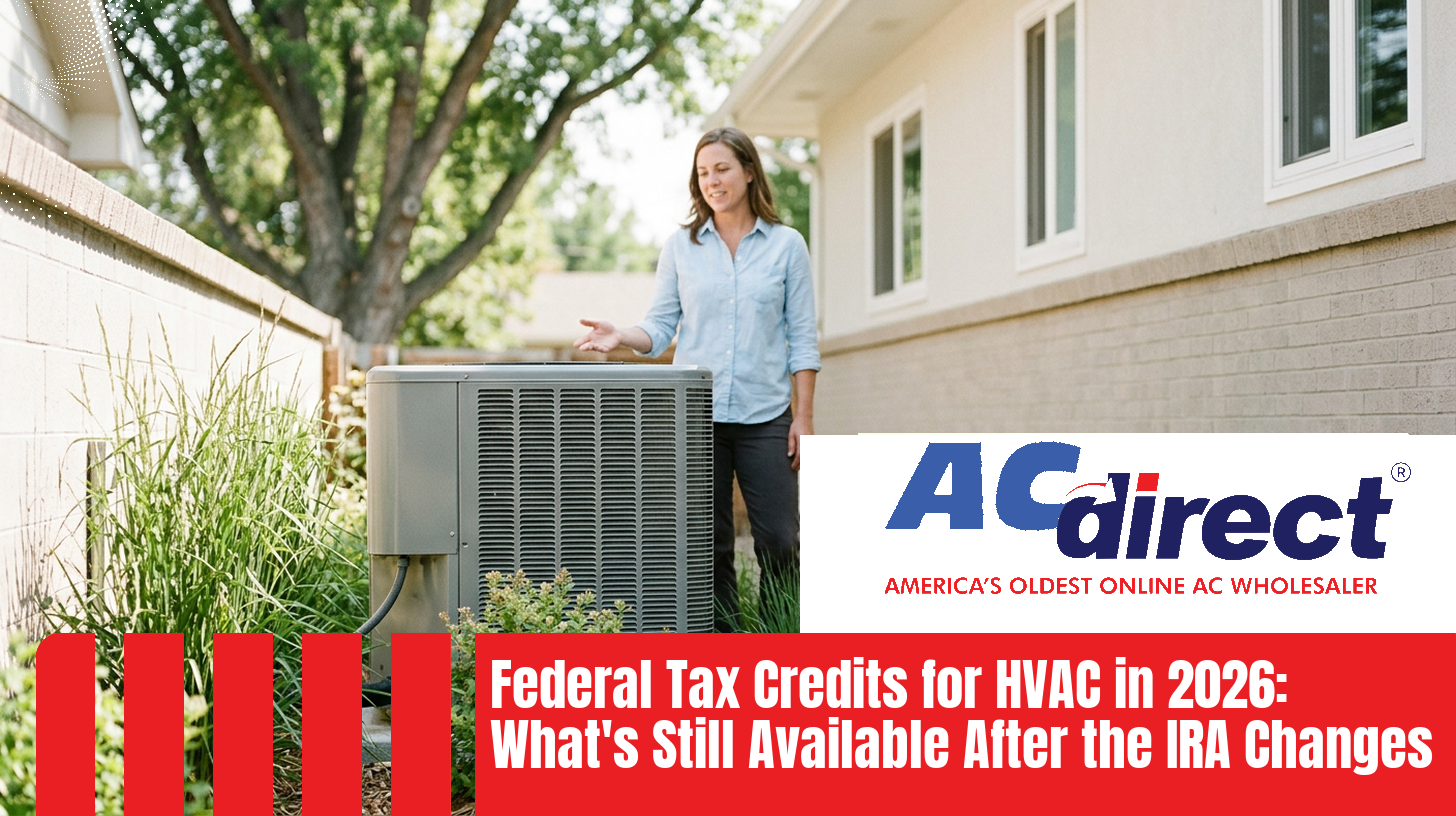
The rumor is true. The 25C and 25D federal credits ended for equipment placed in service after December 31, 2025. Here's the straight story, plus the savings that are still on the table.
Let's clear this up right away, because there is a lot of outdated information floating around: the federal HVAC tax credits are gone for 2026 installations. Not reduced. Not harder to claim. Gone. The One Big Beautiful Bill Act, signed into law on July 4, 2025, terminated the Energy Efficient Home Improvement Credit (Section 25C) and the Residential Clean Energy Credit (Section 25D) for any equipment placed in service after December 31, 2025.
If you've read a blog post (including on some very large HVAC websites) telling you these credits run "through 2032," you were reading an article written before the law changed. That 2032 end date was repealed. The IRS has confirmed it in plain language. Any site still promising you a $2,000 federal heat pump credit for a 2026 install is giving you information that can cost you real money at tax time.
We'd rather be the ones to tell you the truth: the federal credit is off the table this year. But that doesn't mean you're out of options. State rebate programs survived, utility rebates are still active, and the single biggest savings lever left, buying your equipment at wholesale instead of retail, never depended on the IRS in the first place. This guide covers all of it.
On July 4, 2025, the One Big Beautiful Bill Act (OBBBA, Public Law 119-21) was signed into law. Among many other provisions, it terminated the two federal tax credits that had been driving HVAC purchase decisions since the Inflation Reduction Act of 2022:
This was the credit most homeowners used: 30% of qualified costs, up to $2,000 per year for heat pumps and up to $1,200 for other improvements like central AC, furnaces, and insulation. Under OBBBA, it does not apply to any property placed in service after December 31, 2025.
This covered geothermal heat pumps, solar, and battery storage at 30% with no cap. Under OBBBA, it does not apply to expenditures made after December 31, 2025.
The IRS confirmed both terminations in Fact Sheet FS-2025-05, published August 21, 2025. A heat pump, air conditioner, or furnace installed in 2026 receives $0 in federal tax credits. There is no phase-out, no reduced rate, and no grandfathering for equipment ordered in 2025 but installed in 2026.
The federal tax credits are gone, but two categories of real money survived the rollback, and neither one requires waiting until tax season.
The Home Electrification and Appliance Rebates program (HEAR, called HEEHRA in older articles) was funded separately from the tax credits, and it was not terminated by OBBBA. These are point-of-sale rebates administered by individual state energy offices, meaning the discount is applied when you buy, not claimed on a tax return.
- Up to $8,000 for a qualifying heat pump, for income-eligible households (full rebates below 80% of area median income, partial rebates up to 150%)
- Up to $4,000 for an electrical panel upgrade and up to $1,600 for insulation and air sealing, where offered
- Administered state by state: some programs are live, some are paused, and some states never launched. Funding allocations fluctuate, and programs can suspend applications when a funding tranche runs out.
- Recent Department of Energy guidance has tightened the rules around fuel-switching projects (for example, replacing a gas furnace with an electric heat pump), so eligibility for that specific upgrade path varies by state and program status.
Your move: check your state energy office's website directly for current program status and income eligibility before you count on a HEAR rebate. Program status changes month to month.
Hundreds of electric and gas utilities run their own rebate programs for high-efficiency equipment, typically $100 to $2,000 depending on the utility and the equipment tier. These were never tied to federal law and continue as normal. The fastest way to find them is the DSIRE database: enter your zip code and it lists every active incentive in your area, including utility, city, and state programs.
Here's the part most coverage of the credit expiration misses. The federal credit was never the biggest number in the HVAC equation. It just felt that way because it arrived as a check. The biggest number has always been the spread between what contractors pay for equipment and what homeowners are charged for it at retail.
When you buy through a traditional retail install, the equipment is marked up, often substantially, before labor is ever added. Buying your system at distributor pricing through AC Direct and hiring a local licensed contractor for the installation removes that markup entirely. No IRS paperwork, no income eligibility, no waiting for a program to reopen. The savings show up in the purchase price.
| Cost Component | Retail Install | Wholesale + Your Installer |
|---|---|---|
| Equipment | Marked-up retail price | Distributor/wholesale price |
| Installation labor | Bundled, opaque | Quoted directly by your local contractor |
| Federal tax credit | $0 | $0 |
| Where the savings come from | Nowhere, you're waiting on programs | Upfront, in the purchase price |
With no federal credit to offset retail markup, the markup itself is the cost to attack. Wholesale purchasing routinely saves more than the old $2,000 credit ever did, and it applies to every buyer, at every income level, in every state.
The other 2026 economic argument has nothing to do with taxes. Under the AIM Act, production of R-410A, the refrigerant in most systems installed over the past two decades, is being phased down on a fixed federal schedule. New equipment now ships with next-generation refrigerants like R-32 and R-454B.
- If your current system runs R-410A, every year of the phase-down makes servicing it more expensive. A compressor failure or refrigerant leak on an aging R-410A system increasingly means an uncomfortable repair-versus-replace math problem, with the repair side getting worse.
- Upgrading to an R-32 or R-454B system in 2026 moves you onto the current technology cycle. You're insulated from R-410A supply tightening for the entire life of the new equipment.
The credit expiring doesn't pause the refrigerant transition. If anything, it sharpens the case for buying smart, at wholesale, rather than waiting for a federal incentive that is no longer coming back.
The old checklist was about tax filing. The 2026 checklist is about buying well. Four steps:
Go straight to your state energy office's website. Confirm the program is currently accepting applications, whether your household income qualifies (80% / 150% of area median income tiers), and whether your specific upgrade (especially a fuel-switching project) is eligible under current rules.
Five minutes on dsireusa.org shows every active local incentive. Utility rebates often require pre-approval or a specific efficiency tier, so read the fine print before you order equipment.
Choose an R-32 or R-454B system sized for your home and buy it at distributor pricing through AC Direct. This is the largest single savings lever available to every 2026 buyer: no program, paperwork, or income cap required.
A licensed local installer handles the refrigerant work, electrical connections, and permits. You keep the equipment savings and still get a professional, code-compliant install using the same equipment contractors buy, without the bundled markup.
The federal HVAC tax credits are over for 2026 installations. OBBBA (Public Law 119-21) ended Sections 25C and 25D for equipment placed in service after December 31, 2025, and IRS Fact Sheet FS-2025-05 confirms it. If your install was completed in 2025, claim your credit on your 2025 return with Form 5695. That is the last one.
For everyone buying in 2026, the savings didn't disappear. They moved. State HEAR rebates (where live) and local utility rebates still cut real dollars off qualifying projects. And the biggest lever is the one that never depended on Washington: buying your equipment at wholesale and hiring your own installer.
The real risk in 2026 isn't missing a credit that no longer exists. It's overpaying retail markup to offset a credit that isn't coming, or nursing an aging R-410A system while its service costs climb every year of the phase-down.
AC Direct ships next-generation R-32 and R-454B heat pump and AC systems nationwide at true wholesale pricing, the same equipment contractors buy from their distributors. Pair it with a local licensed installer and keep the difference.