

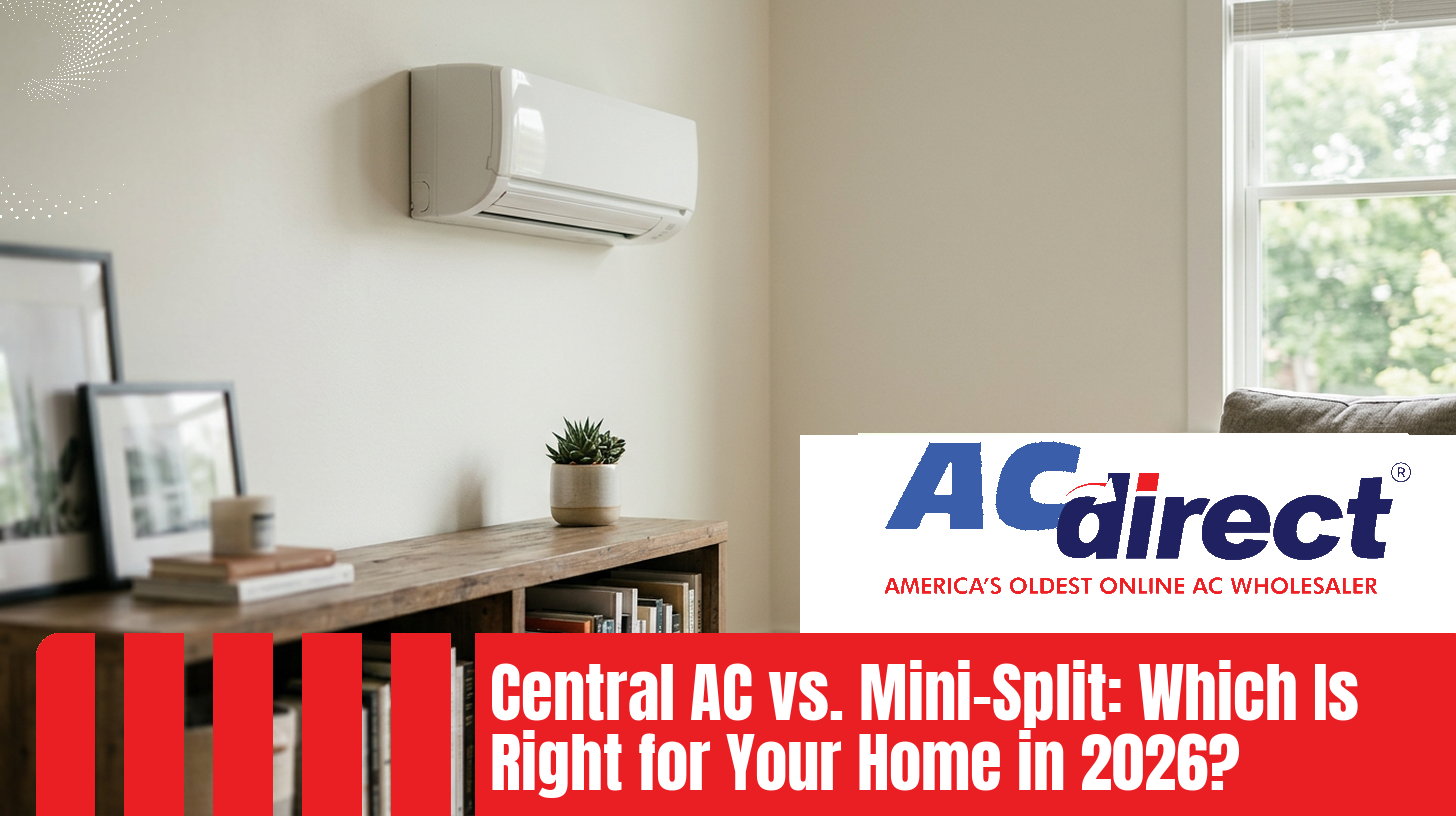
Central AC vs. Mini-Split: Which Is Right for Your Home in 2026?
-
 By
Michael Haines
By
Michael Haines
- Mar 14, 2026
Ductwork, cost, zoning, efficiency, and aesthetics - the honest comparison nobody selling you a system wants to give you.
Search "central AC vs mini-split" on Reddit and you will find hundreds of threads, most of them full of contradictions. One person swears mini-splits are the future. The next says central air is the only serious option. A contractor jumps in to push whichever system they install most often. Somewhere around the fifteenth comment, everyone is arguing and nobody is helping.
Here is the reality: neither system is universally better. Central air conditioning and ductless mini-splits are both mature, proven technologies, and both have gotten meaningfully better in the last few years. The right answer depends on your house, your budget, how you actually use your space, and whether you already have ductwork. This article walks through every factor that matters so you can make that call yourself, without relying on a contractor who may have their own reasons for pushing one over the other.
Both central AC and mini-splits use the same basic physics. A refrigerant absorbs heat from your indoor air, carries it outside, dumps it, and cycles back in to absorb more. The difference is in how they deliver cooled air to your rooms.
A single outdoor unit connects to a single indoor unit (usually an air handler or furnace with an evaporator coil). The indoor unit cools air in one central location, then pushes it through a network of ducts to every room in the house. One thermostat controls the whole system. Think of it like a whole-house audio system - one source, piped everywhere through the walls.
An outdoor compressor connects to one or more individual indoor units, each mounted in a specific room or zone. Refrigerant lines run through a small hole in the wall - no ductwork needed. Each indoor unit has its own thermostat or remote, so you control each zone independently. Think of these as individual Bluetooth speakers - you choose which rooms get the music and at what volume.
Cooling efficiency is measured by SEER2 (Seasonal Energy Efficiency Ratio 2). Higher SEER2 means lower electricity costs per unit of cooling. Here is how the two systems compare in 2026:
ENERGY STAR estimates that replacing a system rated SEER 10 or below with a new certified model can save homeowners up to 20% on cooling costs. Source: energystar.gov
On paper, mini-splits win the efficiency race - sometimes by a wide margin. But there is a critical asterisk here: duct losses. Even a high-SEER central system loses efficiency if its ductwork is leaky or poorly insulated. Industry estimates suggest that leaky ducts can reduce a central system's effective efficiency by as much as 30%. Mini-splits sidestep that problem entirely because there are no ducts to leak.
That said, if your home already has well-sealed, properly insulated ductwork, the real-world gap narrows considerably. A 17 SEER2 central system running through tight ducts can outperform a 22 SEER2 mini-split in certain whole-house scenarios simply because it was designed to move air through the entire structure at once.
Cost is where the comparison gets complicated, because it depends heavily on what your home looks like right now.
| System Type | Typical Installed Cost | Key Cost Factor |
|---|---|---|
| Central AC (with existing ductwork) | $3,000 - $7,000 | Ductwork condition and modifications |
| Central AC (new ductwork required) | $7,000 - $15,000+ | Ductwork installation adds $3,000-$7,000+ |
| Mini-Split (single zone) | $3,000 - $8,000 | Unit quality and installation access |
| Mini-Split (multi-zone, 3-5 zones) | $10,000 - $20,000+ | Each indoor unit adds cost |
AC Direct's wholesale pricing removes the contractor markup on equipment, which can reduce total project cost significantly regardless of which system you choose.
If your home already has good ductwork, central AC is almost always cheaper to install. You are replacing the outdoor unit and possibly the indoor coil or air handler - the ducts stay. But if your home has no ductwork (common in older homes, additions, converted attics, or homes heated by radiators), the equation flips hard. Adding ductwork to an existing home costs $3,000 to $7,000 or more, requires cutting into walls and ceilings, and takes days of disruptive work. In that scenario, mini-splits are often both cheaper and faster to install.
Mini-splits generally cost less to operate because of their higher efficiency ratings and zoning ability. If you work from home and only need to cool your office and bedroom during the day, a mini-split lets you do exactly that. A central system cools the whole house whether anyone is in the guest room or not.
However, if you have a large family using most rooms throughout the day, a central system distributing air everywhere at once can be more cost-effective than running five or six mini-split heads simultaneously.
Imagine you are working from home in your upstairs office while the rest of the house sits empty. Are you really going to cool the entire house just to keep one room comfortable? That scenario plays out millions of times a day across America, and it is the single strongest argument for mini-splits.
Every indoor unit is its own zone with its own thermostat. Cool the kitchen to 72 while the bedrooms stay off. No additional equipment needed.
You can add motorized dampers and multiple thermostats to a ducted system, but it adds $2,000 to $3,500 in equipment and labor. Most standard central installs do not include this.
Central systems often struggle with uneven temperatures - the upstairs is always warmer than the downstairs. Mini-splits solve this because each zone adjusts independently.
This comes up constantly on Reddit, and it is a fair concern. The standard wall-mounted mini-split head is a visible, white rectangle sitting high on your wall. Not everyone loves that look. But there are options that did not exist a few years ago:
- Ceiling cassette units sit flush with the ceiling and are far less visible.
- Slim duct mini-splits hide in a soffit or above a drop ceiling, distributing air through short duct runs. You see a small grille, not the unit.
- Floor-mounted units resemble baseboard heaters and blend more naturally into a room.
Central AC wins on aesthetics by default - the only visible indoor components are supply vents and a return grille, which most people barely notice.
Mini-splits are generally quieter indoors, especially inverter-driven models that run at low fan speeds most of the time. Many operate at 19-26 dB indoors, which is softer than a whisper. Central systems are not loud by modern standards, but the air handler and duct airflow create more background noise. Outdoors, both systems produce similar sound levels from the compressor unit.
This is a factor that catches many people off guard. Most mini-splits are heat pumps, meaning they cool in summer and heat in winter using the same equipment. You are buying a year-round climate system, not just an air conditioner. Heat pump mini-splits with HSPF (Heating Seasonal Performance Factor) ratings above 12 can heat efficiently even in cold weather.
Central AC, by contrast, is typically cooling-only. If you want heating, you pair it with a furnace (gas, propane, or electric) or a separate heat pump. A dual fuel / hybrid setup is a popular approach for homes in climates that see genuine winters.
Neither system is "set it and forget it," but the maintenance requirements are different.
| Task | Central AC | Mini-Split |
|---|---|---|
| Filter cleaning/replacement | Every 1-3 months (disposable) | Every 2-4 weeks (washable) |
| Professional tune-up | Once per year | Once per year |
| Duct cleaning | Every 3-5 years | N/A - no ducts |
| Indoor unit deep cleaning | N/A (coil cleaning at tune-up) | Every 6-12 months (blower wheel, coil) |
| Outdoor unit clearance | Keep 2 ft clear | Keep 2 ft clear |
Mini-splits require more frequent filter cleaning (the washable mesh filters need a quick rinse every few weeks), and the indoor units should be deep-cleaned periodically to prevent mold or odor buildup inside the blower assembly. Central systems have the added maintenance of ductwork - periodic cleaning and occasional sealing of leaks. Both systems need an annual professional tune-up to check refrigerant levels, electrical connections, and overall performance.
Instead of a vague "it depends," here is a practical decision framework based on the most common real-world scenarios:
Plenty of homeowners use both. A central system handles the main living areas through existing ductwork, and a single-zone mini-split handles the bonus room, sunroom, or upstairs bedroom that the central system never quite reaches. This is often the most cost-effective approach when a home is mostly ducted but has one or two problem zones.
Both system types have embraced smart home integration. Wi-Fi-enabled thermostats and controllers, voice activation through Alexa or Google Home, and smartphone-based energy monitoring are now standard on most mid-range and higher equipment. Variable-speed inverter compressors - which ramp up and down like a dimmer switch instead of cycling on and off - have become the norm in mini-splits and are increasingly common in central systems. This technology reduces energy waste, keeps temperatures steadier, and extends equipment life.
The Inflation Reduction Act continues to offer substantial incentives for energy-efficient HVAC upgrades in 2026. These apply to both central heat pumps and mini-split heat pumps.
For current details on eligible models and how to claim these incentives, visit the AC Direct rebate page. You can also check the IRS website for the latest guidance on the Energy Efficient Home Improvement Credit.
The EPA is phasing down production of older HFC refrigerants like R-410A, pushing the industry toward lower-GWP (Global Warming Potential) alternatives like R-32 and R-454B. In 2026, you will see both refrigerants in new equipment. This does not change how you should choose between central AC and mini-splits, but it is worth knowing that newer refrigerant systems are not compatible with older ones. If you are planning a future expansion or addition, make sure your system's refrigerant is something that will still be readily available and serviceable for years to come.
Whether you go central or ductless, an oversized or undersized system will cause problems. Oversized units short-cycle (turning on and off too frequently), waste energy, and fail to dehumidify properly. Undersized units run constantly and never quite get the job done. A proper Manual J load calculation takes into account your square footage, insulation, window area, ceiling height, and local climate to determine exactly how many BTUs your home needs.
Not sure where to start? Our sizing guide walks through the basics, or your installing contractor should perform this calculation before recommending specific equipment.
There is no universal winner between central AC and mini-splits. Central air is simpler, cheaper when ductwork already exists, and cools an entire home evenly through one system. Mini-splits are more efficient on paper, offer room-by-room control, eliminate duct losses, and double as heaters. The best choice depends on your home's layout, your existing infrastructure, how you use your space, and your budget.
The one thing both systems have in common? Buying the equipment at wholesale pricing instead of paying a contractor's markup saves you real money regardless of which direction you go. AC Direct carries both central and ductless systems from the industry's leading manufacturers, shipped directly to you or your installer.
AC Direct offers wholesale pricing on both central AC systems and ductless mini-splits. Browse by size, efficiency, or brand. No installation markup. Ships nationwide.