

Best Inverter Units for Small Homes, Apartments, and Condos
-
 By
Michael Haines
By
Michael Haines
- Jul 7, 2026

For tight footprints, the answer is usually a single zone mini split or a compact side discharge inverter unit, picked by square footage bracket.
For small homes, apartments, and condos, the recommendation logic is simple: start with a single zone ductless mini split, or a compact side discharge inverter unit if you already have ductwork. Then narrow the pick by square footage bracket. The brackets below are estimates only. For real sizing, use our what size air conditioner do i need guide.
The reason small spaces lean toward inverter units comes down to how they run. Instead of slamming on and off, a variable-speed compressor modulates output to match the load, which suits a 700 sq ft condo or a 1,200 sq ft ranch far better than a fixed-speed unit that overshoots and short cycles. If you want the full background on how the technology works, our inverter air conditioner guide covers it in detail.
Small spaces need units that run quietly, dehumidify well, and modulate down to low output without short cycling. That usually means a single zone ductless mini split for spaces without existing ducts, or a compact side discharge inverter unit where ducts already exist. Both use variable-speed compressors that can operate at roughly 25% to 100% capacity as demand shifts.
Three characteristics matter more in a small footprint than in a large home:
- Turn-down ratio. A unit that can drop to 25% capacity can hold a steady temperature in a 600 sq ft room. A fixed-speed unit stuck at 100% will overshoot, shut off, and swing.
- Dehumidification at low load. Longer, gentler run cycles pull more moisture out of the air than short bursts. This matters most in shoulder seasons when the temperature is fine but the humidity is not.
- Sound. In a condo or apartment, the outdoor unit sits closer to windows and neighbors. Side discharge inverter units and modern mini splits routinely operate in the 45 to 56 dBA range, comparable to a refrigerator hum.
For studios, one-bedroom apartments, small condos, ADUs, and open-plan cottages under roughly 1,000 sq ft, a single zone ductless mini split in the 9,000 to 18,000 BTU range is usually the right shape of answer. One indoor head, one outdoor unit, one line set. No ductwork, no air handler in a closet, and the whole system modulates as one.
The two lines that fit this bracket cleanly:
Daikin builds inverter technology into every mini split they make. The Aurora line targets homes that need real heating performance down into cold weather, with SEER2 ratings up to 20 and HSPF2 up to 9.7. For a small condo or apartment where humidity control matters as much as raw cooling, the low-load performance is the story. These are professional-install units and fall under the AC Direct Price Promise for Daikin equipment.
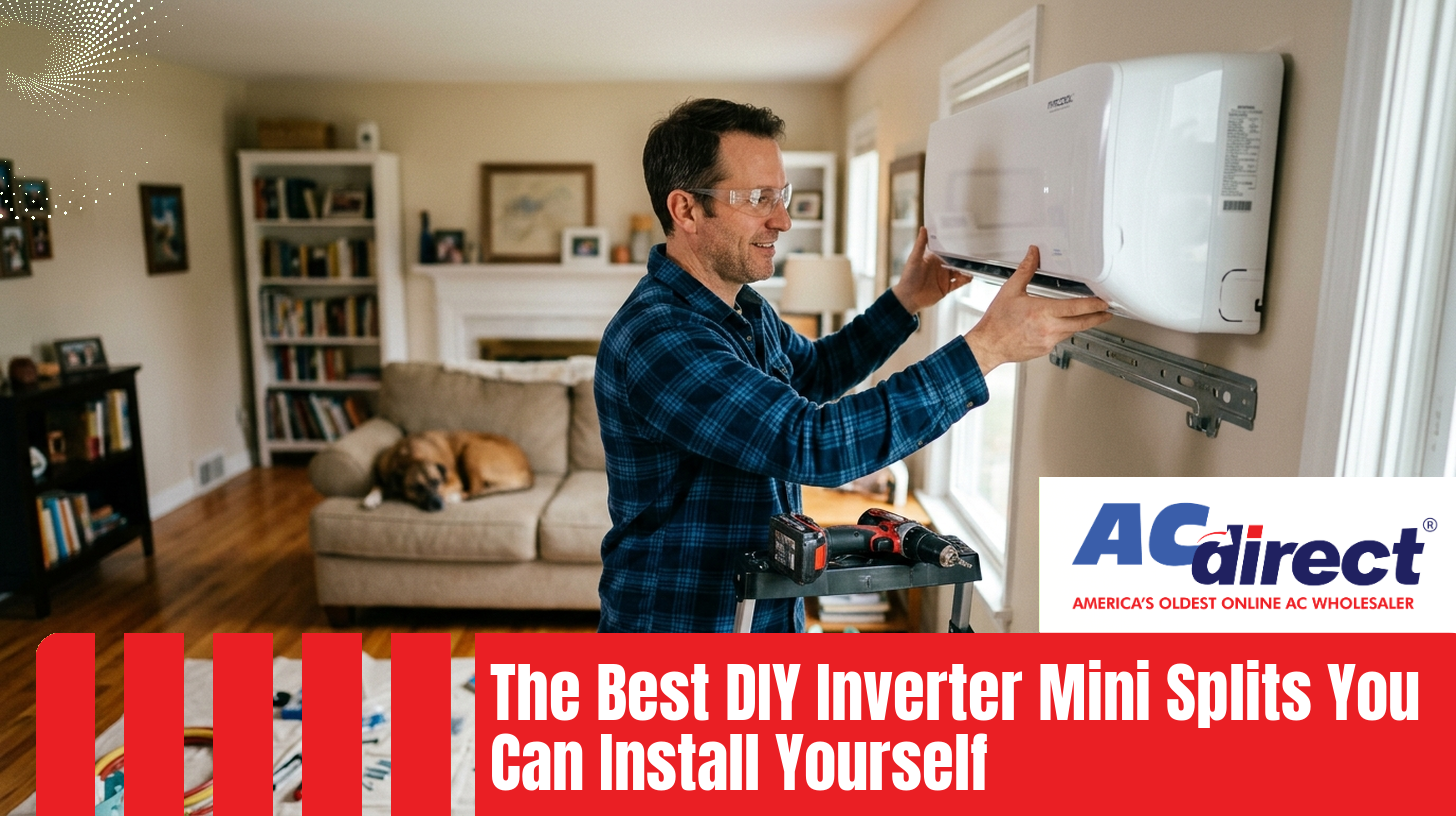
If you are a renter with landlord approval, or a condo owner comfortable with a weekend project, MRCOOL is the one brand engineered for homeowner installation. The line sizes cover the sub-1,000 sq ft brackets well, and pre-charged line sets remove the vacuum-and-charge step that normally requires a licensed technician. Browse MRCOOL DIY mini splits for current models and capacities.
Both approaches deliver the core inverter benefit in a small space: the unit runs long and gentle, holds temperature within about a degree, and pulls humidity out at part load. In a studio or one-bedroom, that difference is felt in every room.
Between roughly 1,000 and 1,500 sq ft, the choice usually splits along one question: is the home ducted or not? If ducts are already in place and in decent shape, a compact side discharge inverter unit paired with a matching air handler is often the cleanest fit. If there are no ducts, a single zone or two zone mini split covers the space.
The Goodman SD line is built specifically for tight urban and suburban lots where a traditional top discharge condenser will not fit next to a townhouse or against a zero-lot-line property. The footprint is small, and the sound levels run as low as 45 dBA in Quiet Mode. Efficiency reaches up to 17.2 SEER2 and 8.5 HSPF2 on the heat pump variants. Goodman equipment is also covered by the AC Direct Price Promise.
Daikin's take on the side discharge form factor is worth knowing if you are shopping this bracket. It is compact, quiet, and uses inverter technology at the compressor. For a full walkthrough, see What Is the Daikin FIT? Side Discharge Inverter Comfort Explained.
For a 1,000 to 1,500 sq ft home without ducts, a single-zone Daikin Entra is a strong fit. The line is rated at 18 SEER2, 9 HSPF2, and 10.5 EER2, and it comes pre-charged with R-32, which puts it on the right side of the 2026 refrigerant transition. If humidity is your main complaint in this size home, an Entra sized correctly to the load will run long, low, and dry.
All three of these product lines require professional installation. To browse configurations, shop inverter AC units by tonnage.
Renters and condo owners face constraints that a single-family homeowner does not: HOA rules, landlord approval, wall penetrations, and outdoor unit placement on a shared balcony or roof pad. Those constraints usually push the decision toward a single zone mini split with a small outdoor footprint, or the DIY approach if the lease and building permit it.
A few practical checkpoints before ordering anything:
Condos often restrict where the condenser can sit. Balcony rails, roof pads, and wall brackets all have HOA rules. Get placement approved in writing before you buy.
Mini splits need a 3 inch line set hole through an exterior wall. In a rental, that requires landlord approval. In a condo, it may need HOA sign-off.
Most single zone mini splits need a dedicated 208/230V circuit. Older apartments and condos may not have panel space. A licensed electrician should confirm before install day.
MRCOOL DIY lines are engineered for homeowner installation with pre-charged line sets. Every other brand is a professional-install unit. Match the choice to your comfort level and building's rules.
The picks above are easier to sort against real situations. This table groups the common small-space scenarios against the product line that tends to fit. Square footage brackets are estimates. Use the sizing guide for a precise load calculation on your specific home.
| Situation | Est. Square Footage | Product Line That Usually Fits | Install Path |
|---|---|---|---|
| Studio or 1BR apartment, no ducts | 400 to 700 | Single zone mini split, 9K to 12K BTU | Pro or MRCOOL DIY |
| Small condo, no ducts | 700 to 1,000 | Single zone mini split, 12K to 18K BTU | Pro or MRCOOL DIY |
| ADU or small cottage, no ducts | 500 to 900 | Daikin single zone or MRCOOL DIY | Pro or DIY |
| Small ranch, existing ducts | 1,000 to 1,500 | Goodman SD side discharge inverter unit | Professional install |
| Townhouse with tight side yard, ducted | 1,200 to 1,500 | Goodman SD or Daikin FIT | Professional install |
| Small ductless home, humid climate | 900 to 1,400 | Daikin Entra with R-32 | Professional install |
Browse single zone mini splits, Goodman SD side discharge units, and Daikin inverter units at wholesale pricing. Shipped nationwide.
What is the best AC for a small house?
For most small houses without ductwork, a single zone ductless mini split with inverter technology is the best fit. Sized correctly, it runs long, quiet cycles that hold temperature within about a degree and dehumidify well at part load. If the home is already ducted, a compact side discharge inverter unit paired with a matched air handler is a strong alternative.
What size mini split do I need for an apartment?
A rough starting point is 9,000 BTU for spaces up to about 400 sq ft, 12,000 BTU for 400 to 650 sq ft, and 18,000 BTU for 650 to 1,000 sq ft. These are estimates only. Ceiling height, insulation, sun exposure, and window count all shift the load. Use our sizing guide for a real load calculation before you buy.
Is an inverter AC worth it for a small home?
Yes, and arguably more so than in a large one. Small spaces amplify the weaknesses of fixed-speed units, including temperature swings, poor humidity control, and short cycling. Inverter units modulate output down to around 25% capacity, which matches the smaller load of a condo or apartment much more precisely and runs quieter in the process.
What is the best AC unit for a 1,000 sq ft space?
For 1,000 sq ft without ducts, a single zone 18,000 BTU mini split from Daikin or a MRCOOL DIY unit typically fits. For 1,000 sq ft with existing ductwork, a compact Goodman SD side discharge inverter unit or a Daikin FIT is usually the cleaner pairing. Confirm the exact size with a Manual J load calculation before ordering.
Can renters install a mini split?
Sometimes, with landlord approval. MRCOOL DIY mini splits are the only line engineered for homeowner installation without a licensed technician, using pre-charged line sets. Even so, the install involves a 3 inch wall penetration and a dedicated electrical circuit, both of which require written landlord permission and, in many buildings, HOA sign-off.