

The Best Inverter Heat Pumps of 2026
-
 By
Michael Haines
By
Michael Haines
- Jul 7, 2026

Situation-based picks across Goodman, Daikin, and MRCOOL, chosen for real-world efficiency, comfort, and cold-weather output.
The best inverter heat pump for most homes in 2026 is a Daikin variable-speed line unit, because it pairs strong SEER2/HSPF2 numbers with quiet, side-discharge operation and Daikin's long track record on R-32 refrigerant. Goodman is the value leader, MRCOOL owns DIY, and hot-humid Southeast homes have their own best fit. Details below.
- Best overall: Daikin variable-speed inverter heat pump lines, for balanced efficiency, humidity control, and quiet operation.
- Best value: Goodman inverter heat pump lines, delivering variable-speed comfort without the premium price ceiling.
- Best premium: Daikin high-tier inverter lines (like Daikin FIT platforms), for compact footprint and top-end efficiency.
- Best DIY: MRCOOL DIY inverter heat pumps, the only line we recommend for owner installation.
- Tax credits: Section 25C eligibility depends on the buyer's tax situation, per current IRS 25C guidance.
- Refrigerants: New units in 2026 use R-32 or R-454B, both A2L refrigerants replacing R-410A under the EPA Technology Transitions rule.
This is our situation-based buying guide, not a leaderboard. Every home has a different heat load, a different climate, and a different budget, so the "best" unit is the one that fits your situation. Start with our inverter air conditioner guide if you want the background on how variable-speed compressors actually work, then come back here to narrow the picks.
We looked at four things: rated efficiency under the current SEER2, EER2, and HSPF2 test procedures; cold-weather heating output; refrigerant type and long-term serviceability; and how the unit fits real installation scenarios. We only recommend brands AC Direct actually stocks (Goodman, Daikin, MRCOOL), and we do not rank losers.
As of 2023, every new residential heat pump sold in the U.S. is rated on SEER2, EER2, and HSPF2, which test at higher external static pressure than the old ratings and reflect real duct conditions more honestly. The current national minimum for heat pumps is 14.3 SEER2 and 7.5 HSPF2 per the U.S. Department of Energy. For Section 25C tax credit eligibility, the bar goes higher: SEER2 at or above 16, EER2 at or above 12, and HSPF2 at or above 9, per current IRS 25C guidance.
We only recommend inverter heat pumps as AHRI-matched units (outdoor unit plus a compatible indoor coil or air handler). The Air-Conditioning, Heating, and Refrigeration Institute verifies that a specific outdoor/indoor combination hits its rated efficiency. A mismatched pairing can lose efficiency and, more importantly, void tax credit eligibility because the rated numbers no longer apply.
Daikin's variable-speed inverter heat pump lines are our overall pick because they combine strong SEER2/HSPF2 ratings, quiet side-discharge outdoor units, and R-32 refrigerant, which Daikin has used globally for over a decade before deploying it across North America. The comfort and humidity control are noticeably better than single-stage units at part load.
Daikin's compact platforms, including the Daikin FIT family, tuck into tight side-yards and townhome installations where a traditional top-discharge condenser would not fit. Ratings on top-tier units reach into the high SEER2 range with HSPF2 numbers that clear the 25C threshold, though final eligibility always depends on the matched AHRI configuration and your tax situation. AC Direct's Daikin lineup is covered by the AC Direct Price Promise.
Browse the current lineup on our inverter heat pumps page for live specs and configurations.
Goodman's inverter heat pump lines are the value pick because they deliver true variable-speed operation, R-32 refrigerant, and efficiency ratings that reach into the 24 SEER2 range on top configurations, at a price point that lands well below premium brands. For homeowners who want inverter comfort without stretching the budget, Goodman consistently makes the most sense.
Goodman inverter units qualify for the AC Direct Price Promise, and matched units in the higher-efficiency tiers typically clear the SEER2, EER2, and HSPF2 thresholds required for Section 25C consideration. As always, confirm the specific AHRI certificate for your chosen combination, and confirm your own eligibility with a tax professional.
Replacement projects on a real budget, primary residences where the buyer wants inverter behavior (long low-speed runs, better dehumidification, quieter cycling) without paying for the highest-tier features. Goodman's parts network is deep and every licensed HVAC contractor in the country can service one.
The premium pick is a Daikin FIT-class inverter heat pump, or the equivalent high-tier Daikin platform. These are the units for buyers who want the smallest possible footprint, the quietest operation, and Daikin's tightest inverter control. The FIT platform is less than 14 inches wide at the base, which solves installations that a standard condenser simply cannot fit.
You are paying for three things at the premium tier: the compact side-discharge cabinet, low sound levels at part load, and the tightest modulation curve on a well-designed R-32 refrigerant circuit. In practice, that means longer, quieter, lower-speed runs that hold the setpoint within a tight band and pull more moisture out of the air. It also means the unit is more sensitive to installation quality, so this tier is worth the money only when paired with a competent contractor.
For the Southeast (Florida, coastal Georgia, coastal Carolinas, the Gulf Coast), the best fit is a mid-tier Goodman or Daikin inverter heat pump prioritized for cooling efficiency and dehumidification, not extreme cold-climate output. Winters here rarely dip below the balance point where a heat pump struggles, so paying for a cold-climate designation is money spent on capacity you will never use.
What matters in the Southeast is EER2 (steady-state cooling efficiency at 95F), long low-speed runtime for humidity removal, and quiet outdoor operation. Variable-speed compressors dominate on all three. In hot-humid climates the inverter's ability to run at 30 to 40 percent capacity for hours is what actually makes the house feel dry, which single-stage units simply cannot do without over-cooling.
For colder markets, HSPF2 and the ENERGY STAR Cold Climate designation matter more. The ENERGY STAR Cold Climate criteria require a COP of at least 1.75 at 5F and at least 70 percent of rated heating capacity at 5F versus 47F. If you are north of the Mason-Dixon line, prioritize those numbers, and see our companion piece on HSPF2 and cold-climate inverter heat pumps. For a broader look at how a single inverter heat pump handles both heating and cooling, our inverter ac heating primer walks through the full-year picture.
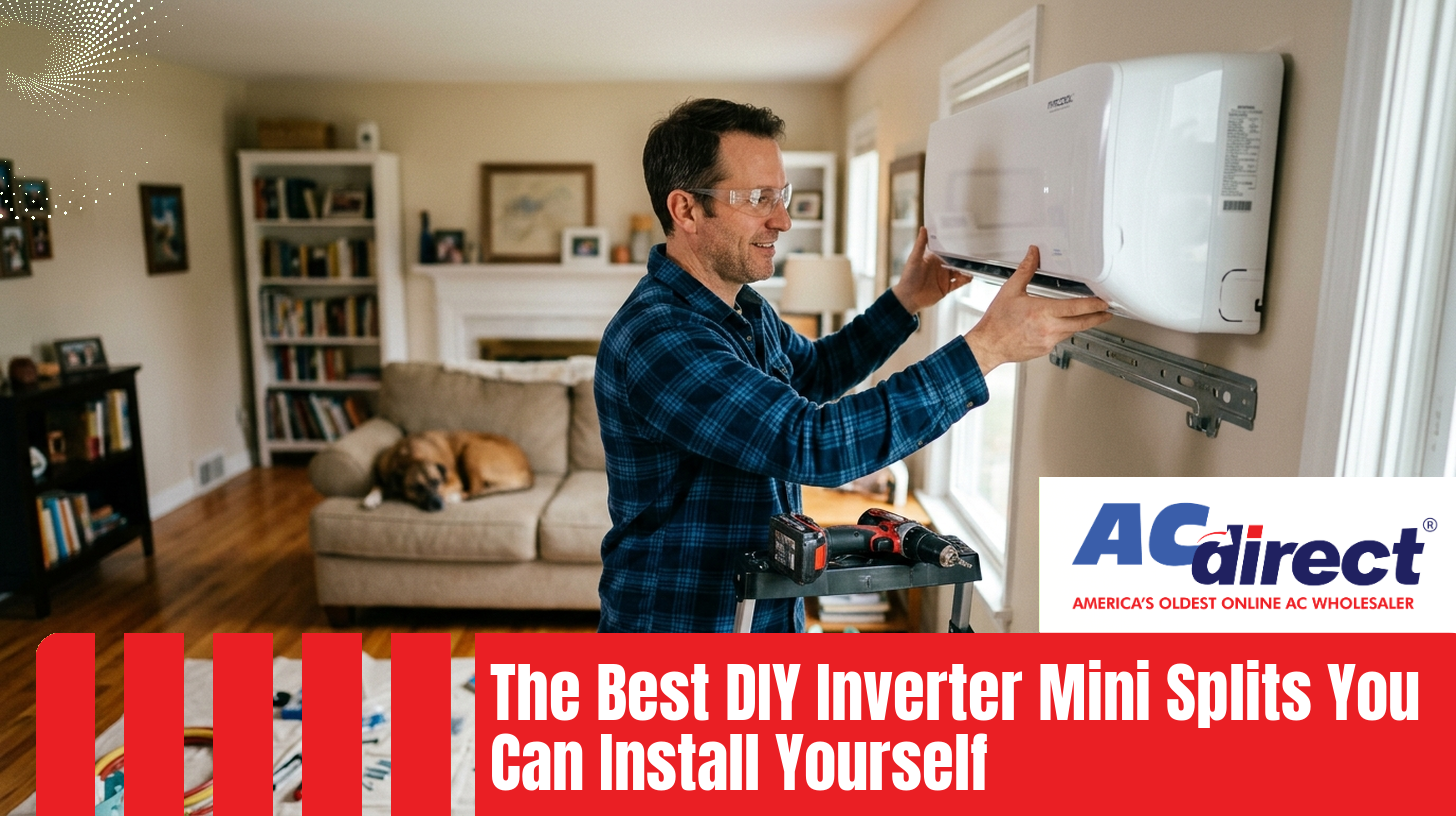
MRCOOL is the only line we recommend for owner installation. Their DIY inverter heat pumps use pre-charged, quick-connect line sets designed specifically for homeowner installation without brazing, without vacuum pumps, and without an EPA 608 refrigerant handling license for the connection itself. Every other brand on this page needs a licensed HVAC contractor.
MRCOOL is best for detached garages, accessory dwellings, additions, and situations where paying a contractor doubles the total project cost. See the current MRCOOL DIY mini splits and heat pump options for what is in stock right now.
Section 25C, the Energy Efficient Home Improvement Credit, can offset a portion of the cost of a qualifying heat pump for eligible buyers. Eligibility depends on the buyer's tax situation, the installation being at a primary residence, and the installed system meeting the current efficiency thresholds. We do not promise anyone will qualify. Confirm with a tax professional and current IRS 25C guidance before you rely on any credit in your budget.
Per current IRS guidance, split-system heat pumps must meet or exceed SEER2 at 16, EER2 at 12, and HSPF2 at 9 to be considered eligible. Those numbers apply to the specific AHRI-matched combination, not just the outdoor unit. Ask for the AHRI certificate showing the outdoor/indoor pairing you are actually buying, and keep it with your tax records.
Use this as a starting map, not a spec sheet. Exact SEER2 and HSPF2 numbers depend on the matched configuration, so verify on the live product page and the AHRI certificate.
| Situation | Pick | Refrigerant | Best For |
|---|---|---|---|
| Best overall | Daikin variable-speed inverter heat pump | R-32 | Balanced efficiency, comfort, and quiet operation |
| Best value | Goodman inverter heat pump | R-32 | True variable-speed at a lower price ceiling |
| Best premium | Daikin FIT-class inverter | R-32 | Compact footprint, top-end quiet and modulation |
| Best for mild Southeast winters | Mid-tier Goodman or Daikin inverter | R-32 | Cooling efficiency and humidity control |
| Best DIY | MRCOOL DIY inverter heat pump | R-32 or R-454B (varies) | Detached spaces, additions, owner installation |
Ready to see live configurations, sizes, and matched AHRI options? Browse the current inverter AC units catalog for what is in stock right now.
Every new inverter heat pump sold in 2026 uses either R-32 or R-454B, both A2L refrigerants. This follows the January 1, 2025 EPA Technology Transitions rule that ended new-equipment manufacture with refrigerants above a Global Warming Potential of 700. R-410A units are gone from production; existing R-410A units can still be serviced with reclaimed refrigerant.
R-32 has a GWP of roughly 675 and is a single-component refrigerant, which simplifies recovery and recharge. R-454B has a GWP of roughly 466. Both are mildly flammable under specific rare conditions but are considered safe for residential use with proper installation practices. Neither one changes what you do as a homeowner. It matters mainly for your installer, and any licensed HVAC contractor working on new units in 2026 is already trained on A2L handling.
Is an inverter heat pump worth it in 2026?
For most homeowners in most climates, yes. Inverter units run longer at lower speeds, which improves humidity control, cuts noise, and lowers energy use versus single-stage units. The higher upfront cost typically pays back through lower operating costs, though the exact payback depends on your climate, electricity rates, and how well the system is sized and installed.
What SEER2 rating do I need for the federal tax credit?
Per current IRS 25C guidance, split-system heat pumps generally need SEER2 at or above 16, EER2 at or above 12, and HSPF2 at or above 9 to be considered for the credit. These thresholds apply to the specific AHRI-matched combination you install. Eligibility depends on your tax situation, so confirm with a tax professional before relying on the credit.
Are Goodman and Daikin the same company?
Daikin Industries owns Goodman, but the two lines are engineered, priced, and warrantied separately. Goodman targets the value tier with strong efficiency at a lower cost, and Daikin targets the mid-to-premium tier with compact platforms like the FIT and tighter inverter control. AC Direct's Price Promise applies to both lines but not to MRCOOL or other brands.
Can I install an inverter heat pump myself?
Only MRCOOL DIY inverter heat pumps are designed for homeowner installation, using pre-charged quick-connect line sets. Goodman, Daikin, and all conventional inverter heat pumps require a licensed HVAC contractor because they need vacuum evacuation, precise refrigerant charge, and EPA 608 certification for handling A2L refrigerants. DIY installation on those brands typically voids the warranty.
How long do inverter heat pumps last?
A well-installed and maintained inverter heat pump typically lasts 12 to 18 years, similar to conventional heat pumps. The variable-speed compressor experiences less thermal stress because it avoids constant on/off cycling, which can extend service life. Longevity depends more on installation quality, correct sizing, and annual maintenance than on the brand name on the cabinet.