 and now, NASCAR Racing Sponsor


The Best Inverter AC Units of 2026
-
 By
Michael Haines
By
Michael Haines
- Jul 7, 2026

Picks by buyer situation, from the inventory we actually ship: best overall, best value, best premium, and best DIY.
For most homeowners in 2026, the best overall inverter AC unit is the Daikin FIT side-discharge inverter, matched by Goodman's inverter lineup as the best value and MRCOOL as the best DIY option. Rather than rank a single winner, we sort our picks by buyer situation so you land on the unit that actually fits your home, budget, and installation plan.
- Best overall: Daikin FIT, for its compact footprint, quiet variable-speed operation, and premium build.
- Best value: Goodman inverter units, backed by the AC Direct Price Promise.
- Best premium: Daikin FIT, also covered by the AC Direct Price Promise.
- Best DIY: MRCOOL, with pre-charged linesets built for homeowner installation.
- All 2026 units ship with A2L refrigerant (R-32 or R-454B) under the EPA Technology Transitions Program.
- Inverter units run longer, quieter cycles, and can remove significantly more moisture than single-stage units.
If you want the full technical background before picking a unit, start with our inverter air conditioner guide. Otherwise, keep reading. This article names the lines we stand behind, tells you which situation each one fits, and links to live product pages for current models and pricing.
We evaluated inverter units across four criteria: verified efficiency under the DOE M1 SEER2 testing rule, real-world comfort behavior (humidity control, quiet operation, temperature stability), 2026 A2L refrigerant compliance, and how well each line fits a specific buyer situation. We did not rank on a single 1-to-10 scale because a "best" central inverter for a Southern retrofit is not the same as a "best" ductless DIY project.
The U.S. Department of Energy M1 rule raised the bar in January 2023, and 2026 regional minimums are 13.4 SEER2 in Northern regions and 14.3 SEER2 in the Southeast for split ACs under 45,000 Btu/h (Angi summary of DOE regional rules). ENERGY STAR Most Efficient ducted criteria require SEER2 at or above 15.2, HSPF2 at or above 8.1, and EER2 at or above 10 (ENERGY STAR). Every unit on this list clears those thresholds comfortably.
As of January 1, 2026, all new AC installations must use approved low-GWP A2L refrigerants such as R-32 (GWP 675) or R-454B (GWP 466), replacing R-410A (GWP 2,088). That's an environmental impact reduction of roughly 68 to 78 percent (EPA phase-out summary). Every unit in our 2026 lineup is A2L compliant.
The Daikin FIT side-discharge inverter system takes best overall for 2026. It combines a compact side-discharge footprint (useful for tight lot lines and zero-lot-line neighborhoods), true variable-speed operation, and the build quality of the world's largest HVAC manufacturer. It's the unit we recommend when a homeowner wants premium comfort without an oversized outdoor cabinet, and when quiet operation matters as much as raw efficiency.
The FIT's inverter compressor modulates continuously rather than stepping between fixed stages, which means longer, slower cycles and better latent (humidity) removal. Variable-speed units can pull dramatically more moisture from the air than single-stage units under worst-case conditions, which is why Southern homeowners in humid climates almost always end up happier with an inverter than a single-stage of the same tonnage.
For a deep dive on how the FIT's side-discharge design changes installation and comfort, read What Is the Daikin FIT? Side Discharge Inverter Comfort Explained.
Goodman's inverter lineup is the best-value pick for homeowners who want variable-speed comfort without stretching the budget. Goodman inverter units deliver the same core benefits (precise temperature control, superior humidity removal, quiet longer cycles) at a lower entry point than Daikin, and they're covered by the AC Direct Price Promise. For most single-family homes needing a central inverter replacement, this is where we start the conversation.
Goodman's inverter compressors modulate across a wide capacity range, which delivers substantial energy savings compared to non-inverter units (Goodman Manufacturing). The SD (side-discharge) inverter series is worth calling out separately: it operates as low as 56 dBA in normal mode and reaches roughly 45 dBA in Quiet Mode, which is comparable to a whisper. Efficiency reaches 17.2 SEER2 on the AC and 17.5 SEER2 with 8.5 HSPF2 on the heat pump version.
Homeowners replacing a single-stage system in a Southern or Southwestern climate, contractors buying volume, and anyone who wants proven inverter technology at a working-family price. Goodman is our highest-volume inverter brand for a reason. For the complete line breakdown, see the Goodman Inverter Air Conditioner Units: The Complete Lineup.
Ready to see current Goodman inventory? Browse our energy efficient inverter units for live availability and pricing.
The Daikin FIT is also our best-premium pick. That's not a contradiction: it wins best overall because of its balance of comfort, footprint, and build, and it wins best premium because at the top of its efficiency tier it competes with any residential inverter unit on the market. If you want the quietest, most precise, most compact central inverter we stock, this is it. It's also covered by the AC Direct Price Promise.
Three places: compressor refinement (Daikin builds its own inverter compressors and has done so longer than most competitors), the side-discharge cabinet (fits where a top-discharge unit won't), and long-cycle behavior. Premium inverter units aren't about hitting a higher SEER2 headline. They're about how the system behaves at 3 AM when the load is 20 percent of design. That's where the FIT separates itself.
Homeowners in tight-footprint installations (townhomes, zero-lot-line, side yards under 3 feet), owners of well-insulated homes where oversizing is a real risk, and anyone whose priority list starts with "I don't want to hear it." The FIT is what we install in our own homes.
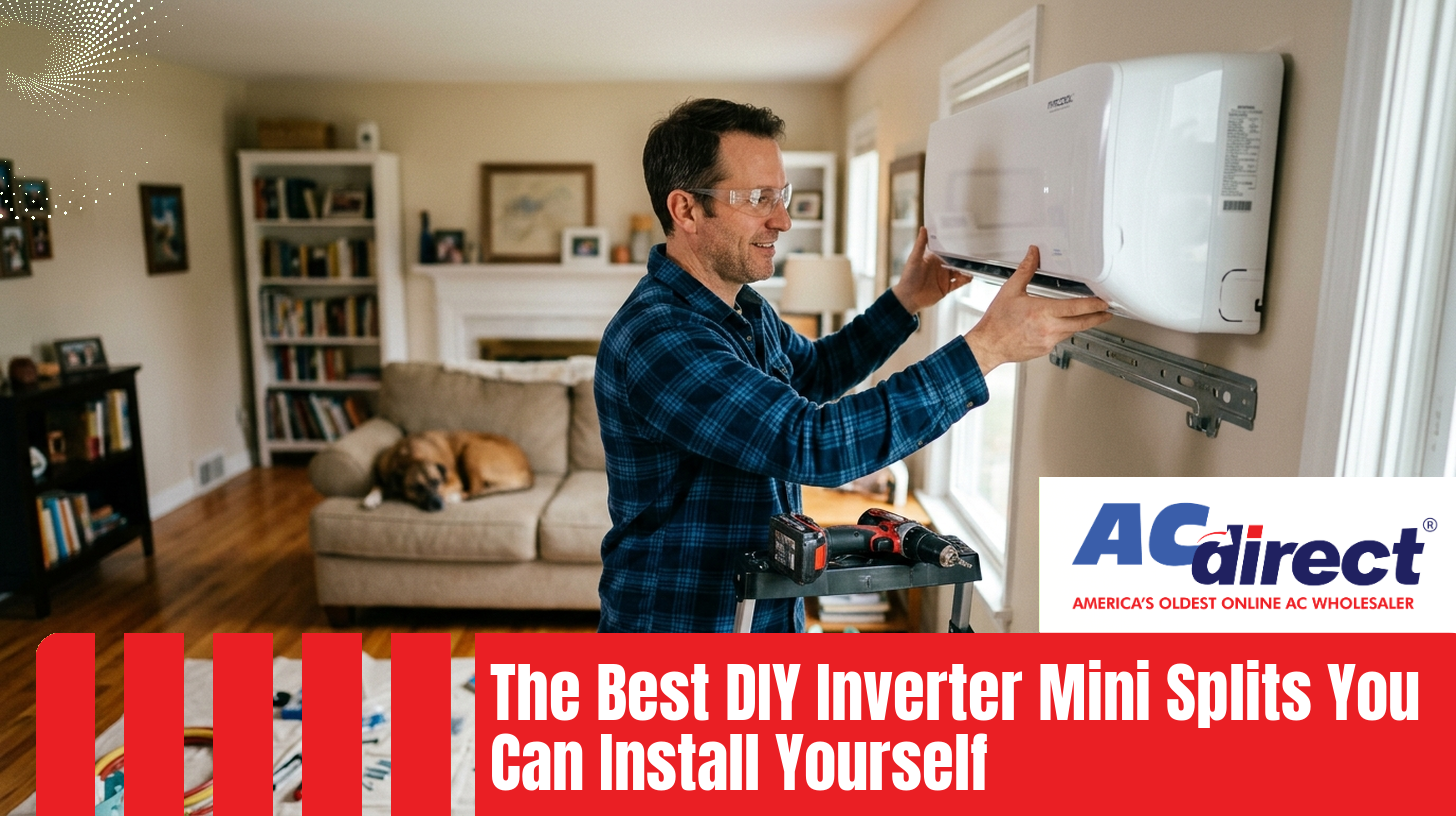
MRCOOL is the only brand in our 2026 lineup engineered specifically for homeowner installation. Their pre-charged linesets connect without vacuum pumps, gauges, or brazing, which means a handy homeowner can install a ductless mini split or multi-zone system in a weekend. For garages, additions, workshops, ADUs, and rooms your central system doesn't reach, MRCOOL is the answer we give.
The DIY series ships with quick-connect refrigerant lines, pre-charged with A2L refrigerant for 2026 compliance. You mount the indoor head, set the outdoor condenser, run the lineset, tighten the flare connections, and power up. No HVAC license required for the refrigerant work, because the sealed lineset never opens to atmosphere. That's the entire innovation, and it changes the math on adding conditioned space to a home.
For everything to know before you order a DIY system (sizing, electrical, lineset routing, and the mistakes we see homeowners make), read MRCOOL DIY Inverter Mini Splits: Everything Before You Buy. Or jump straight to current inventory: MRCOOL DIY mini splits.
Same criteria, four situations. This table is positioned to help you match, not to declare a loser. Every unit here is a strong pick for the buyer it's built for.
| Pick | Brand / Line | Best For | Installation | Refrigerant (2026) |
|---|---|---|---|---|
| Best Overall | Daikin FIT | Balanced premium comfort, tight footprints | Professional | A2L (R-32) |
| Best Value | Goodman Inverter (incl. SD series) | Central replacement, working-family budget | Professional | A2L (R-32) |
| Best Premium | Daikin FIT (top tier) | Quietest operation, well-insulated homes | Professional | A2L (R-32) |
| Best DIY | MRCOOL DIY Series | Additions, ADUs, garages, single-room zones | Homeowner (pre-charged lineset) | A2L |
Current models and pricing on the live inverter units category.
Match the pick to your situation. Below is the decision path we walk homeowners through on the phone. If two paths apply (say, a Southern homeowner replacing a central system and also adding a garage mini split), you'll end up with two units from two different brands, and that's completely normal.
Start with Goodman for value. If the outdoor footprint is tight, if the home is well-insulated (2020 build or newer, spray foam, upgraded windows), or if quiet operation is on the priority list, step up to Daikin FIT. Both require professional installation and both are covered by the AC Direct Price Promise.
Any inverter unit will out-dehumidify a single-stage of the same tonnage because of the longer, slower run cycles. If the current system leaves your home feeling clammy at 74 degrees, an inverter fixes that. Goodman handles this well at its price point. Daikin FIT does it a bit better, quieter, and in less space.
MRCOOL DIY, almost every time. A pre-charged mini split in the garage, workshop, or converted attic is faster and less expensive than extending ductwork from your central system. And you're not asking a central unit sized for the original house to now serve 25 percent more square footage.
Goodman inverter volume pricing plus the AC Direct Price Promise is hard to beat for repeatable jobs. Reach out for quote pricing on the central inverter units you install most often.
Daikin FIT for overall and premium. Goodman for value. MRCOOL for DIY. Every unit on this list is 2026 A2L compliant, every one uses true variable-speed inverter operation, and every one clears ENERGY STAR Most Efficient thresholds when you pick the right model in the line. The wrong pick isn't a bad brand, it's a mismatch between the unit and the situation.
Browse current inventory across all three brands. Wholesale pricing, ships nationwide, and the AC Direct Price Promise on Goodman and Daikin.
For most homeowners, the Daikin FIT is the best overall inverter air conditioner of 2026, thanks to its compact side-discharge design, quiet variable-speed operation, and premium build. If budget is the priority, Goodman's inverter lineup offers the same core benefits at a lower entry point. For DIY installation, MRCOOL is the only brand purpose-built for homeowner installs.
In most climates, yes. Inverter units run longer, slower cycles that hold temperature within a fraction of a degree, remove significantly more humidity than single-stage units, and consume less power. The upfront cost is higher, but lower monthly energy bills and better comfort typically recover the difference over the unit's life.
As of January 1, 2026, all new AC installations must use A2L refrigerants such as R-32 or R-454B under the EPA Technology Transitions Program (EPA summary). R-32 has roughly 68 percent lower global warming potential than R-410A, and R-454B is lower still. Every unit in our 2026 lineup is A2L compliant.
Only if you buy a MRCOOL DIY unit. MRCOOL's pre-charged linesets are engineered for homeowner installation without EPA refrigerant certification because the sealed lineset never opens to atmosphere. Goodman, Daikin, and any other central inverter system requires a licensed HVAC contractor for installation, refrigerant handling, and permits in most jurisdictions.
Very quiet. Goodman's SD inverter series operates as low as 56 dBA in normal mode and roughly 45 dBA in Quiet Mode, comparable to a refrigerator or a whisper. Daikin FIT is in the same range or quieter depending on model. The reason: inverter compressors ramp up smoothly instead of slamming on at full speed, eliminating the loud start-stop cycles of single-stage units.
Federal minimums are 13.4 SEER2 in Northern regions and 14.3 SEER2 in the Southeast for split ACs under 45,000 Btu/h (DOE M1 rule). ENERGY STAR Most Efficient requires 15.2 SEER2 or higher for ducted units. Inverter units in our lineup typically deliver 17 SEER2 and up, which qualifies for most utility rebates.