 and now, NASCAR Racing Sponsor


Does Your Electrical Panel Need an Upgrade Before You Install a Heat Pump?
-
 By
Michael Haines
By
Michael Haines
- Mar 13, 2026
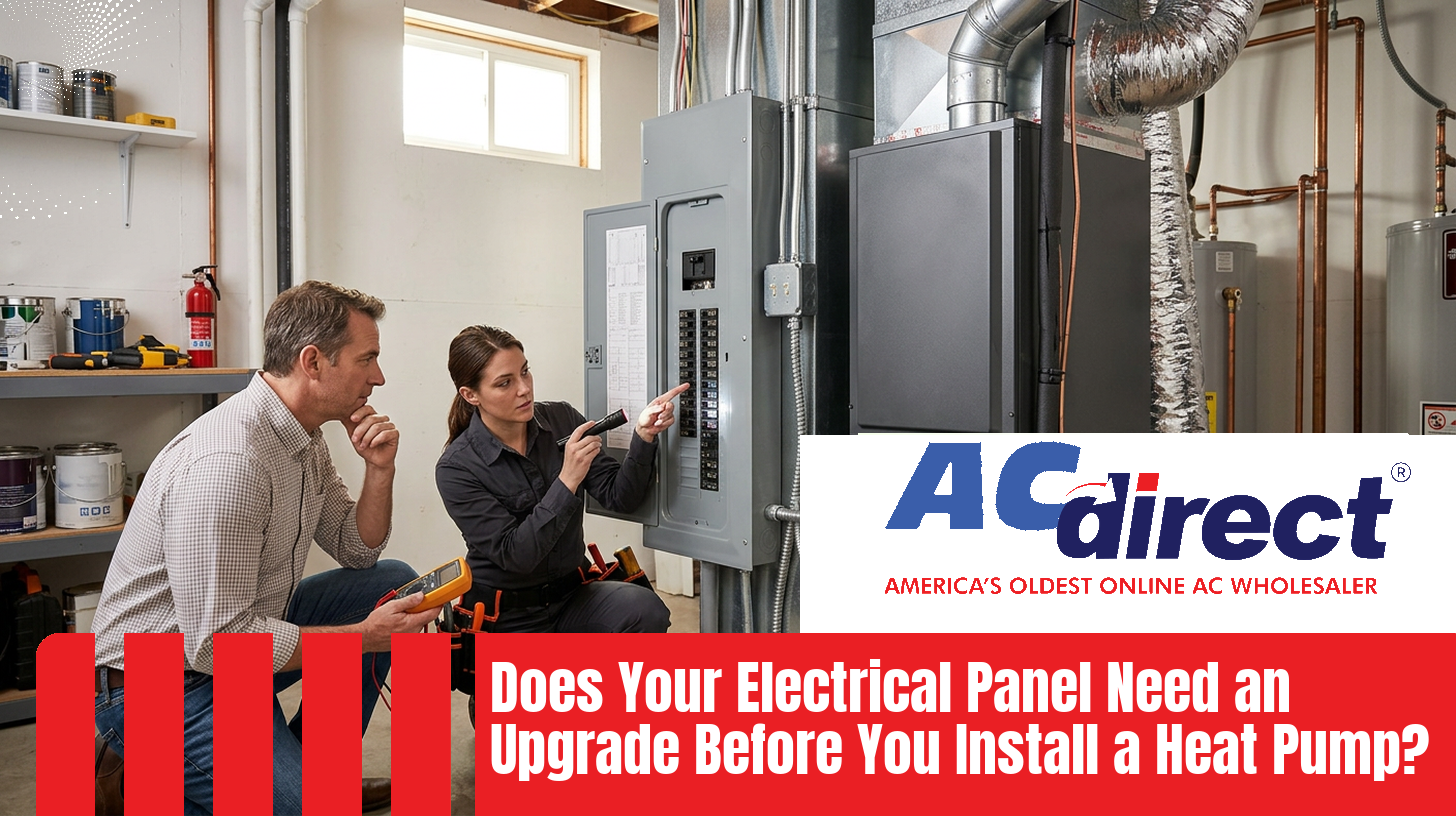
The $2,000 to $5,000 surprise that catches homeowners off guard - and how to know whether you actually need to pay it.
You have done the research. You have picked the heat pump. You might even have the federal tax credit figured out. Then the contractor walks through your garage, opens the electrical panel, and delivers the news: "You're going to need a panel upgrade. That's another three to five thousand dollars." If that scenario sounds familiar, you are not alone. It is one of the most common surprise expenses in the entire heat pump installation process, and it sends homeowners straight to Reddit looking for answers.
Here is the good news: not every home actually needs a panel upgrade. Some contractors quote one reflexively because it eliminates risk on their end. Others quote one because your home genuinely cannot safely handle the additional electrical load. The difference between those two scenarios can save you thousands of dollars, but only if you understand what is actually going on inside that gray metal box on your wall.
This article walks you through the whole thing. No electrical engineering background needed. By the end, you will know whether your panel is likely fine, probably needs work, or is definitely due for an upgrade - before anyone hands you a quote.
Think of your electrical panel as a bottleneck - on purpose. Your utility company feeds electricity into your home through a main service line. That electricity flows into the panel, which splits it into individual circuits: one for your kitchen outlets, one for your dryer, one for your bathroom lights, and so on. Each circuit has a breaker that trips if it draws too much power.
The panel itself has a total amperage rating. That number - stamped on the main breaker or on the panel's label - represents the maximum amount of electricity your entire home can pull at the same time. Most homes built after the early 2000s have 200-amp panels. Homes from the 1970s through the 1990s often have 100-amp or 150-amp panels. And some older homes still have 60-amp panels or, in rare cases, fuse boxes instead of breakers.
The key question is not whether your panel has empty breaker slots. It is whether the total amperage rating can handle everything you already run plus a heat pump running at peak demand.
This is where the math matters. A heat pump does not draw the same amount of power all the time. On a mild day, it coasts. During a deep freeze or a brutal summer afternoon, it ramps up significantly. The number that matters for panel sizing is peak amperage draw - the maximum the unit will pull during the hardest working conditions.
| System Size | Typical Peak Amps | Required Breaker Size |
|---|---|---|
| 1.5 Ton (18,000 BTU) | 15 - 20 amps | 20 - 30 amp |
| 2 Ton (24,000 BTU) | 18 - 25 amps | 25 - 35 amp |
| 2.5 Ton (30,000 BTU) | 20 - 30 amps | 30 - 40 amp |
| 3 Ton (36,000 BTU) | 25 - 35 amps | 35 - 50 amp |
| 3.5 Ton (42,000 BTU) | 30 - 40 amps | 40 - 60 amp |
| 4 Ton (48,000 BTU) | 35 - 50 amps | 50 - 60 amp |
| 5 Ton (60,000 BTU) | 40 - 55 amps | 60 - 70 amp |
Inverter-driven heat pumps generally draw less at startup than older single-stage units, which reduces peak load spikes. Always check the specific nameplate data on the unit you are considering.
If your home has a 200-amp panel and moderate electrical usage, a 2.5 or 3-ton heat pump drawing 25 to 35 amps is usually well within the panel's capacity. But if your home has a 100-amp panel, an electric water heater, an electric dryer, and an electric range already competing for that limited capacity, the same heat pump could push you over the safe limit.
Before you accept (or challenge) a contractor's panel upgrade quote, here is a simple framework to gauge where you stand. This is not a substitute for a licensed electrician's load calculation, but it will help you walk into that conversation informed.
Open your electrical panel (carefully - do not touch any wiring). The main breaker at the top will be labeled with a number: 60, 100, 150, or 200. That is your panel's total capacity in amps.
List the big electric consumers in your home: electric water heater (roughly 20 to 30 amps), electric dryer (24 to 30 amps), electric range/oven (40 to 50 amps), central air conditioning (20 to 50 amps), and any other large appliances. Add up the breaker sizes for these items.
Check the spec sheet or product page for the heat pump you are considering. It will list the minimum circuit ampacity and recommended breaker size. Add that to your total from step 2.
If the total of your major loads plus the heat pump is well under 80% of your main breaker rating, you are probably fine. If it is close to or exceeds 80%, a load calculation by a licensed electrician is the right next step. If it clearly exceeds your panel's capacity, an upgrade is likely necessary.
Your home has a 200-amp panel. You have a gas water heater, gas dryer, or gas range handling some of the heavy lifting. Your current central AC unit is being replaced by the heat pump (so you are swapping one large electrical load for another, not adding a new one). In this situation, the heat pump often fits within your existing capacity without any panel work at all.
Your home has a 150-amp panel, or a 200-amp panel that is already heavily loaded with electric appliances. You might be fine, or you might be over the limit. This is where a professional load calculation is worth every penny. An electrician can tell you exactly how much headroom you have. Some homes in this range can avoid a full panel upgrade by using load management devices - smart controllers that briefly reduce power to non-critical loads (like a water heater) when the heat pump is drawing hard.
Your home has a 100-amp panel or smaller, especially with multiple major electric appliances. Or your home still has a fuse box instead of a breaker panel. In these cases, the math almost always points to an upgrade. A 100-amp panel was designed for an era when homes had fewer electric appliances and no central HVAC systems. Adding a heat pump that draws 30 to 50 amps to a panel that is already stretched thin is not a good idea from a safety or code perspective.
If you do need one, it helps to know what reasonable pricing looks like. Here is what homeowners are paying in 2025 and 2026, based on national averages.
| Upgrade Type | Typical Cost Range | Notes |
|---|---|---|
| 100A to 200A panel swap | $1,800 - $4,000 | Most common upgrade for heat pump installs |
| Fuse box to 200A breaker panel | $2,500 - $5,000+ | May require new wiring, meter base, utility coordination |
| 200A to 320A or 400A | $3,500 - $6,000+ | Rare; typically for all-electric homes with solar, EV charger, and heat pump |
| Sub-panel addition (instead of main upgrade) | $800 - $2,000 | Can work if main panel has capacity but no open slots |
| Load management device | $200 - $600 | May avoid a full upgrade in borderline cases |
Always get at least two quotes for panel work. The HVAC contractor and the electrician should be separate bids so you can evaluate each on its own.
A few things to watch for in quotes:
- Permit fees are usually separate and range from $75 to $300 depending on your municipality.
- Utility coordination may be needed. The utility has to disconnect and reconnect your service, which sometimes adds time and cost.
- Meter base replacement is sometimes required when upgrading from 100A to 200A, especially in older homes.
- Whole-house rewiring is almost never required just for a panel upgrade. If a contractor suggests it, get a second opinion.
This is the question that fills Reddit threads. Here are the signs to watch for on both sides.
- The contractor or electrician performed an actual load calculation, not just a visual inspection.
- They can explain specifically why your current panel cannot handle the heat pump - with numbers.
- Your panel is 100 amps or smaller.
- Your panel is a known recalled or unsafe brand (Federal Pacific, Zinsco, or certain Challenger panels have documented safety issues).
- The quote includes a detailed line-item breakdown, not just a lump sum.
- The contractor says "you always need a 200-amp panel for a heat pump" without doing any calculations specific to your home.
- They quote the panel upgrade as a single number bundled into the heat pump installation with no separate breakdown.
- You have a 200-amp panel in good condition and the contractor still insists on an upgrade.
- They cannot explain what specific loads are pushing you over the limit.
- They recommend a 400-amp panel for a typical residential home with no solar or EV charger.
If your panel is in the "close but not certain" range, there are some strategies that can keep your existing panel in place.
These are smart controllers that monitor your home's electrical draw in real time. When the heat pump ramps up, the device can temporarily reduce power to another large appliance - like pausing your electric water heater for 15 minutes. You never notice, and the panel never gets overloaded. Products like the Span panel or simpler load-shedding relays can cost $200 to $600, a fraction of a full panel upgrade.
Modern inverter-driven heat pumps with higher SEER2 and HSPF ratings often have lower peak amperage draw than older or less efficient models. A high-efficiency 3-ton unit might draw 25 amps at peak, while a lower-efficiency 3-ton unit might draw 35 amps. That 10-amp difference could be the margin that keeps you under your panel's limit. Efficiency saves money on bills and potentially saves you from a panel upgrade.
If you are replacing a gas furnace with a heat pump, the heat pump adds a new electrical load. But if you are replacing an old electric resistance heating system or an existing central AC unit, you are swapping one large electrical load for another. In swap scenarios, the net increase in electrical demand is much smaller, and a panel upgrade is less likely to be needed.
If your main panel has enough total amperage but has physically run out of breaker slots, a sub-panel ($800 to $2,000) creates additional circuit space without replacing the main panel. This is a common and cost-effective solution when capacity is fine but space is tight.
The Inflation Reduction Act made heat pumps significantly cheaper through federal tax credits. But what about the panel upgrade itself?
That $600 federal credit for panel upgrades is separate from the $2,000 heat pump credit. You can claim both in the same tax year if you install both. Check the AC Direct rebate page for the latest details on what qualifies.
Whether or not your panel needs work, choosing the right heat pump is the first step. AC Direct carries a full range of inverter-driven systems at wholesale prices - including high-efficiency models with lower peak amperage draw that may help you avoid a panel upgrade altogether. Not sure what size your home needs? Our sizing guide walks through the math.
17 SEER2 · R454B refrigerant · Inverter compressor for lower peak draw · Ideal for 1,200-1,500 sq ft
View Product17 SEER2 · R32 refrigerant · Variable output reduces peak amperage · Strong cold-weather performance
View Product19 SEER2 · 80% capacity at -22°F · Lower amperage draw makes panel upgrades less likely · R454B
View ProductR32 refrigerant · Variable-speed fans · Budget-friendly option with consistent performance
View Product17.5 SEER2 · R32 refrigerant · High-efficiency inverter · For homes up to 2,500 sq ft
View Product16.7 SEER2 · Heats to -22°F · R454B refrigerant · Strong cold-climate performer
View ProductPrefer ductless? Browse multi-zone mini-split systems or read the full mini-split buyer's guide. Mini-splits generally have lower amperage requirements than ducted systems, which is another way to work within a smaller panel.
Before you sign any installation contract, run through these steps to protect yourself from unnecessary costs:
- Check your main breaker amperage. Open the panel door and read the number on the main breaker. Write it down.
- List your major electric appliances. Water heater, dryer, range, existing AC - note which are electric and which are gas.
- Ask for a load calculation. Any reputable HVAC contractor or electrician should be willing to perform one. If they refuse or skip this step, that is a red flag.
- Get separate quotes. One for the heat pump installation. One for any electrical work. Do not let these get bundled into a single opaque number.
- Get a second opinion on the electrical work. An independent licensed electrician who is not part of the HVAC company has no incentive to over-recommend.
- Ask about load management alternatives. If you are in the gray zone, a $400 load management device might save you from a $3,000 panel upgrade.
- Check for panel recalls. Federal Pacific, Zinsco, and some Challenger panels have known safety issues. If you have one of these, a replacement is a good idea regardless of the heat pump.
- Research incentives before you commit. The $600 federal tax credit for panel upgrades and the $2,000 heat pump credit are both available. State rebates may add more. Visit the DSIRE database for your state.
A panel upgrade is a real and legitimate expense for some homes - especially those with 100-amp panels, fuse boxes, or heavy all-electric loads. But it is not a universal requirement, and you should never accept a blanket statement that "every heat pump install needs one." A proper load calculation, an independent electrician's opinion, and separate line-item quotes are your three best tools for making sure you only pay for work that is actually necessary.
And if you do need the upgrade, it is still worth it. The combination of 30 to 40% lower heating bills, up to $2,600 in federal tax credits (heat pump plus panel), and a modern, safer electrical system makes the investment pay off well within the life of the equipment. For a detailed breakdown of heat pump costs, check out our complete cost guide.
AC Direct offers wholesale pricing on inverter-driven heat pumps from ACiQ, Goodman, and more. No contractor markup. Ships nationwide. Start with the right equipment, then figure out the panel.