

How to Recharge an R-410A AC System (Step-by-Step Homeowner Guide)
-
 By
Michael Haines
By
Michael Haines
- May 8, 2026

A clear-eyed walkthrough of what an R-410A recharge actually involves in 2026, why charging by weight matters, and the moment to put down the gauges and call a pro.
Your AC isn't cooling like it used to, and somewhere on the internet you saw that adding refrigerant might fix it. Maybe. But before you order a 25-pound jug of R-410A and a set of gauges, there are a few things you should understand - both about the regulations in 2026 and about what "recharging" really means on a modern split system. This guide walks through the process honestly, including the parts most DIY videos skip.
Quick context first: R-410A is not banned. The EPA AIM Act stopped manufacturing of new R-410A residential equipment on January 1, 2025, but existing systems are grandfathered, fully serviceable, and legal to operate indefinitely. If you want the full regulatory picture, our complete homeowner's guide to R-410A covers it in depth. This article focuses on the recharge itself.
Here is the single most important thing to internalize: a sealed AC system should never need refrigerant added. R-410A doesn't get "used up." It cycles through the same copper loop for the entire 15-to-20-year life of the equipment. If your system is low, it has a leak. Period.
That means recharging without finding and fixing the leak is, at best, a temporary band-aid - and at $40 to $90 per pound for professional R-410A service (and rising), an expensive one.
Recharge is the right move when:
- A small, slow leak has been located and sealed (a Schrader valve core, a service valve packing, a brazed joint that has been re-brazed).
- The system was opened for a major component replacement (compressor, evaporator coil, line set) and needs a full charge from empty.
- The system was undercharged from the original installation - which does happen, and is verified by superheat and subcooling readings, not guesses.
Recharge is the wrong move when nobody has actually confirmed there is a leak, when ice is building up on the evaporator coil (that can be airflow, not refrigerant), or when the unit is more than 15 years old and the math favors replacement. If you're weighing repair against replacement, our r410a air conditioning system overstock pricing is worth a look while inventory holds.
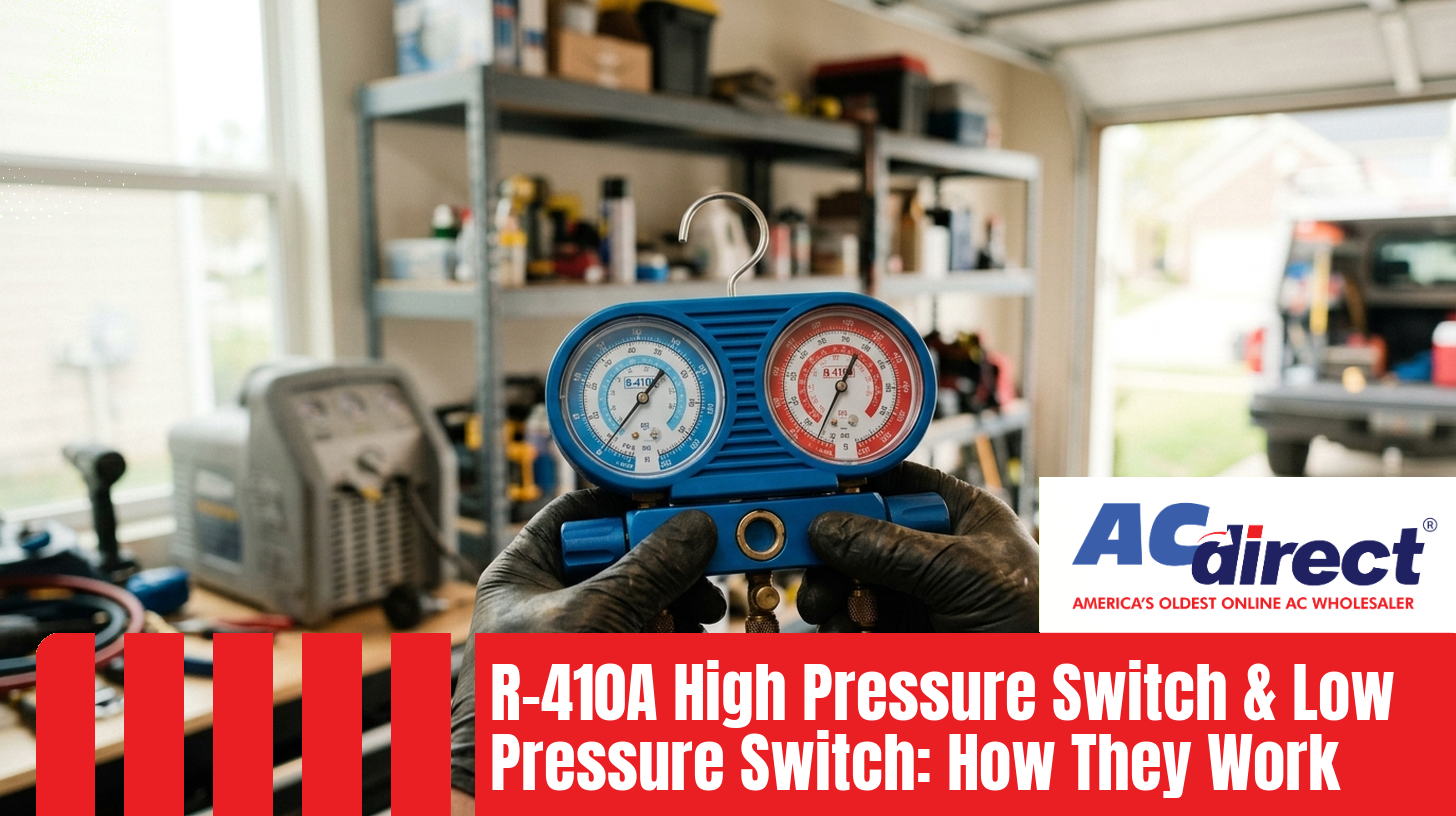
R-410A operates at roughly 60% higher pressures than older R-22 systems. That means R-22 era tools are not safe or accurate on R-410A. The minimum kit looks like this:
| Tool | Why It Matters |
|---|---|
| Manifold gauges rated for R-410A (800 PSI high side minimum) | R-22 gauges will be destroyed; readings will be wrong before they fail |
| R-410A refrigerant cylinder (pink) | Color-coded by industry standard; valve thread differs from R-22 |
| Digital refrigerant scale | R-410A is a zeotropic blend - charging by weight is the only accurate method |
| Vacuum pump (2-stage, 4 CFM minimum) | Removes air and moisture before charging; required after any line opening |
| Micron gauge | Verifies system reaches 500 microns or below - PSI gauges cannot |
| Digital thermometer or clamp probe | For superheat and subcooling verification |
| EPA Section 608 certification | Federally required to purchase R-410A and handle refrigerant. Not optional. |
That last line is worth a pause. Under EPA Section 608, it is illegal for an uncertified individual to purchase R-410A or to intentionally vent it. Wholesale jugs are sold only to certified buyers. If you're not 608 certified, the rest of this article is educational - it is not a permission slip. If you want a deeper look at the gauge side specifically, our guide to R-410A manifold gauges covers gauge selection in detail.
This is the procedure a certified technician follows. We're showing it so you understand what you're paying for - and why a $59 "top off" service usually isn't doing all of this.
If any refrigerant remains, it must be recovered into a recovery cylinder using a recovery machine. Venting R-410A to atmosphere is a federal violation under the Clean Air Act with fines up to $37,500 per day, per violation.
After repair, the system is pressurized with dry nitrogen (typically 300 to 500 PSI) and held for 15 to 30 minutes to confirm no pressure drop. If pressure falls, there's still a leak.
Connect the vacuum pump and run until the micron gauge reads 500 microns or lower, then valve off and confirm the reading holds. This pulls air, nitrogen, and (critically) moisture out of the system. Moisture in a refrigerant circuit creates acids that destroy compressor windings.
Every outdoor unit has a data plate listing the factory charge in pounds and ounces (for example, "4 lbs 7 oz"). For line sets longer than 15 feet, the manufacturer's installation manual specifies how much additional refrigerant per foot of line. This is the target number.
Place the R-410A cylinder on the scale, invert it (R-410A must be charged as a liquid because it's a zeotropic blend - charging vapor changes the blend ratio and degrades performance), and meter liquid into the high side service port with the system OFF. Watch the scale - stop at the nameplate weight.
After running 15 to 20 minutes to stabilize, confirm the charge with measurements - not guesses. On a 70-75°F day, expect suction pressure of 118-135 psi, discharge pressure of 370-420 psi, subcooling of 8-12°F, and superheat of 10-15°F. Always defer to the manufacturer's spec, which is printed on the data plate or in the install manual.
| Measurement | Typical Range | What It Tells You |
|---|---|---|
| Suction (low side) pressure | 118 - 135 psi | Indicates evaporator load and charge level |
| Discharge (high side) pressure | 370 - 420 psi | Indicates condenser performance and charge level |
| Static pressure (system off, 70°F) | ~201 psi | Baseline check before starting |
| Subcooling (TXV systems) | 8 - 12°F | Confirms liquid reaches the metering device |
| Superheat (fixed orifice systems) | 10 - 15°F | Confirms full evaporator use without flooding compressor |
Why two methods? Modern systems with thermal expansion valves (TXVs) are charged by subcooling. Older fixed-orifice (piston) systems are charged by superheat. Get this wrong and you'll chase numbers that don't apply.
- Eye protection and gloves, every time. Liquid R-410A boiling on skin is around -60°F.
- Never open a service port with the system pressurized and your face nearby. Crack fittings slowly with the port pointed away.
- Never apply heat to a refrigerant cylinder. Not a heat gun, not a torch, not hot water above 125°F. Cylinders can rupture.
- Never mix refrigerants. Adding R-22 or R-32 to an R-410A system contaminates the charge, voids any warranty, and can damage the compressor.
- Never vent refrigerant to atmosphere. Federal violation. EPA fines start at thousands of dollars per incident.
- Work outdoors or in well-ventilated space. R-410A displaces oxygen in enclosed areas.
We'll be honest: for the vast majority of homeowners, an R-410A recharge is not a DIY job. The federal certification requirement alone closes the door for most. But even setting that aside, the equipment cost (manifold gauges, vacuum pump, micron gauge, scale, recovery machine) runs $600 to $1,200 - roughly the cost of two professional service calls.
If you'd rather skip the recharge math entirely and look at your options, shop our r410a air conditioning system overstock - new pre-2025 manufactured equipment that's still legal to install in 2026 under the EPA's enforcement-discretion window. Or call AC Direct at (888) 776-1427 to talk to an R-410A expert about whether recharging or replacing makes more sense for your specific situation.
For homeowners who do hold a 608 certification and want to handle smaller refrigerant tasks themselves, our guide to R-410A recharge kits walks through what's in a complete kit and what to skip.
If your system is older and a recharge feels like throwing money at the problem, you have two legitimate paths in 2026. New equipment using R-454B (Carrier, Trane, Rheem, Lennox, Mitsubishi) or R-32 (Daikin, Goodman, Amana, LG, Fujitsu) - both lower-GWP A2L refrigerants - is now the standard. Or, brand-new R-410A equipment manufactured before the January 1, 2025 cutoff is still available, still legal to install while inventory holds, and often priced aggressively to clear. Both are real options. Different products for different buyers.
Can I add R-410A to my AC myself in 2026?
Federally, no - not unless you hold an EPA Section 608 certification. R-410A cannot be sold to uncertified buyers, and intentional venting carries federal penalties. If you are 608 certified and equipped, the procedure follows the steps above. If not, this is a service call.
How much R-410A does my system need?
The factory charge is printed on the outdoor unit's data plate in pounds and ounces. For line sets longer than 15 feet, the installation manual specifies additional refrigerant per foot. Charging is done by weight on a scale - never by guessing pressures.
My system is low on refrigerant. Why?
It has a leak. R-410A is not consumed during normal operation; a sealed system should hold its original charge for the life of the equipment. Common leak points include the Schrader valve cores, brazed joints at the indoor coil, and corrosion-induced pinholes on the evaporator. Locate and repair the leak before recharging, or you'll be paying for refrigerant twice.
What pressures should I see on a properly charged R-410A system?
On a 70-75°F outdoor day, expect suction pressure between 118 and 135 psi and discharge pressure between 370 and 420 psi. Verify the actual charge with subcooling (8-12°F on TXV systems) or superheat (10-15°F on fixed-orifice systems), not pressure alone.
Is R-410A illegal in 2026?
No. The EPA AIM Act stopped manufacturing of new R-410A equipment on January 1, 2025, but existing systems are grandfathered. You can legally own, operate, service, and recharge an R-410A system indefinitely. New R-410A equipment manufactured before the 2025 cutoff also remains legal to install while inventory lasts, under current EPA enforcement discretion.
Should I recharge my old R-410A unit or replace it?
If the unit is under 10 years old and the leak is small and repairable, recharge after repair makes sense. If the unit is 12 to 15+ years old, has a major leak (evaporator coil, compressor, line set), or has needed multiple refrigerant additions, the math usually favors replacement. AC Direct stocks both R-410A overstock equipment and the new R-454B and R-32 lineups - call to discuss which fits your situation.
Whether you need a recharge kit, replacement R-410A equipment from our pre-2025 overstock, or guidance on switching to an R-454B or R-32 system, our team can help you weigh the real costs. Wholesale pricing direct to homeowners and contractors.