

R-410A HVAC Systems: Why Now Is Still the Right Time to Buy
-
 By
Michael Haines
By
Michael Haines
- May 3, 2026
Manufacturing stopped in 2025. Installation is still legal. Overstock pricing is real. Here's what every homeowner and contractor needs to know about buying a complete R-410A HVAC system in 2026.
There's a quiet misunderstanding in the HVAC market right now, and it's costing homeowners money. Most people hear "R-410A phase-out" and assume the systems are illegal, broken, or somehow second-tier. None of that is true. What actually happened is more nuanced, and for buyers paying attention in 2026, it has created one of the better value windows in recent HVAC memory.
The short version: new R-410A equipment manufactured before January 1, 2025 is still legal to install, fully warrantied, and increasingly available at clearance pricing. For the full regulatory picture, our R-410A Air Conditioning Systems: Complete 2026 Buyer's Guide covers it in depth. This article focuses on what you need to understand if you're ready to actually buy a complete system.
When people shop online, they sometimes pick a single condenser and assume that's "the system." It isn't. A complete R-410A HVAC system is several matched components engineered to work together as one unit. Buying piecemeal, or pairing mismatched components, is one of the fastest ways to lose efficiency and void a warranty.
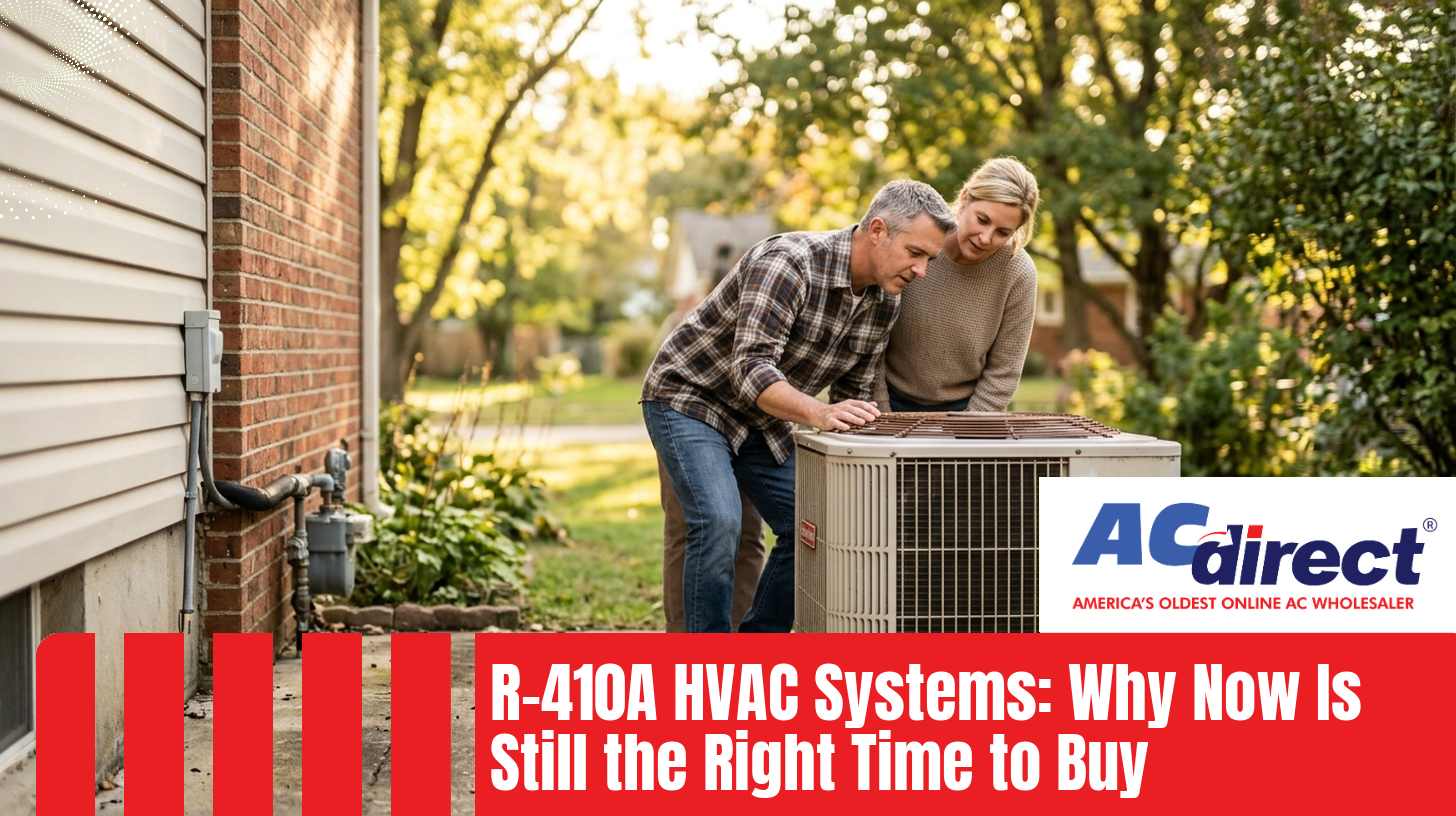
- Outdoor condenser (or heat pump unit). The big metal box outside. Contains the compressor, the outdoor coil, and the fan that rejects heat to the outside air (or pulls heat from it, in a heat pump).
- Indoor air handler or evaporator coil. Sits in your attic, closet, or basement. Either a complete air handler with a built-in blower, or a cased coil that mounts on top of an existing furnace.
- Line set. A pair of insulated copper refrigerant lines (suction and liquid) that connect the indoor and outdoor units. Length and diameter must match the system's tonnage and the manufacturer's spec.
- Thermostat and low-voltage wiring. The control layer. Must be compatible with single-stage, two-stage, or variable-speed equipment as appropriate.
- Refrigerant charge. R-410A factory-charged in the condenser, with additional refrigerant added based on line set length per the manufacturer's instructions.
The economics here are the whole story. New systems running R-454B or R-32 are estimated to cost roughly 10 to 30 percent more than the R-410A equipment they replace, driven by refrigerant cost and the A2L safety components now required (built-in leak detection sensors, modified compressors, updated controls).
R-410A overstock equipment doesn't carry that premium. It was manufactured before the cutoff at standard production cost, and distributors are motivated to move it. The result is a meaningful spread on a complete r410a air conditioning system compared to its A2L counterpart of equal capacity and efficiency.
| Cost Factor | R-410A Overstock System | New A2L (R-454B or R-32) System |
|---|---|---|
| Equipment base cost | Clearance pricing | Current production pricing |
| vs. comparable A2L | 10 to 30% lower | Reference baseline |
| Refrigerant for service (per lb installed) | $40 to $90 | Higher, supply still ramping |
| Wholesale 25 lb cylinder | $75 to $200 | Variable, often higher |
| Required A2L safety hardware | Not required | Built-in leak detection mandatory |
| Warranty | Full manufacturer warranty | Full manufacturer warranty |
For ongoing service, R-410A refrigerant itself is not being phased out of production until the 2040s, and reclaimed supply is expected to sustain the service market for at least 10 to 20 years. A central AC typically takes 2 to 4 pounds per ton of cooling capacity for a full recharge, so even a worst-case future service event remains manageable.
The HVAC industry was facing potential losses exceeding $500 million nationwide if the original R-410A installation deadline had been strictly enforced. When the EPA proposed removing that deadline and deprioritized enforcement of the installation ban, distributors pivoted hard. Inventory that was sitting in warehouses became aggressively priced overstock, and that's the opportunity in front of buyers right now.
This is not distressed inventory. It's brand-new equipment, sealed in original factory packaging, manufactured before January 1, 2025 by major brands like Goodman, Rheem, MRCOOL, and others. The reason it's discounted is simple inventory mechanics, not product quality. A few realities to keep in mind:
- Inventory is finite. No new R-410A equipment is being produced. Once a model sells out, it sells out. There is no restock.
- Selection narrows over time. The most popular tonnages (2.5, 3, 3.5, and 4 ton) tend to move first. If you have a specific size in mind, sooner is better than later.
- Higher efficiency tiers go fast. 16 SEER and above tends to clear earlier than baseline 14 SEER inventory.
Buying a complete r410a air conditioner is straightforward. The install process has a few specific items worth flagging so the warranty stays intact and the system performs as designed.
For peace of mind, confirm the equipment was manufactured before January 1, 2025. Reputable distributors document this. AC Direct's overstock listings indicate eligibility clearly.
R-410A installation requires a tech who can pull a proper vacuum, weigh in the correct charge, and verify operating pressures. R-410A operates at higher pressures than older R-22 systems, with low side typically running 102 to 145 PSIG and high side 370 to 420 PSIG depending on conditions. Manifold gauges must be R-410A rated.
Ideal subcooling for R-410A systems is typically 8°F to 12°F, with superheat usually between 10°F to 15°F under normal operating conditions. These readings confirm proper charge and protect the compressor.
Line set length and diameter must match the manufacturer's spec for the tonnage being installed. Long line runs require additional refrigerant per the install manual. Skipping this is the single most common cause of capacity loss on otherwise correctly installed equipment.
Most manufacturers require warranty registration within 60 to 90 days of installation, with proof of professional install. This step is what converts the standard warranty into the longer registered warranty period.
If you want to walk through specific brand and tonnage options, our R-410A AC unit buyer's guide covers what to look for. And if you'd rather just talk to a person about your home and what fits, call AC Direct to talk to an R-410A expert. Sizing, matching components, and confirming the right efficiency tier takes about 10 minutes on the phone.
The framing here matters. The r410a price advantage isn't a permanent feature of the market. It exists specifically because manufacturers stopped making R-410A equipment in January 2025, and what's available now is the last production run flowing through distribution. As inventory drains, the deals end. There is no new supply coming.
Meanwhile, A2L equipment is the future and will eventually become the cost-competitive default. Both R-454B (used by Carrier, Trane, Lennox, Goodman, Rheem, MRCOOL, Bosch, and others) and R-32 (used by Daikin, LG, Fujitsu, and parts of the Mitsubishi lineup) are legitimate, EPA-compliant paths forward. Different brands chose different refrigerants for legitimate engineering reasons, and both will serve homeowners well for decades to come. For a closer look at the comparison most buyers are running, see r32 vs r410a (the comparison they're searching).
The point is simply that for buyers needing equipment in 2026, the overstock window is the value window. Once it closes, the entire market resets to A2L pricing.
Yes, provided the equipment was manufactured before January 1, 2025. The EPA proposed removing the installation compliance deadline and has deprioritized enforcement of the original installation ban for residential and light commercial R-410A systems built before the cutoff. A final Technology Transitions rule is expected in early to mid-2026.
Yes. R-410A is not scheduled for production phase-out until the 2040s, and the EPA places no restriction on its use for repair or maintenance of existing systems. Reclaimed R-410A supply is expected to sustain the service market for at least 10 to 20 years.
For homeowners, R-410A typically costs $40 to $90 per pound installed, with some recent reports ranging higher depending on the market. A 25 lb cylinder costs roughly $75 to $200 at the wholesale level. Most central AC units use 2 to 4 pounds of refrigerant per ton of cooling capacity for a full charge.
No. Neither R-454B nor R-32 is a drop-in replacement for R-410A. Required lubricants are different, the equipment must be purpose-built, and A2L refrigerants require integrated leak detection that R-410A systems don't include. Substituting refrigerants voids the warranty and can damage the compressor.
R-410A overstock equipment is brand-new, factory-sealed, manufactured before January 1, 2025, and carries full manufacturer warranty. A2L systems (R-454B or R-32) are the new standard going forward and include built-in leak detection sensors. New A2L systems are currently estimated to cost 10 to 30 percent more than comparable R-410A equipment, which is the core reason overstock pricing is attractive right now.
Until inventory runs out, with no restock. No new R-410A equipment is being manufactured in the U.S. The most popular tonnages and higher efficiency tiers tend to clear first. Once a specific model sells through, it's gone.
Buying a complete R-410A HVAC system in 2026 isn't a workaround. It's a legitimate, fully warrantied, fully serviceable purchase at materially lower cost than the A2L alternative. The catch, if you can call it that, is that the inventory window is finite. New manufacturing has stopped. What's on shelves today is what's left.
For homeowners and contractors who want a proven system at clearance-tier pricing, the math is straightforward.
AC Direct carries complete factory-matched R-410A systems from major brands at phase-out clearance pricing. Limited inventory, no restock once depleted. Ships nationwide.