

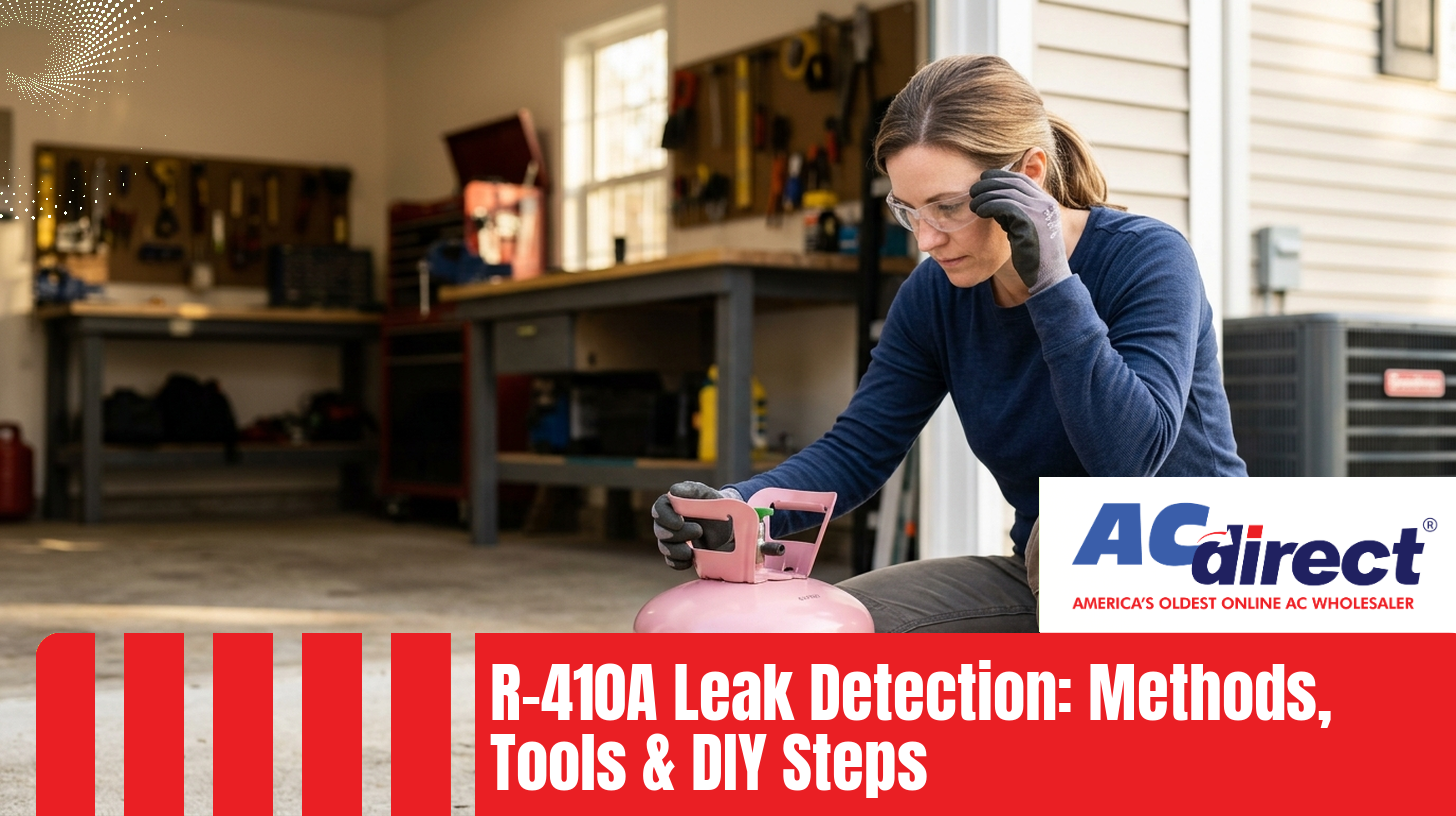
R-410A Leak Detection: Methods, Tools & DIY Steps
-
 By
Michael Haines
By
Michael Haines
- May 9, 2026
A practical, technician-grade guide to finding refrigerant leaks in 2026, when R-410A is still legal to service but every pound costs more than ever.
Your R-410A system is hissing through refrigerant faster than it should, and you have a decision to make. Find the leak, fix the leak, and keep the system alive — or keep topping it off at $50 to $90 per pound and watch the money disappear into the atmosphere. This guide walks through the leak-detection methods professionals actually use, the tools worth buying, the DIY steps you can safely run yourself, and the moment when calling a licensed pro is the right call.
One thing to clear up before we start: R-410A is not banned in 2026. Existing systems can be serviced indefinitely, replacement components are still being produced, and pre-2025 manufactured equipment can still be installed under EPA's current enforcement posture. For the full regulatory picture, see our parent guide, What Is R-410A? The Complete Homeowner's Guide (2026 Edition). The catch is that R-410A refrigerant pricing has climbed sharply, so leaks are no longer a minor annoyance — they're a budget event.
There is no single perfect leak detection method. Pros use a combination, starting broad and narrowing in. Here are the four that actually work on R-410A in the field.
The industry standard. A heated diode sensor pulls air across a heated element that reacts to halogenated refrigerant molecules, triggering an audible alert. These detectors work on R-410A and the new A2L refrigerants (R-454B and R-32) alike, and they will reliably catch leaks down into the small fractions of an ounce per year. Calibration matters — most manufacturers recommend recalibrating every 6 months or after roughly 40 hours of use. Older halide torch detectors, which relied on chlorine content, are essentially obsolete for R-410A and modern A2L work.
A fluorescent dye is injected into the system through the service port. As refrigerant circulates, the dye travels with it and seeps out at any leak point. A UV light then makes the dye glow bright green or yellow at the leak. UV dye is excellent for slow, intermittent, or hard-to-locate leaks — the kind that an electronic detector struggles to catch in real time. Downside: it adds labor for the dye injection visit and a return visit to inspect once the system has run.
Cheap, low-tech, and surprisingly effective. A solution of dish soap and water is dabbed onto suspected leak points — fittings, flare connections, Schrader valve cores, brazed joints. Escaping refrigerant blows visible bubbles. The soap bubble test is most useful as a confirmation step after an electronic detector has narrowed the location, or for pinpointing a leak the detector keeps "ghosting" on.
The diagnostic of choice when the system is empty or after a major repair. The system is recovered, evacuated, and pressurized with dry nitrogen (commonly to 300 to 500 psi for split systems and mini-splits). A pressure gauge is then watched over an extended hold period. Any drop indicates a leak. Combined with soap bubbles or an electronic sniffer, nitrogen pressure testing locates the source with high confidence and is the only honest way to verify a repair held before recharging with refrigerant.
The right detector depends on whether you're a homeowner running occasional checks, a tech servicing systems daily, or somewhere in between. All of the categories below work on R-410A and on the A2L refrigerants you'll increasingly encounter on newer equipment.
| Tool Type | Typical Price | Best For | Works on R-410A & A2L? |
|---|---|---|---|
| Heated Diode Electronic Detector (Pro) | $300 to $700 | Daily service work, fast scanning | Yes |
| Heated Diode Electronic Detector (Entry) | $80 to $200 | Homeowners, occasional DIY checks | Yes |
| UV Dye Kit (dye + injector + light) | $40 to $150 | Slow or intermittent leaks | Yes |
| Ultrasonic Leak Detector | $150 to $400 | Loud environments, supplemental | Yes |
| Soap Bubble Solution (DIY mix) | Under $5 | Pinpointing a known general area | Yes |
| Halide Torch | n/a | Obsolete for R-410A and A2L | No |
Bacharach H-10 and D-tek series detectors are frequently cited by working technicians as reliable, well-calibrated tools that hold up over years of service. For homeowners, an entry-level heated diode model from a reputable HVAC supply brand is enough to confirm whether a leak exists before calling for professional service. If you're already buying tools, take a look at our breakdowns of R-410A recharge kits and when stop-leak additives actually make sense.
Homeowners cannot legally purchase or charge R-410A without EPA Section 608 certification. But you absolutely can locate a leak yourself, document it, and hand a confirmed leak point to your technician — which can shave hours of diagnostic labor off the repair bill.
Warm air from supply vents, ice on the suction line or evaporator coil, hissing sounds near the indoor unit or line set, or a system that runs constantly without cooling. These are classic low-charge symptoms. If the system is short-cycling or the breaker is tripping, stop here and call a pro.
Kill power at the disconnect. Look for oil residue around fittings, brazed joints, the Schrader valve cores, and along the copper line set. R-410A circulates with POE oil, and the oil leaks where the refrigerant leaks. An oily film on a fitting is a strong tell.
Mix dish soap and water (roughly 1 part soap to 4 parts water). The system needs to be under pressure for this to work, so leave it charged. Dab the solution on every accessible flare nut, service port, and visible braze. Watch for 30 to 60 seconds. Growing bubbles equal escaping refrigerant.
Move the probe slowly — about an inch per second — along the line set, around the condenser coil, the evaporator coil access (if reachable), and every fitting. Hold below each suspected point, since R-410A is heavier than air. Mark every alarm with a piece of tape.
Photograph or mark every confirmed leak. Note system age, recent recharge history, and what you've already ruled out. A technician walking up to a pre-diagnosed leak point will spend the visit fixing rather than hunting.
Some leak situations are fully outside the homeowner lane. Hand it off when any of these apply:
- Evaporator coil leaks. Indoor coil leaks usually mean coil replacement, often the largest single repair on a residential AC. Expect 4 to 8 hours of labor and significant parts cost.
- Compressor or service valve leaks. Both require recovery, brazing, evacuation, and recharging — all of which need a certified technician.
- Multiple slow leaks across the system. When a system leaks in three or four spots, the underlying issue is usually corrosion or formicary damage, and patch repairs rarely hold.
- The system is over 10 years old. The math shifts. Repair costs running $1,000 or more on a system past a decade of service, paired with $50-to-$80-per-pound R-410A, often points toward replacement.
- The leak is at the line set inside a wall. Diagnosis and access become specialized work.
A common rule: multiply the repair cost by the system's age in years. If the result exceeds $5,000, replacement usually wins long-term. With recurring leaks adding $500 to $700 per recharge to the picture, that breakeven arrives faster than it used to. Average refrigerant leak repair costs nationally run $200 to $1,600, with most landing around $800. If you're repeatedly chasing leaks on an aging unit, browsing an r410a air conditioner from current overstock inventory may be the cheaper path than another season of patches.
One thing worth knowing: R-410A systems cannot be retrofitted with R-454B or R-32. The new A2L refrigerants require redesigned compressors, different lubricant chemistry, A2L-rated service equipment, and A2L-trained technicians. If your R-410A coil fails, a like-for-like R-410A replacement using overstock equipment is often the fastest, cheapest fix. To check current pricing on available units, see our r410a price page or call to talk to an R-410A expert.
Yes. Leak detectors, soap bubble solutions, and UV dye kits are all available to homeowners without certification. Section 608 certification is only required to handle, purchase, or charge the refrigerant itself.
EPA-recommended sensitivity for refrigerant leak detectors is 0.1 ounce per year for most service work. Heated diode detectors at this sensitivity will catch the slow leaks that bubble tests miss. Calibration every 6 months or 40 hours of use keeps the detector accurate.
Common causes include vibration loosening flare connections, formicary corrosion on indoor evaporator coils (especially in homes with high VOC environments), failed Schrader valve cores, and improperly brazed joints from the original installation. A pattern of repeated leaks usually points to coil corrosion or a workmanship issue rather than bad luck.
No. The EPA's manufacturing cutoff was January 1, 2025, but pre-cutoff equipment remains legal to install in 2026 under current EPA enforcement guidance. Existing systems can also be serviced and recharged with R-410A indefinitely. There are no federal restrictions on the production of replacement components for existing systems.
Stop-leak additives can buy time on very small, slow leaks, but they are not a substitute for proper diagnosis. They can also clog metering devices and complicate future service. We cover the trade-offs in our R-410A stop-leak review.
Refrigerant leak repairs typically run $200 to $1,600 nationally, with the average landing near $800. Add $250 to $700 for the recharge itself, depending on system size. Service call plus leak repair packages frequently land in the $500 to $1,500 range.
AC Direct still has overstock R-410A condensers, air handlers, and complete systems manufactured before the 2025 cutoff — legal to install, factory-warrantied, and priced before the next refrigerant price hike. Limited inventory while supplies last.