

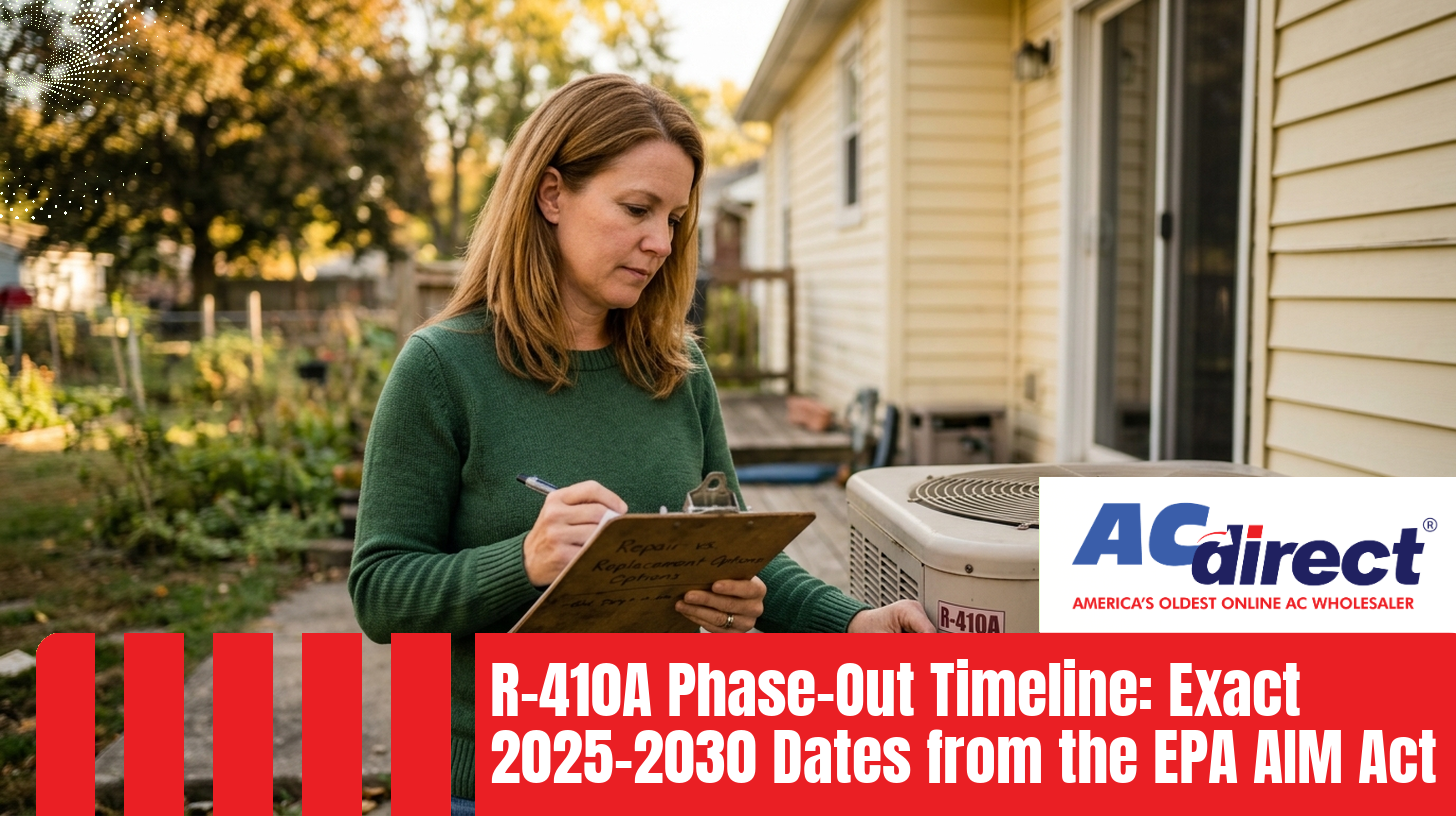
R-410A Phase-Out Timeline: Exact 2025-2030 Dates from the EPA AIM Act
-
 By
Michael Haines
By
Michael Haines
- May 4, 2026
A plain-English calendar of every regulatory milestone, what each one actually means for homeowners, and why "phase-out" is not the same word as "banned."
If you have searched for the R-410A phase-out timeline lately, you have probably run into a confusing mess of dates, headlines, and forum posts insisting that R-410A is either "totally banned in 2025" or "fine forever, don't worry about it." Neither is correct. The truth lives in the middle, and once you see the actual calendar laid out, the picture gets clear fast.
This article walks through every meaningful date in the EPA AIM Act timeline from pre-2024 through 2036, what each one means for homeowners with existing R-410A systems, and what it means for buyers shopping right now. For the broader homeowner overview, see our complete 2026 phase-out guide.
The American Innovation and Manufacturing (AIM) Act was signed into law in December 2020. Its core mandate is simple to state and complicated to execute: cut U.S. production and consumption of hydrofluorocarbon (HFC) refrigerants, including R-410A, by 85% from baseline by 2036.
The phasedown works on a step-down schedule. Each step caps how much HFC can be manufactured or imported as a percentage of the original baseline.
The first reductions began in 2022, capping HFC production at 90% of baseline. These were modest cuts and most homeowners never noticed them at the service counter. Equipment manufacturers, however, used this period to retool factories and finalize their new low-GWP product lines.
This is the date that gets the most attention, and also the most misinterpretation. Starting January 1, 2025, manufacturers are prohibited from producing or importing new residential split system air conditioners and heat pumps that use R-410A.
Read that again carefully. The prohibition applies to manufacturing and importing. It does not say the equipment cannot be sold. It does not say it cannot be installed. It does not say R-410A refrigerant is illegal. The rule narrowly targets the factory door.
Equipment manufactured before January 1, 2025 entered the supply chain legally. Distributors, contractors, and retailers like AC Direct can continue to sell that inventory. This is the foundation of the overstock market that exists right now.
2026 is where the regulatory picture got more interesting, and more favorable for homeowners shopping for an R-410A system.
The EPA originally set January 1, 2026 as the deadline for installing new HVAC systems with GWPs above 700, which would have included any remaining R-410A equipment. That created an obvious problem: hundreds of thousands of legally manufactured R-410A units were still in warehouses, on shelves, and on contractor trucks.
In late 2025, the EPA announced it would deprioritize enforcement of that installation deadline for residential and light commercial AC and heat pump equipment manufactured or imported before January 1, 2025. A formal rule on the reconsideration was expected in early 2026. The agency's enforcement focus shifted to manufacturing and import violations, not installations of already-legal inventory.
This window is exactly why limited R-410A overstock available at wholesale pricing exists in the first place. The equipment is legal, warrantied, and meaningfully cheaper than the new A2L equivalents.
This is where homeowners with existing R-410A systems need to pay attention. The AIM Act's HFC production cap tightens in steps, and each step reduces the amount of virgin R-410A entering the U.S. market for service work.
| Period | Cap (% of Baseline) | What It Means for R-410A |
|---|---|---|
| Through 2028 | 60% | Sharpest single step early in the schedule. Already pushing wholesale prices up. |
| 2029 to 2033 | 30% | Cap cut in half. Expect accelerated price increases on service refrigerant. |
| 2034 to 2035 | 20% | Significant scarcity. Reclaimed refrigerant becomes a primary supply source. |
| 2036 onward | 15% | Final cap. Achieves the AIM Act's 85% reduction target. |
The January 1, 2025 manufacturing/import cutoff applied to all new R-410A equipment, split systems and packaged units alike. What differs is the installation deadline. Split systems had a January 1, 2026 install deadline (which has since been deprioritized for enforcement by the EPA). Packaged and self-contained R-410A units get a longer runway: units manufactured before January 1, 2025 may still be sold and installed through January 1, 2028 under the EPA's sell-through provisions.
Wholesale R-410A prices have already risen 40 to 70% from 2022 baseline levels. As of 2026:
- Wholesale (certified pro purchase): roughly $4 to $8 per pound
- 25 lb cylinder: $75 to $200
- Installed service refill: $50 to $150 per pound
Industry forecasts following the R-22 precedent suggest prices could reach $150 to $250 per pound or higher as the supply cap tightens through the late 2020s. If you have an existing system that needs a recharge, the math on repair-versus-replace shifts every year. Our companion article on whether to replace your R-410A system now or wait walks through the numbers.
Looking past the next service phase-down step, the picture trends in one direction: less virgin R-410A, more reclaimed product, and progressively higher service costs. Importantly, none of this makes existing R-410A systems illegal to operate.
The AIM Act does not require homeowners to remove or replace working R-410A equipment. Systems can run for their useful life and be serviced as needed.
As virgin production caps tighten, refrigerant reclaimed from decommissioned systems will fill the service market. EPA rules already encourage this practice.
The AIM Act reaches its 85% reduction target. Service refrigerant remains available but at scarcity pricing similar to what R-22 reached in its final years.
The 2025 manufacturing cutoff combined with the EPA's enforcement deprioritization on installation created a specific window: legally manufactured R-410A equipment, fully warrantied, available at wholesale pricing while inventory lasts. New A2L systems (using R-454B or R-32) are running 15 to 30% more expensive than their R-410A predecessors due to refrigerant cost and added A2L safety components.
Both R-454B and R-32 are legitimate, EPA-compliant replacement refrigerants. R-454B is used by Carrier, Trane, Rheem, Lennox, and Bosch in ducted systems. R-32 is used by Daikin, Mitsubishi, LG, and Goodman, often in mini-splits. Different products for different buyers, both with valid engineering tradeoffs. If you want the side-by-side, our r32 vs r410a (the comparison they're searching) resource lays it out.
R-410A is in a managed, multi-year phase-out, not an overnight ban. The 2025 manufacturing cutoff already happened. The 2028 cutoff for packaged units is coming. Service refrigerant pricing climbs as production caps tighten. And for buyers right now, pre-2025 manufactured R-410A equipment is legal, warrantied, and priced below the new A2L equivalents.
If you would rather talk through your situation with a person, call AC Direct to talk to an R-410A expert or shop R-410A AC systems before phase-out.
The dates and percentages in this article are drawn from the following primary regulatory sources:
- American Innovation and Manufacturing (AIM) Act of 2020 - the underlying statute that mandates the HFC phasedown schedule.
- EPA HFC Reduction Program - official EPA portal for AIM Act regulations, phasedown allowances, and the Technology Transitions Rule.
- Federal Register - the EPA's October 2025 proposed rule on installation deadline reconsideration was published here, with the final rule expected in early 2026.
- EPA Technology Transitions Rule (40 CFR Part 84, Subpart B) - establishes the GWP-based restrictions on new equipment by sector and the January 1, 2025 manufacturing cutoff.
No. R-410A is not banned in 2026. New residential split system equipment using R-410A cannot be manufactured or imported as of January 1, 2025, but existing inventory can still be sold and installed. Existing systems can continue to operate and be serviced. R-410A refrigerant remains legal to purchase and use for service work.
Yes, if the unit was manufactured or imported before January 1, 2025. The EPA announced in late 2025 that it would deprioritize enforcement of the original January 1, 2026 installation deadline for pre-2025 manufactured equipment. These units carry full manufacturer warranties and are legal to install.
It does not stop, but supply tightens on a fixed schedule. The HFC production cap drops to 60% of baseline through 2028, then 30% from 2029 to 2033, then 20% from 2034 to 2035, and finally 15% from 2036 onward. Reclaimed R-410A is expected to fill an increasing share of service demand as virgin production declines.
Wholesale R-410A prices have risen 40 to 70% from 2022 levels because the AIM Act caps the total amount of HFC refrigerant that can be produced or imported each year. As the cap tightens, supply contracts and prices climb. Industry forecasts suggest service refrigerant could eventually reach $150 to $250 per pound or higher, following the same pattern R-22 went through after its phase-out.
No. R-454B and R-32 are not drop-in replacements for R-410A. They use different lubricants, run at different operating conditions, and are classified A2L (mildly flammable), which requires specific equipment design and safety components. Attempting a retrofit will void warranties, likely cause compressor failure, and create safety hazards. When the time comes, the path is a properly designed new system, not a refrigerant swap.
January 1, 2025 was the manufacturing and import cutoff for residential split system air conditioners and heat pumps using R-410A. January 1, 2028 is the upcoming cutoff for packaged and self-contained units. Both dates restrict only new production, not the use or service of existing equipment.


