Use Code MEGA3 for an Extra 3% Off
Free Shipping On Orders Over $1500

America's Leading Discount HVAC Supplier Since 2001 ... and now, NASCAR Racing Sponsor

Ask an Expert
866 862 8922


 Hours of Operation
 8am - 8pm EST
8am - 8pm EST


Furnace BTU Sizing Tonnage Calculator – Free & Easy to Quickly Find the Right Size
Free furnace BTU calculator
Furnace Sizing Calculator: Find the Right BTU for Your Home
Enter your square footage and climate zone and get the heating output your house needs, then the furnace input size that delivers it at 80% or 96% AFUE. Results link straight to furnaces in that size.
Step 1
Calculate your furnace size
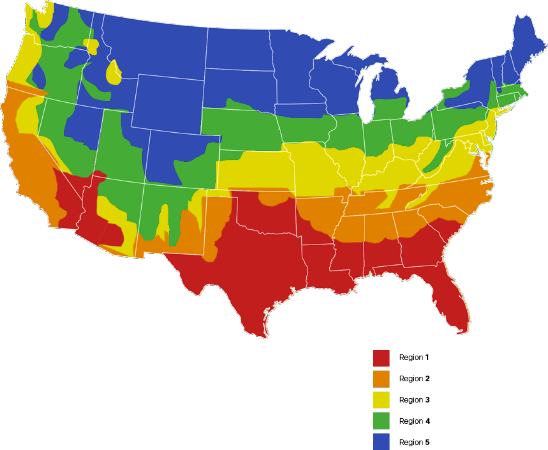
The calculator uses the standard BTU per square foot ranges for each United States heating zone, then adjusts for insulation and ceiling height. Find your zone on the map above or in the table below.
Step 2
Heating BTU per square foot by climate zone
| Zone | Heating need | Typical states |
|---|---|---|
| Zone 1 | 30 to 35 BTU per sq ft | Florida, Gulf Coast, southern Texas and Arizona, coastal California |
| Zone 2 | 35 to 40 BTU per sq ft | Georgia, the Carolinas, Tennessee, Arkansas, most of Texas and California |
| Zone 3 | 40 to 45 BTU per sq ft | Virginia, Kentucky, Missouri, Kansas, Oklahoma, Nevada, the Pacific Northwest |
| Zone 4 | 45 to 50 BTU per sq ft | Pennsylvania, Ohio, Indiana, Illinois, Iowa, Nebraska, Colorado, Utah |
| Zone 5 | 50 to 60 BTU per sq ft | New England, New York, Michigan, Wisconsin, Minnesota, the Dakotas, Montana |
The ranges are heating output, the heat that actually reaches your rooms. Pick the low end of your zone for a tight, well insulated house and the high end for an older house with original windows, a lot of glass or rooms over an unheated garage.
Square footage is the biggest single input, but it is not the only one. Two 2,000 square foot houses on the same street can need furnaces a full size apart because one has new windows and attic insulation and the other does not. How to size a furnace by square footage walks through the other factors.
Step 3
Input BTU, output BTU and why AFUE changes the size you buy
Furnaces are labeled and sold by input BTU, the gas they burn per hour. The heat you get is the input multiplied by the AFUE rating. An 80,000 BTU input furnace delivers 64,000 BTU at 80% AFUE and 76,800 BTU at 96% AFUE. That is why the calculator shows two input sizes: a higher efficiency furnace can be one size smaller and still heat the same house.
Sizing to output also explains why a 100,000 BTU furnace is not automatically the safe choice for a large home. An oversized furnace satisfies the thermostat in a few minutes, shuts down, and starts again a few minutes later. Short cycling wastes gas, wears the igniter and blower, and leaves the far rooms cool because the air never ran long enough to reach them. The right size runs longer, quieter cycles.
Two-stage and modulating furnaces soften a slightly oversized pick because they can run at reduced input most of the season. They do not rescue a furnace that is two sizes too big. The high efficiency furnace guide compares single-stage, two-stage and modulating lineups at 96% and 97% AFUE.
Step 4
From a number to a furnace
Pick the BTU band
Every gas furnace we sell is grouped by input BTU: 40,000 to 75,000, 80,000 to 105,000 and 110,000 to 150,000. Wholesale pricing shows on each product page.
Match width and airflow
A replacement furnace has to fit the cabinet width and move enough air for your existing ductwork and air conditioner. The product page lists cabinet width and blower CFM for every model.
Talk to an advisor or order Manual J
Call 1-866-862-8922 to have a factory trained advisor confirm the size, or order a Manual J residential load calculation from your floor plan and location.
Answers
Furnace sizing questions
How many BTUs does a furnace need per square foot?
Roughly 30 to 60 BTU of heating output per square foot, depending on climate. Zone 1 homes in the warm South need about 30 to 35 BTU per square foot, while Zone 5 homes in the far North need 50 to 60. Insulation, ceiling height and window area move the number inside that range.
What is the difference between furnace input BTU and output BTU?
Input BTU is the gas the furnace burns per hour. Output BTU is the heat that reaches your ductwork. The difference is the AFUE rating: an 80,000 BTU input furnace at 80% AFUE delivers 64,000 BTU of heat, while the same input at 96% AFUE delivers 76,800 BTU. Furnaces are sold by input, so size to output and then pick the input that gets you there.
What size furnace do I need for a 2,000 square foot house?
In a moderate climate (Zone 3, 40 to 45 BTU per square foot) a 2,000 square foot house needs about 80,000 to 90,000 BTU of heating output. That is a 100,000 BTU input furnace at 80% AFUE or an 80,000 to 100,000 BTU input furnace at 96% AFUE. Colder zones push the number higher; a well insulated newer home pulls it lower.
Is a bigger furnace better?
No. An oversized furnace heats the house in short bursts, shuts off, and repeats. That short cycling wastes gas, wears out the igniter and blower faster, and leaves rooms far from the thermostat cold. The correct size runs longer, quieter cycles and holds a steadier temperature.
Does this calculator work for mobile or manufactured homes?
No. Manufactured homes use furnaces built to a different standard with their own sizing rules. Use the mobile home furnace sizing calculator instead.
How accurate is a square footage furnace calculator?
It gets most homes within one furnace size and is a good starting point for shopping. For a final selection on a house with unusual windows, a finished basement, vaulted ceilings or an addition, a Manual J load calculation measures the actual heat loss room by room.