

Converting R-22 to R-410A: Is It Worth It in 2026?
-
 By
Michael Haines
By
Michael Haines
- May 7, 2026
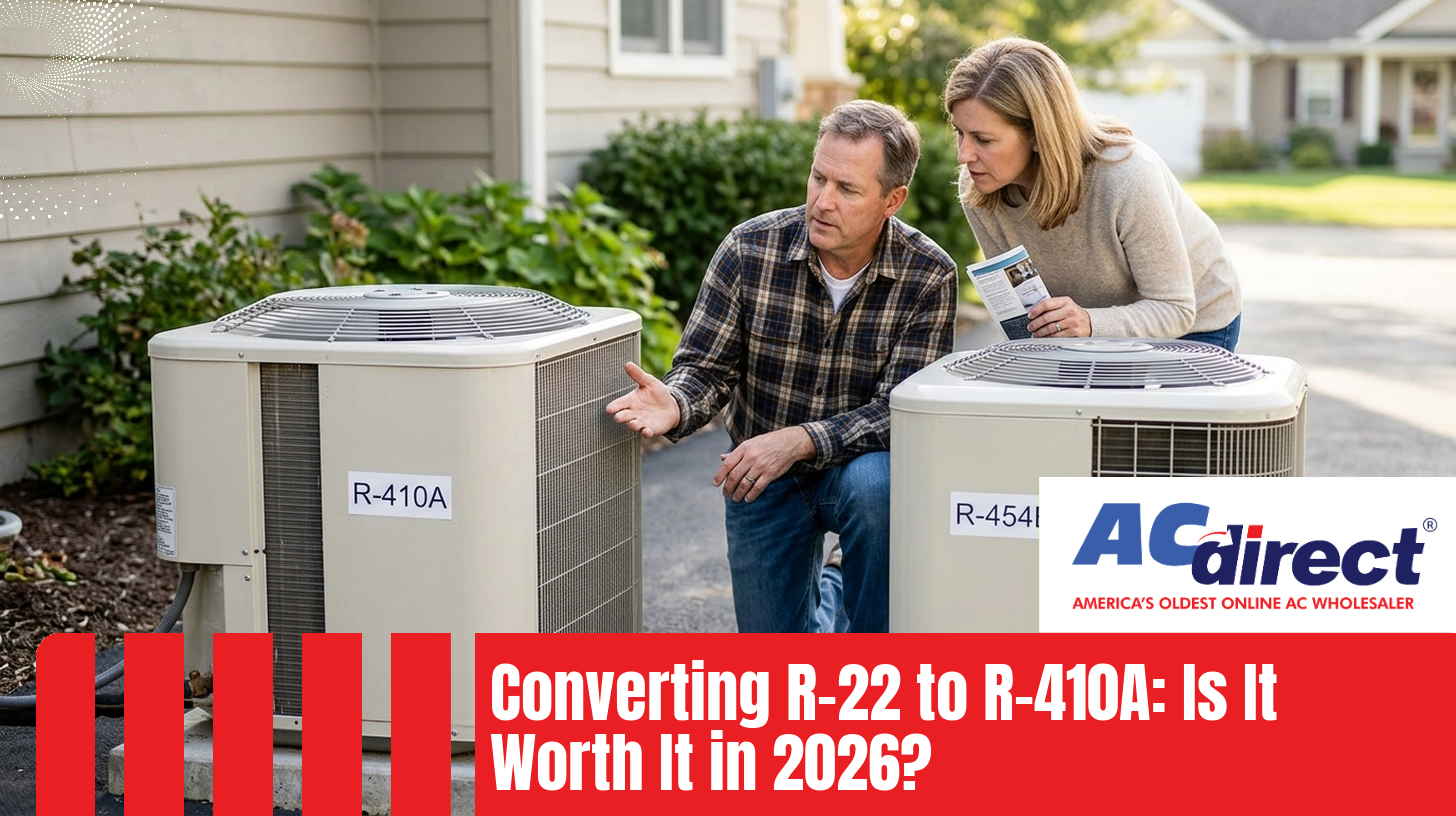
An honest look at what an R-22 to R-410A conversion actually involves, what it costs, and why most contractors will tell you to skip it entirely.
If you still have an R-22 air conditioner running in your home, you've probably been told the refrigerant is getting expensive, hard to find, or both. That's true. So the natural next question is: can I just convert this thing to R-410A and keep the rest of my equipment? Technically, yes. Practically, almost never.
This article walks through exactly what an R-22 to R-410A conversion requires, what it tends to cost, and how that math compares to buying a new R-410A overstock system at phase-out pricing. If you want the bigger picture on every refrigerant in play right now, our R-32 vs R-410A vs R-454B vs R-22 complete refrigerant comparison guide covers each one side by side.
The motivation usually comes down to one of three things:
- R-22 refrigerant has gotten expensive. Production stopped years ago, and reclaimed R-22 prices have climbed steadily. A single recharge can hit four figures.
- The outdoor unit "still works." The compressor hums, the fan spins, and the air gets cold. Replacing the whole thing feels wasteful.
- Sticker shock on full replacement. A complete new system, especially one of the new A2L units, can run noticeably more than expected. Converting sounds like a budget shortcut.
The instinct is reasonable. The reality of what conversion involves, unfortunately, is not as friendly as the pitch suggests.
The phrase "refrigerant conversion" makes it sound like a swap. It isn't. R-410A operates at significantly higher pressures than R-22, and the two refrigerants use incompatible lubricants. Converting a system isn't a refrigerant change; it's a near-total rebuild of the equipment.
Here's what a real conversion job demands, in roughly the order a technician would tackle it:
R-22 compressors are not rated for R-410A pressures. There is no exception to this. The compressor must be swapped for a unit specifically built for R-410A.
The condenser coil and evaporator coil were both designed around R-22's pressure and heat-transfer characteristics. Running R-410A through R-22 coils risks ruptures and gives you mediocre performance even when nothing fails. Both coils typically come out and get replaced.
R-22 systems use mineral oil. R-410A systems use POE (polyolester) oil. The two do not mix well, and any residual mineral oil left in the line set can damage the new compressor. Lines must be thoroughly flushed at minimum, and replaced outright if there's any doubt about their integrity at the higher pressures.
The expansion valve or piston is calibrated for R-22's flow characteristics. R-410A requires its own metering device. This part is small but non-negotiable.
Every drop of mineral oil has to come out. POE oil goes in. Get this step wrong and the new compressor dies early.
A new R-410A-rated filter-drier is required. Fittings and service ports often need updating to handle the higher pressures and to match standard R-410A service equipment.
This is where the conversion idea usually falls apart on paper. Let's stack them up honestly. Numbers below are typical ranges; your actual quotes will vary by region and contractor.
| Line Item | R-22 → R-410A Conversion | New R-410A Overstock System |
|---|---|---|
| Compressor | $1,200 - $2,200 | Included |
| Condenser coil | $600 - $1,400 | Included |
| Evaporator coil | $700 - $1,500 | Included |
| Metering device + drier | $150 - $400 | Included |
| Line set flush or replace | $300 - $900 | Reuse or replace as needed |
| POE oil + R-410A charge | $200 - $500 | Factory charged |
| Labor (8-14 hours) | $1,200 - $2,400 | Standard install labor |
| Approximate total | $4,350 - $9,300 | Often less, with full warranty |
| Manufacturer warranty | Voided / patchwork | Full new-equipment warranty |
| System matched & rated | No AHRI match | AHRI-matched and SEER2 rated |
A "converted" system is, by definition, a Frankenstein assembly. It carries no AHRI rating, no manufacturer warranty on the assembled system, and no efficiency rating you can trust on a utility bill or rebate application.
For roughly the same money — sometimes less — you can install a brand-new r410a air conditioning system from current overstock inventory. New cabinet, new everything, factory warranty, AHRI-matched, and priced down because of the EPA's manufacturing cutoff. The conversion path costs more and delivers less.
The honest answer most contractors will give you, if they're being straight: no. Here's why the math keeps landing in the same place in 2026.
Once you total the parts and labor, conversion lands in the same neighborhood as a fresh R-410A install. You just end up with mismatched components, an old cabinet, and no system warranty.
The EPA's AIM Act prohibited new manufacturing of R-410A residential AC equipment after January 1, 2025. Equipment built before that date can still be legally installed under sell-through provisions, and the EPA has signaled enforcement flexibility on the installation deadline. But the long-term direction is clear: R-454B and R-32 are the future. Converting an R-22 system to R-410A in 2026 means investing in a refrigerant that's also winding down. (For the broader timing question, see our piece on whether to replace your R-410A system now or wait.)
A 15-year-old R-22 cabinet was built to roughly 10-13 SEER. New r410a air conditioner systems hit 14.3 SEER2 minimum (equivalent to roughly 15 SEER on the old scale), with many overstock units running 16-18 SEER2. Converting keeps the old, lower-efficiency cabinet. You're paying premium parts costs to keep below-current-standard efficiency.
The single biggest shift since 2022: pre-2025 R-410A inventory is selling at phase-out prices, while new A2L systems (R-454B and R-32) are running 8-30% more expensive and dealing with refrigerant supply issues. That's the practical comparison most homeowners face — not "convert vs. replace at full retail," but "convert vs. take advantage of overstock r410a price while it's available."
If your R-22 outdoor unit is genuinely new (rare, but it happens with light commercial equipment), and the indoor coil is recent, and the line set is clean, and you can source a compatible R-410A compressor, and labor in your area is unusually cheap — there's a narrow scenario where conversion math works. For 99% of residential homeowners reading this: no. (For a clean-slate decision framework, our R-22 vs R-410A comparison walks through the practical differences.)
Skip the conversion. Replace the system. With the EPA cutoff already in place and overstock R-410A inventory shipping at phase-out pricing, this is genuinely the right window to buy. Need a hand pricing the right size for your home? Call AC Direct at 1-855-244-1349 to talk to an R-410A expert.
Limited inventory of pre-2025 R-410A systems still ships nationwide. Full warranty, AHRI-matched, wholesale direct.
Can you put R-410A in an R-22 system without changing parts?
No. R-410A operates at roughly double the high-side pressure of R-22 and uses POE oil instead of mineral oil. Charging R-410A into an unmodified R-22 system risks compressor failure, line ruptures, and immediate equipment damage. Anyone offering a "drop-in" R-410A swap is misrepresenting what's actually involved.
How much does converting R-22 to R-410A cost in 2026?
A complete, properly executed conversion typically lands in the $4,350 to $9,300 range for a 3-ton residential system, including new compressor, coils, metering device, line set work, oil change, refrigerant, and labor. That's in the same neighborhood as a brand-new overstock R-410A system, which comes with a full manufacturer warranty and an AHRI-rated efficiency match.
Is R-410A still legal to install in 2026?
Yes, with conditions. The EPA prohibited new manufacturing of R-410A residential AC equipment after January 1, 2025, but equipment built before that date can still be legally installed under sell-through provisions. The EPA has also indicated enforcement flexibility on the installation deadline. Existing R-410A systems remain fully legal to own, operate, and service indefinitely.
Will my R-22 outdoor unit work with a new R-410A indoor coil?
No. R-22 and R-410A systems are not cross-compatible at the component level. The outdoor unit's compressor, refrigerant charge, metering, and oil are all R-22-specific. Mixing a new R-410A indoor coil with an old R-22 outdoor unit doesn't work and can damage both.
Should I just replace my R-22 system instead of converting it?
For nearly every residential situation, yes. Replacement gives you a matched, warrantied, AHRI-rated system with modern efficiency. Conversion gives you a patchwork assembly at similar cost with no warranty and lower efficiency. The decision is even clearer right now because pre-2025 overstock R-410A equipment is available at phase-out pricing — often less than what a proper conversion would total.
Are R-454B or R-32 systems a better choice than overstock R-410A?
Both are legitimate paths and both will be the long-term standard. In early 2026, however, A2L systems are running 8-30% more expensive than equivalent R-410A equipment and have dealt with refrigerant supply shortages. For buyers focused on upfront cost, the r410a cost on overstock units is hard to beat right now. For buyers prioritizing the newest refrigerant standard, R-454B and R-32 systems are excellent and worth the premium.