

R-22 vs R-410A: Differences, Conversion & What Old AC Owners Need to Know
-
 By
Michael Haines
By
Michael Haines
- May 6, 2026

Two refrigerants, two regulatory phase-outs, and a lot of confusion. Here is what actually matters if you own an older system or are shopping for a new one in 2026.
Your AC starts blowing warm air in the middle of a heat wave. You call a technician and within five minutes you are hearing words like "phase-out," "A2L," and "the refrigerant in your unit is no longer being made." So what does it actually mean? Do you need to replace a perfectly good system? Is your old unit suddenly illegal? Are the new refrigerants better, or just newer?
This guide walks through the real differences between R-22 and R-410A, why both have been pushed out of new equipment, what conversion actually involves, and what your options look like in 2026. For a wider look at how R-410A stacks up against the next-generation refrigerants too, see our complete refrigerant comparison guide covering R-32, R-454B, R-410A, and R-22.
R-22, often sold under the brand name Freon, is a hydrochlorofluorocarbon (HCFC). For decades it was the default refrigerant in residential split systems. If your outdoor unit was installed before about 2010, there is a strong chance it runs on R-22.
Production and import of new R-22 was banned in the United States on January 1, 2020, completing a phase-out that began under the Montreal Protocol because of R-22's role in depleting the ozone layer. New equipment using R-22 stopped being manufactured years before that. Today, R-22 is only available through reclaimed and recycled supplies, and the price reflects it: prices climbed past $150 to $250 per pound in many markets at the peak of the squeeze.
R-22 contains chlorine, and chlorine is the part that destroys ozone when refrigerant escapes into the atmosphere. The international Montreal Protocol identified HCFCs as a major contributor to ozone depletion, and the United States committed to a multi-decade phase-out that ended new R-22 production on January 1, 2020.
The replacement, R-410A, fixed the ozone problem. It contains no chlorine. But it introduced a different problem - global warming potential (GWP). R-410A has a GWP of 2,088, meaning a pound of escaped R-410A traps roughly 2,088 times more heat in the atmosphere than a pound of carbon dioxide. That is what put R-410A on its own phase-out path under the AIM Act of 2020.
R-410A is a hydrofluorocarbon (HFC). It became the dominant residential refrigerant from roughly 2010 onward and powers tens of millions of systems currently in service. Compared to R-22, it transfers heat more effectively, runs at higher pressures, and uses different oil. Those differences are not just trivia - they are the reason you cannot mix the two refrigerants or swap one for the other in the same equipment.
| Property | R-22 | R-410A |
|---|---|---|
| Chemical class | HCFC (contains chlorine) | HFC (no chlorine) |
| Ozone depletion | Yes - significant | None |
| Global warming potential (GWP) | 1,810 | 2,088 |
| Low-side operating pressure | 58 to 85 PSIG | 102 to 145 PSIG (typical 115-120) |
| High-side operating pressure | ~ 200 to 250 PSIG | 370 to 420 PSIG on a warm day |
| Compressor oil | Mineral oil | Synthetic POE oil |
| New equipment manufacturing | Banned Jan 1, 2020 | Restricted Jan 1, 2025 (GWP > 700) |
| Service refrigerant in 2026 | Reclaimed only - expensive | Available, supply tightening |
The AIM Act restricted manufacturing and import of new residential AC and heat pump systems using refrigerants with GWP at or above 700 starting January 1, 2025. R-410A's GWP of 2,088 sits well above that line, so it is out for new equipment going forward.
But here is the part that gets misreported constantly: R-410A is not illegal. Existing systems are grandfathered, R-410A service refrigerant remains available indefinitely through reclaimed and recycled supplies, and new R-410A equipment manufactured before the January 1, 2025 cutoff remains legal to install. In late 2025, the EPA announced it would temporarily deprioritize enforcement of the install ban on this pre-2025 inventory, giving distributors and homeowners a real window to acquire R-410A equipment at attractive pricing.
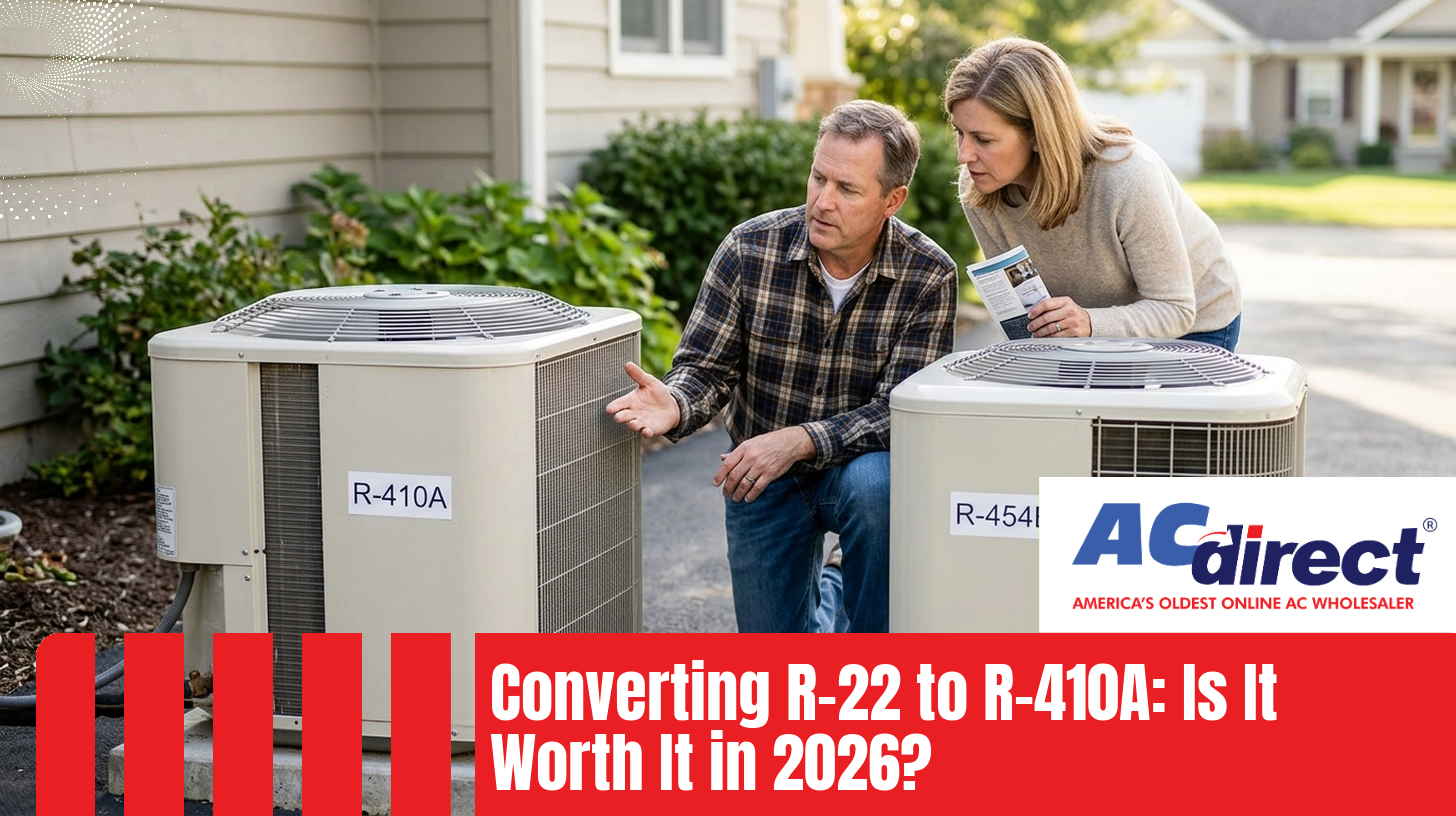
This is the question we hear most from owners of older systems: "Can I just convert my R-22 unit to R-410A?" The short answer is no, not really - but let's unpack why, because the reasoning is the same reasoning that applies if you are thinking about converting an R-410A system to one of the newer refrigerants like R-454B or R-32.
Converting from R-22 to R-410A is not a refrigerant swap. It is, at minimum, a near-complete equipment replacement. Here is what is involved:
R-410A operates at roughly twice the pressure of R-22. The compressor, condenser coil, and connection fittings in an R-22 unit are simply not built to handle that pressure safely. Forcing R-410A into R-22 hardware risks rupture and compressor failure.
Indoor coils are sized and rated for a specific refrigerant. An R-22 coil paired with an R-410A condenser produces poor capacity, poor efficiency, and high failure rates. AHRI-matched systems exist for a reason.
R-22 systems use mineral oil. R-410A uses synthetic POE oil. Residual mineral oil contaminates the new system, breaks down POE, and damages the new compressor. Most contractors simply replace the line set rather than gamble on a flush.
TXVs and pistons are calibrated to the refrigerant. The filter drier desiccant is also refrigerant-specific. Both must be swapped.
By the time you have replaced the condenser, evaporator, line set, metering device, and drier, you have essentially installed a new system. There is no shortcut. For a deeper walkthrough on this exact process, including what to expect for cost and timeline, see our R-22 to R-410A conversion guide.
The refrigerant in an HVAC system is one ingredient in a tightly engineered recipe. Change the ingredient, and the recipe stops working. Three reasons it goes wrong:
R-410A high-side discharge pressures regularly hit 370 to 420 PSIG on a warm day. R-22 systems operate around 200 to 250 PSIG on the same day. Pumping R-410A through R-22-rated tubing, brazed joints, and compressor housings creates a real safety hazard, not just a performance issue.
R-22 mineral oil and R-410A POE oil do not mix in any useful way. Mineral oil will not return to the compressor properly with R-410A as the carrier, leading to lubrication starvation and compressor burnout. Even small residual amounts of mineral oil in a converted system have caused field failures.
Metering devices, accumulators, and filter driers are all engineered around a refrigerant's specific thermodynamic properties. Mismatched components produce poor superheat and subcooling, freezing coils, flooded compressors, and warranty-voiding installations.
The same logic applies to R-410A and the new A2L refrigerants. R-454B and R-32 are not drop-in replacements for R-410A either. They use different oils in some cases, have flammability classifications that require different leak detection and brazing practices, and the equipment must be specifically engineered for them. A useful way to think about it: every refrigerant generation requires its own equipment generation. For details on how the newer refrigerants compare, our R-32 vs R-410A breakdown covers it.
Three realistic scenarios cover most homeowners reading this:
Keep running it until it makes economic sense to replace. Service is legal but expensive. Major leaks or compressor failures usually push the math toward replacement rather than repair, especially since R-22 refrigerant alone can run hundreds of dollars per pound.
You are in the best position. Your equipment is modern, service refrigerant remains widely available, and there is no regulatory pressure pushing replacement. Run it until it dies of natural causes.
You have two legitimate paths:
- New A2L equipment (R-454B or R-32). The latest generation, future-aligned with regulation, but currently affected by refrigerant shortages and price increases that have exceeded 300% in some categories. Lead times can be longer.
- Pre-2025 manufactured R-410A overstock. Legal to install, ships now, and priced aggressively because distributors are moving inventory through the EPA's enforcement deprioritization window. Service refrigerant remains available throughout the equipment's lifespan.
Both are reasonable. The right choice depends on your timeline, your budget, and how long you plan to stay in the home. If you want to talk it through with someone who deals with this every day, call AC Direct to talk to an R-410A expert - they will walk you through both options without any pressure.
R-410A equipment manufactured before January 1, 2025 is legal to install in 2026 under the EPA's enforcement deprioritization. As A2L refrigerants face supply constraints and price increases, that pre-2025 inventory has become genuinely valuable - and it is finite. Once the overstock is gone, it is gone. AC Direct's r410a price on remaining inventory reflects that reality.
No. R-22 production and import was banned on January 1, 2020, but using and servicing existing R-22 systems remains completely legal. The challenge is cost - service refrigerant comes only from reclaimed sources, and prices have climbed accordingly.
Not in any practical sense. A real conversion requires replacing the outdoor condenser, indoor coil, metering device, filter drier, and usually the line set. By the time you finish, you have installed a new system. The only thing salvageable from the old setup is typically the ductwork.
No. New residential equipment using R-410A could not be manufactured or imported after January 1, 2025, but existing systems are grandfathered, service refrigerant remains available, and pre-2025 manufactured equipment is still legal to install under the EPA's enforcement deprioritization announced in late 2025.
Both are legitimate options. Pre-2025 R-410A overstock offers attractive pricing right now and uses refrigerant that will be serviceable for years to come. A2L equipment (R-454B or R-32) is newer and future-aligned but is currently impacted by refrigerant shortages and significant price increases. The right answer depends on your budget, timeline, and how long you plan to stay in the home.
For homeowners, installed prices typically range from $40 to $100 per pound. A typical recharge requires 2 to 4 pounds per ton of cooling capacity. Wholesale 25-pound cylinder pricing for contractors generally runs $400 to $500 or more. Prices are expected to rise gradually as supply tightens through the AIM Act's HFC allowance phase-down.
R-22 uses mineral oil because mineral oil mixes well with R-22 and returns reliably to the compressor. R-410A is not soluble with mineral oil, so it requires synthetic polyolester (POE) oil, which mixes properly with R-410A and lubricates the higher-pressure compressors used in R-410A systems. Mixing oils between systems causes lubrication failure and compressor burnout, which is one of the main reasons refrigerants cannot be swapped.