 and now, NASCAR Racing Sponsor


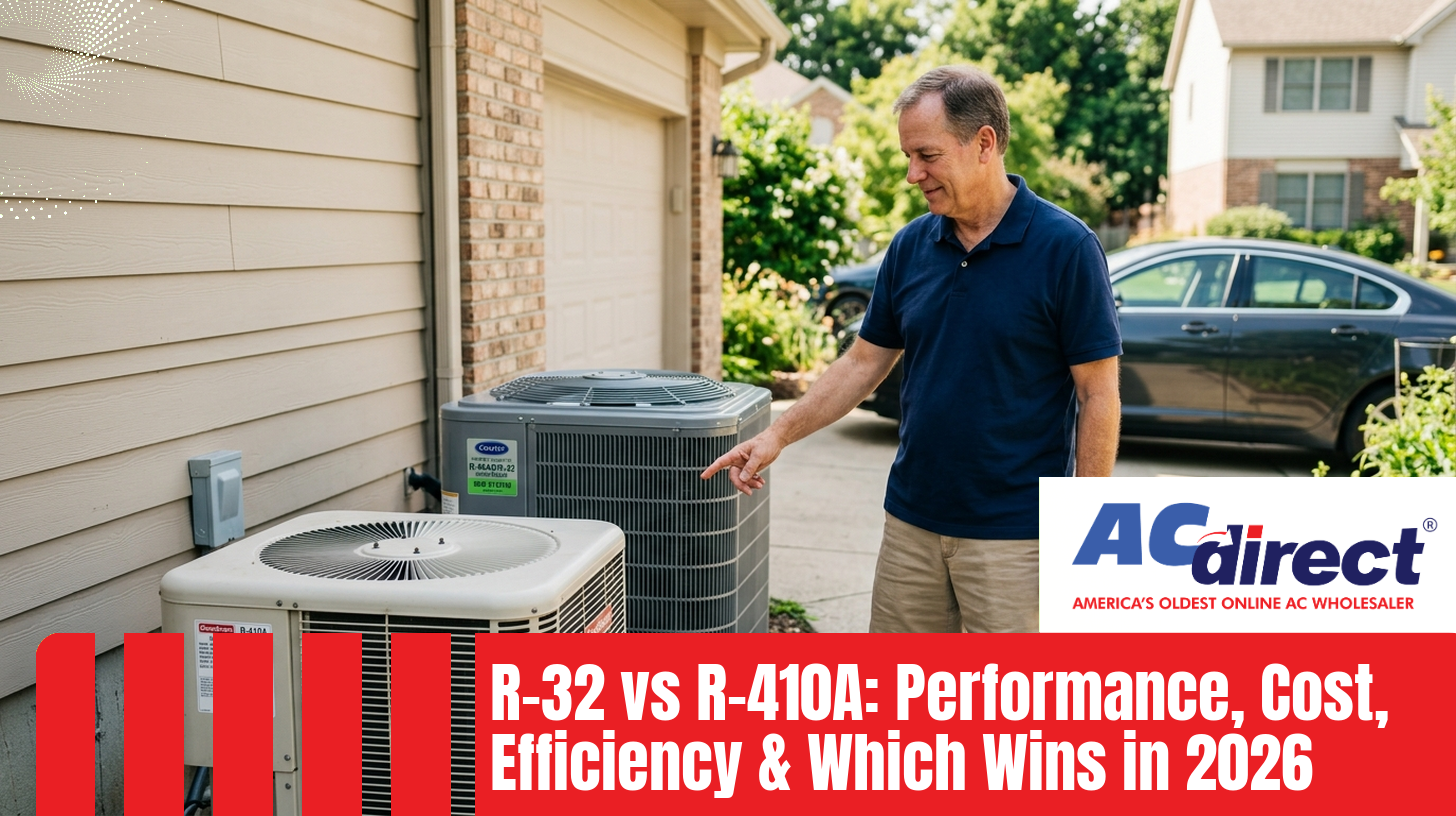
R-32 vs R-410A: Performance, Cost, Efficiency & Which Wins in 2026
-
 By
Michael Haines
By
Michael Haines
- May 6, 2026
Two refrigerants. One industry transition. Here's the honest comparison - pressures, GWP, efficiency, and what it actually costs you in 2026.
Imagine your air conditioner quits in the middle of a scorching July heatwave in 2026. Panic sets in. Can you still get an R-410A unit? Will repairs cost a fortune? Are you forced into an unfamiliar new system overnight? The short answer: you have more options than the headlines suggest, and the comparison between R-32 and R-410A is more nuanced than "old vs new."
This article cuts through the confusion. We'll walk through the specs, the operating pressures, the efficiency math, and the real 2026 pricing picture - so you can make a decision that fits your budget and your timeline. For a wider comparison that includes R-454B and R-22, see our complete refrigerant comparison guide.
Before we get into operating behavior, let's lay out the data side by side. These are the numbers that drive every other difference between these two refrigerants.
| Property | R-410A | R-32 |
|---|---|---|
| Composition | 50/50 blend (R-32 + R-125) | 100% Difluoromethane |
| Global Warming Potential (GWP) | 2,088 | 675 |
| Ozone Depletion Potential | 0 | 0 |
| ASHRAE Safety Class | A1 (non-flammable) | A2L (mildly flammable) |
| Critical Pressure | 716.4 psia | 838.6 psia |
| Boiling Point (0 PSIG) | -54.0°F | -61.0°F |
| Molecular Weight | 72.58 g/mol | 52.02 g/mol |
| Typical Refrigerant Charge | Baseline | 20-30% less than R-410A |
| Typical SEER Range | 16-23 | 18-26 |
A few things jump out: R-32 is a single-component refrigerant rather than a blend, it has roughly one-third the GWP of R-410A, and it operates at higher pressures. Each of those traits matters in different ways.
R-32 operates at noticeably higher pressures and discharge temperatures than R-410A. Typical R-32 suction pressure runs about 115-130 psi, with discharge pressure in the 350-400 psi range. Discharge temperatures land roughly 12-18°C (about 22-32°F) higher than R-410A under similar conditions.
This is why R-32 is not a drop-in replacement for R-410A. The compressor needs to be designed to handle those higher discharge temperatures. Lubricant chemistry, expansion valve calibration, and component materials all have to be engineered for the refrigerant. The same is true going the other direction: you cannot pour R-32 into a system built for R-410A and expect it to work safely or efficiently. We covered this in detail in our R-410A drop-in replacement breakdown.
From a contractor's standpoint, the practical takeaway is: R-32 systems use familiar gauge ranges but require A2L-rated tools, leak detection, and EPA Section 608 certification training updated for mildly flammable refrigerants. The work is similar; the safety protocol is more careful.
Global Warming Potential is the single biggest reason this transition is happening. GWP measures how much heat a refrigerant traps in the atmosphere compared to an equal mass of carbon dioxide over 100 years. R-410A sits at 2,088. R-32 sits at 675. That's roughly a 68% reduction.
The EPA's AIM Act set the regulatory line at GWP 700 for residential split systems. R-410A is far above that line. R-32 sneaks under it. R-454B (the other major replacement) is even lower at GWP 466. All three have zero ozone depletion potential, so the comparison is purely about climate impact.
R-32 systems typically deliver 10-20% greater energy efficiency than equivalent R-410A units. SEER ratings on R-32 equipment commonly land in the 18-26 range, versus 16-23 for R-410A. COP figures sit at roughly 4.0-4.5 for R-32 versus 3.6-4.0 for R-410A.
Two factors drive this. First, R-32 transfers heat more efficiently due to its higher pressure ratio and single-component composition. Second, because R-32 systems require 20-30% less refrigerant by mass, they need less energy to circulate that smaller charge through the system.
Real-world performance depends on installation quality, sizing, and usage patterns. The efficiency edge is real but does not always translate to dramatic monthly bill differences in mild climates.
Worth noting: an installed R-410A unit operating well today is not suddenly inefficient because R-32 exists. Equipment efficiency depends mostly on the system design (variable-speed compressor, coil sizing, controls), not just the refrigerant. A well-designed R-410A system can absolutely outperform a basic R-32 system. The refrigerant is one variable among many.
Here's where the conversation gets practical. There are three cost layers to think about: equipment cost, refrigerant cost, and long-term operating cost.
New systems built for R-32 (and R-454B) are running roughly 15-30% more expensive upfront than the R-410A equipment they replace. The premium reflects new compressor designs, A2L safety components, redesigned coils, and the early-cycle pricing that accompanies any major industry transition. Pricing is expected to normalize as production volume scales up over the next few years.
R-410A pricing has been climbing as supply tightens. Contractors are paying $400-$500+ per 25-lb cylinder at wholesale in early 2026, which equals roughly $16-$20 per pound. Homeowners typically see $40-$90 per pound on installed service calls, depending on market and labor. R-32 is generally cheaper to manufacture and is expected to settle into lower per-pound pricing as it becomes the dominant refrigerant. For more detail on the r410a price trend, our overstock landing page tracks current inventory.
| Cost Layer | R-410A | R-32 |
|---|---|---|
| New equipment (current market) | Lower (overstock pricing available) | 15-30% higher upfront |
| Wholesale refrigerant (per lb) | $16-$20+ and rising | Lower, expected to stabilize |
| Installed service (per lb) | $40-$90 | Comparable to R-410A early on |
| Annual operating cost | Baseline | 10-20% lower (efficiency) |
The market has split along brand lines, not because one refrigerant is "better," but because manufacturers made different engineering bets.
Daikin, the world's largest HVAC manufacturer, chose R-32 for its residential lineup, and its U.S. subsidiary Goodman was an early adopter on certain models. LG and MRCOOL have also leaned into R-32, particularly on the mini-split and ductless side. R-32's single-component composition and proven track record in Asian and European markets made it a natural fit for these brands.
Carrier (under the Puron Advance name), Trane, Lennox, Rheem, York, Bosch, and Day & Night have largely standardized on R-454B for residential ducted, ductless, and light commercial equipment. R-454B's operating pressures are nearly identical to R-410A, which simplified the transition for these manufacturers' existing platforms.
Existing R-410A systems are everywhere - tens of millions of units installed across the country. They will keep operating for their full service life. Service refrigerant remains available, sourced from remaining virgin stock and a growing reclaimed/recycled market. New R-410A equipment manufactured before January 1, 2025, can still be installed legally under the EPA's current enforcement deprioritization.
If you are weighing R-410A against the older R-22 systems still in some homes, our R-22 vs R-410A breakdown covers that side of the timeline.
Forget the marketing for a minute. Here's the clear-eyed version of when each makes sense in 2026.
- You're planning to own the home 10+ years. The efficiency gains and cheaper future refrigerant supply pay back over time.
- You run AC heavily. In hot climates with long cooling seasons, the 10-20% efficiency advantage adds up.
- You want the longest forward-compatibility window. R-32 is regulatorily compliant and will be supported for decades.
- You're buying ductless. R-32 mini-splits from Daikin, LG, MRCOOL, and others are mature, proven, and widely available.
- You need to replace a unit now and budget is tight. Overstock R-410A equipment is selling at meaningful discounts versus new-refrigerant systems.
- Your existing system uses R-410A and the indoor coil is fine. Matching a new R-410A condenser to an existing R-410A air handler avoids a full system replacement.
- You're a contractor with R-410A inventory to move. The EPA's enforcement deprioritization gives you a longer installation window than originally expected.
- You want familiar service technology. Every HVAC technician has decades of R-410A experience. A2L training is still rolling out.
R-32 (and R-454B) carry the A2L "mildly flammable" classification. That term sounds alarming but the practical reality is more measured. A2L refrigerants have a burning velocity below half a mile per hour and require both a high concentration and a sustained ignition source - like an open flame held directly to a leak - to burn at all. Even when ignited, the flame is unsustainable and self-extinguishing.
What this means in practice: licensed installers use leak detection sensors on the indoor unit, follow updated A2L installation codes, and complete EPA Section 608 certification with the A2L addendum. From the homeowner's standpoint, the equipment looks and operates the same as a non-flammable system. There has been no meaningful real-world safety issue tied to A2L residential refrigerants in markets that have used them for over a decade.
Our team can walk through your specific situation - existing system, replacement needs, budget, and climate - and tell you straight whether overstock R-410A makes sense or whether jumping to a new-refrigerant system is the smarter move.
Cooling performance depends far more on system design than on refrigerant choice. A high-end R-410A system with a variable-speed compressor will out-cool a basic R-32 unit, and vice versa. That said, R-32 systems are typically 10-20% more energy efficient, meaning they deliver the same cooling using less electricity. If you're comparing two equivalent-tier systems, the R-32 unit usually has the edge in efficiency-per-BTU.
No. R-32 operates at higher pressures and discharge temperatures than R-410A, uses different lubricant chemistry, and requires components rated for A2L mildly flammable refrigerants. Attempting to charge an R-410A system with R-32 will damage the equipment, void the warranty, and create a safety hazard. The two refrigerants require purpose-built systems. The same applies to R-454B - none of these are drop-in replacements for R-410A.
No. R-410A is not illegal. The EPA stopped new manufacturing and import of R-410A residential split systems on January 1, 2025, but existing systems are grandfathered, service refrigerant remains legal indefinitely, and equipment manufactured before the cutoff can still be installed under the EPA's current enforcement deprioritization. Looking for an r410a air conditioner? Pre-2025 inventory is still available through legitimate channels.
Refrigerant production was capped under the AIM Act phasedown, and demand from existing systems still in service stays steady. Less supply plus consistent demand equals rising prices. Wholesale costs for R-410A in 25-lb cylinders are running $400-$500+ in early 2026, with installed homeowner service costs landing in the $40-$90 per pound range.
R-32 has dramatically lower GWP at 675, compared to R-410A's GWP of 2,088. That's roughly a 68% reduction in climate impact per unit of refrigerant. Both have zero ozone depletion potential. R-454B sits even lower at GWP 466.
Not on its own. A working R-410A system will continue to operate normally for its full service life, and service refrigerant will remain available for many years through virgin and reclaimed supply. Replace your system when it makes sense based on age, repair history, and efficiency - not because of refrigerant rule changes alone.
Yes, when installed by a licensed technician using A2L-rated equipment. R-32's burning velocity is extremely low, ignition requires a sustained open flame at high concentration, and the flame is self-extinguishing. Markets in Europe and Asia have used R-32 residentially for over a decade without significant safety incidents. Modern A2L safety codes and leak sensors handle the risk effectively.