

R-410A Condenser Guide: Sizing, Replacement & Best Deals (2-5 Ton)
-
 By
Michael Haines
By
Michael Haines
- May 2, 2026

Picking the right tonnage, understanding what's actually legal to install in 2026, and finding the overstock units that haven't disappeared yet.
If your outdoor condenser just gave out, or you're planning ahead for an aging system, you've probably noticed the market got weird in 2025. Manufacturers stopped building new R-410A units. Distributors started discounting inventory. Then the EPA quietly changed its enforcement stance in late 2025, and suddenly that "phased-out" R-410A condenser sitting on a warehouse shelf became one of the better deals in HVAC.
This guide walks through how to size an R-410A condenser correctly, what each tonnage costs in 2026, how the major brands stack up, and when it makes sense to replace just the condenser versus the whole system. For broader background on the equipment category, see our R-410A Air Conditioning Systems: Complete 2026 Buyer's Guide.
Sizing isn't about picking the biggest unit you can afford. An oversized condenser short-cycles, fails to dehumidify, and burns through compressors. An undersized one runs constantly and never catches up on a 95°F afternoon. Both are expensive mistakes.
The right way to size is a Manual J load calculation, performed by a contractor or estimated using detailed software. It accounts for things a square-foot rule of thumb can't:
- Climate zone. Phoenix and Minneapolis don't size the same way.
- Window area, type, and orientation. South-facing single-pane glass loads up a room fast.
- Insulation levels in walls, attic, and crawl space.
- Ceiling height (volume matters, not just floor area).
- Occupancy and appliance heat gains.
- Duct condition. A 4-ton system feeding leaky ducts effectively delivers 3 tons.
- Shading from trees or neighboring buildings.
That said, a starting-point estimate is useful when you're shopping. The general rule of thumb in residential cooling is roughly 400 to 600 square feet per ton, with hotter climates landing on the lower end of that range.
| Home Size | BTU Cooling Load | Condenser Tonnage | Notes |
|---|---|---|---|
| 900 to 1,200 sq ft | 24,000 BTU | 2 Ton | Smaller homes, condos, additions |
| 1,200 to 1,500 sq ft | 30,000 BTU | 2.5 Ton | Mid-size single-story |
| 1,500 to 1,800 sq ft | 36,000 BTU | 3 Ton | Most common residential size |
| 1,800 to 2,100 sq ft | 42,000 BTU | 3.5 Ton | Larger ranch or two-story |
| 2,100 to 2,400 sq ft | 48,000 BTU | 4 Ton | Larger homes, hot climates |
| 2,400 to 3,000 sq ft | 60,000 BTU | 5 Ton | Largest typical residential size |
If your home is well-insulated and shaded, drop one half-ton. If you're in Phoenix or south Texas with lots of glass, consider the next size up.
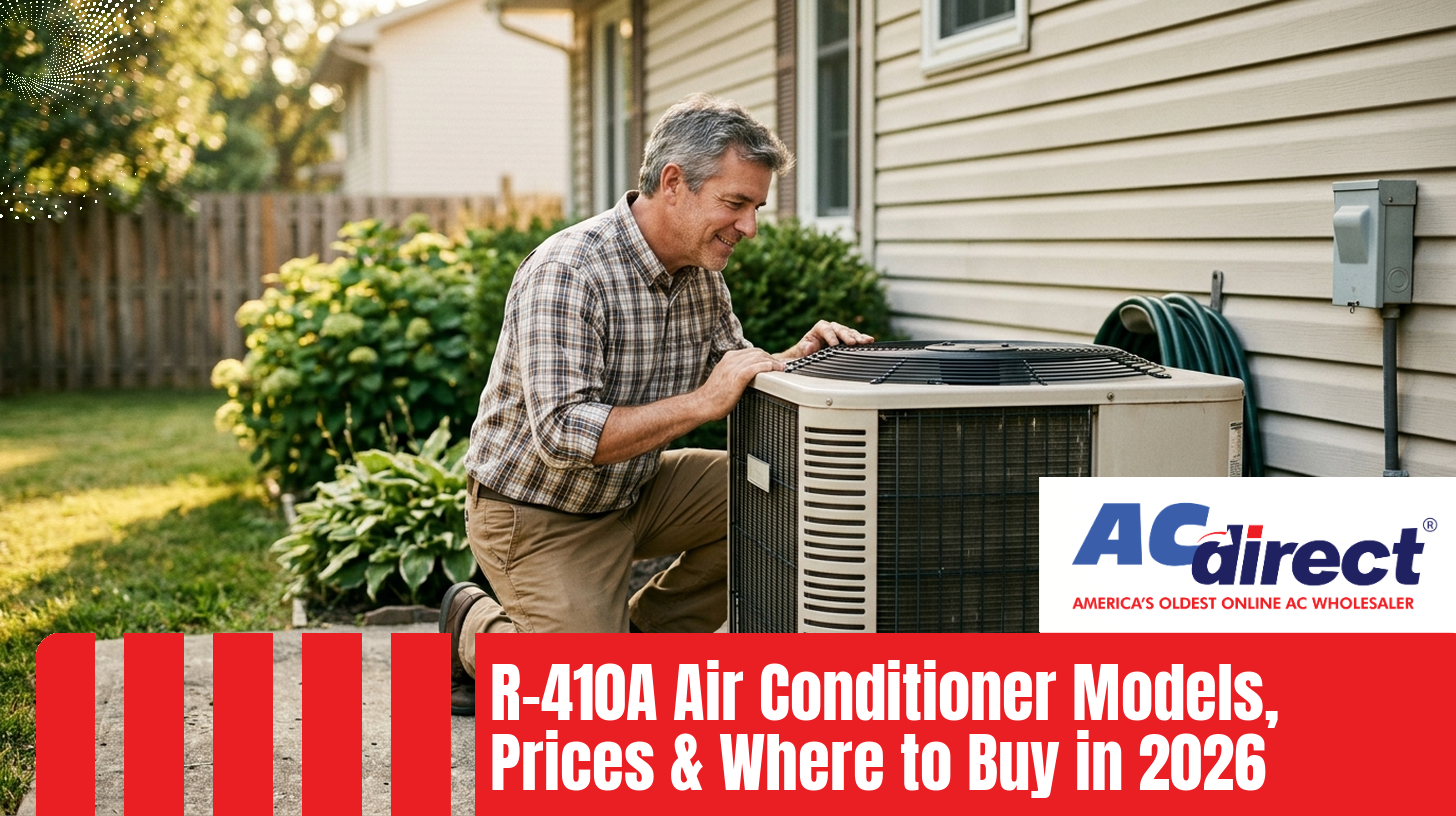
The 2-ton condensing unit covers homes around 900 to 1,200 sq ft, additions, finished basements, and small ranches. It's also the most common replacement size for older, smaller homes. Pre-2025 manufactured 2-ton R-410A units are widely available as overstock at AC Direct's r410a air conditioning system inventory page.
2.5-ton sits in the sweet spot for 1,200 to 1,500 sq ft. It's a popular replacement size when contractors find the original 3-ton was oversized for the actual load. Quieter operation, better humidity control, lower runtime cost.
The most common residential tonnage in America. If you live in a 1,500 to 1,800 sq ft single-family home built in the last 30 years, there's a good chance the existing condenser is a 3-ton. Replacement parts and overstock R-410A condensers in this size are still readily available.
3.5-ton is sized for larger ranches, two-story homes around 1,800 to 2,100 sq ft, and homes with above-average heat gain (lots of windows, vaulted ceilings, hotter climate zones). Less common than 3 or 4 ton, but a real fit for the homes that need it.
The 4-ton handles 2,100 to 2,400 sq ft, especially in southern climates. This is also a frequent choice for two-story homes where one zone covers most of the conditioned space.
The largest standard residential size. Homes in the 2,400 to 3,000 sq ft range, particularly in Florida, Texas, Arizona, and the Gulf states, commonly use 5-ton equipment. If your existing system is a 5-ton, replacing with another 5-ton is almost always the right call - resist the urge to "upgrade" to something bigger.
Browse what's currently available across all tonnages on our aircon r410a overstock page.
Condenser pricing depends on tonnage, SEER2 rating, brand, and whether it's matched with a coil and air handler. The numbers below are typical 2026 ranges for the condenser unit itself, not full installations. For a deep look at refrigerant-only pricing, see our 2026 R-410A cost-per-pound breakdown.
| Tonnage | Typical Range | Best Fit Home Size |
|---|---|---|
| 2 Ton | $1,200 to $1,800 | 900 to 1,200 sq ft |
| 2.5 Ton | $1,400 to $2,000 | 1,200 to 1,500 sq ft |
| 3 Ton | $1,600 to $2,200 | 1,500 to 1,800 sq ft |
| 3.5 Ton | $1,800 to $2,400 | 1,800 to 2,100 sq ft |
| 4 Ton | $2,000 to $2,600 | 2,100 to 2,400 sq ft |
| 5 Ton | $2,300 to $3,000 | 2,400 to 3,000 sq ft |
What's pushing prices: refrigerant cost. Installed R-410A in 2026 typically runs $40 to $90 per pound, up 40 to 70% from 2022 baselines as the AIM Act phasedown squeezes supply. A 3-ton system holds roughly 6 to 9 pounds of charge - factor that into any service call on an existing unit.
The major manufacturers each handled the R-410A transition differently, and most have now moved their new equipment lines to either R-454B or R-32. Here's how the brands AC Direct carries shake out for R-410A overstock and their A2L successors.
| Brand | R-410A Overstock | New A2L Refrigerant |
|---|---|---|
| Goodman | Available | R-32 and R-454B lines |
| Carrier | Available | R-454B (Puron Advance) |
| Rheem / Ruud | Available | R-454B |
| Trane | Available | R-454B |
| Daikin | Limited | R-32 (early adopter) |
| Lennox | Available | R-454B |
| Mitsubishi | Available | R-454B and R-32 |
| MRCOOL | Available | R-454B / R-32 transitioning |
The classic question: your outdoor condenser failed, and your indoor evaporator coil and air handler are still working. Do you replace just the condenser, or swap the whole system?
- Indoor coil and air handler are under 8 years old and well-maintained.
- Existing indoor coil is rated for R-410A and matches the new condenser's capacity (AHRI-matched).
- You want to keep upfront costs down and your current system has been reliable.
- Ductwork is in good condition.
- Indoor and outdoor units are both 12+ years old. Both are in their failure window.
- The indoor coil has had repeated leaks or refrigerant issues.
- You're moving from R-410A to a new A2L system. R-454B and R-32 are NOT drop-in replacements for R-410A. Different oil chemistry, different operating pressures, different safety class. The whole system has to match.
- You want updated SEER2 efficiency for lower bills.
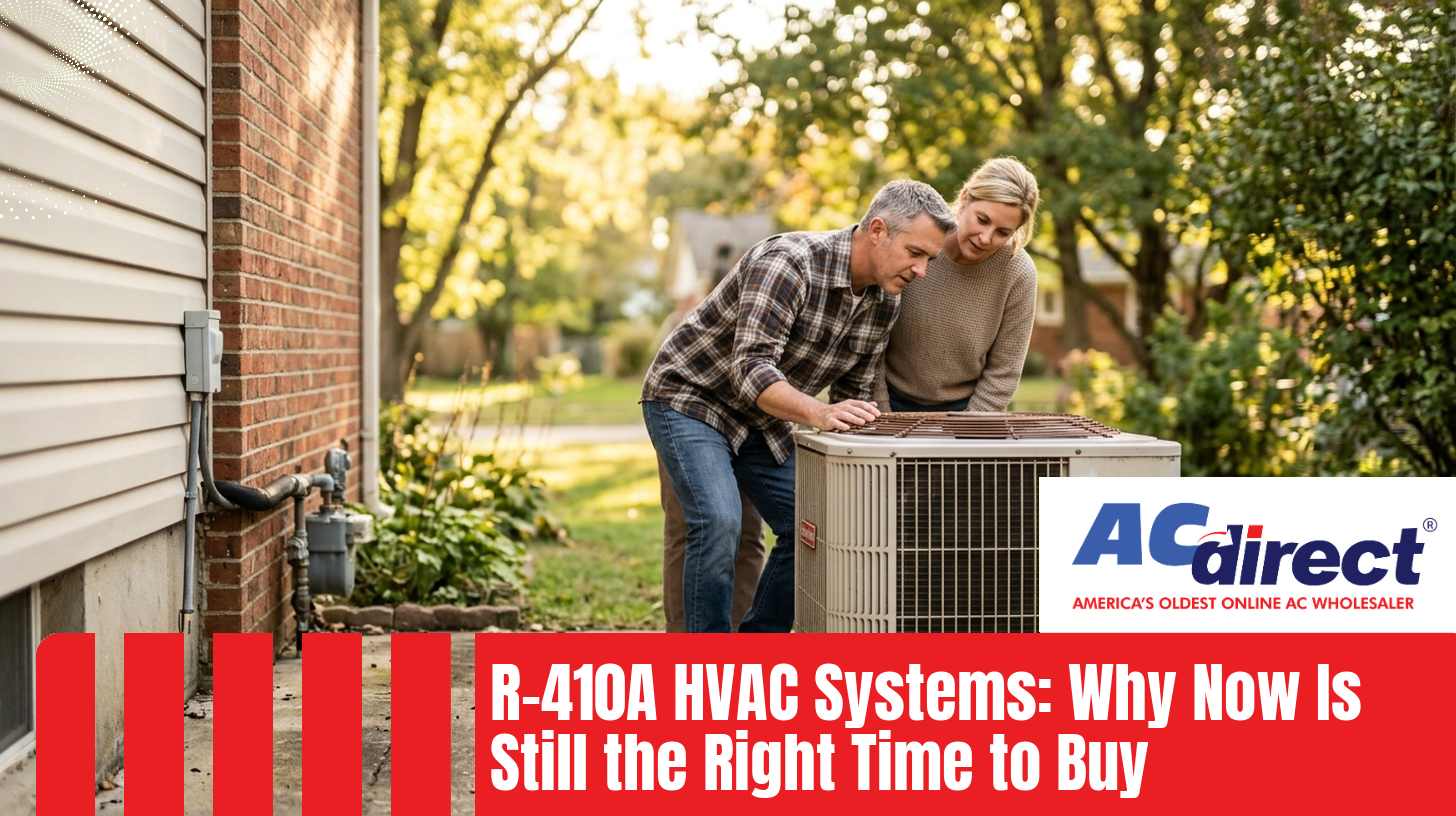
For most homeowners with a working but aging R-410A indoor coil, the strongest play right now is matching it with an overstock pre-2025 R-410A condenser. You get a long-term-serviceable system at clearance pricing without the higher upfront cost of a full A2L conversion. Need help thinking through the math? Call to talk to an R-410A expert before you buy.
For more on how AC Direct's overstock inventory fits into a 2026 buying decision, see our companion piece on R-410A HVAC systems in 2026. Pricing pressure on refrigerant is real - if you're trying to gauge what a service call on an existing system will cost, the latest r410a price data is worth a look before scheduling work.
In most states, yes - if the unit was manufactured before January 1, 2025. The EPA announced in late 2025 that it would deprioritize enforcement of the January 1, 2026 installation deadline. New York's Part 494 maintains the original deadline, and a few other states may follow. Pre-2025 manufactured equipment is what AC Direct stocks as overstock.
No. R-454B and R-32 are not drop-in replacements. The systems are designed around different operating pressures, different refrigerant oil compatibility, and different safety requirements (A2L is mildly flammable). Charging the wrong refrigerant into an R-410A system will damage it and void warranties.
Many years. R-410A refrigerant production isn't ending - only new equipment manufacturing is restricted. Refrigerant for service, parts, and qualified technicians will be available for the foreseeable future, similar to how R-22 systems remained serviceable long after that phase-out began. Expect prices to keep climbing as supply tightens, though.
Start by matching your existing system's tonnage if it has been keeping up with your home comfortably. A general estimate is 400 to 600 sq ft per ton, but a Manual J load calculation is the only accurate way to size. Don't oversize - it causes humidity problems and short-cycling.
Distributors have been working through stranded inventory - more than $500 million in R-410A equipment was sitting in warehouses going into 2026. With manufacturing of new units halted, that overstock is being moved aggressively. The window for these prices is finite. Browse the current r410a air conditioner inventory at AC Direct to see what's in stock.
It depends on the age of your indoor coil. If it's under 8 years old and AHRI-matched to the new condenser, condenser-only replacement is fine. If both indoor and outdoor units are 12+ years old, replacing both at once usually saves money long-term and lets you choose between staying on R-410A overstock or moving to a new A2L system.
AC Direct stocks pre-2025 manufactured R-410A condensers from Goodman, Carrier, Rheem, Trane, and more, at overstock pricing. Limited inventory - once it clears, it's gone. Wholesale prices, ships nationwide.