

R-410A Operating Pressures: Normal Ranges, Symptoms of Issues & How to Read
-
 By
Michael Haines
By
Michael Haines
- May 7, 2026
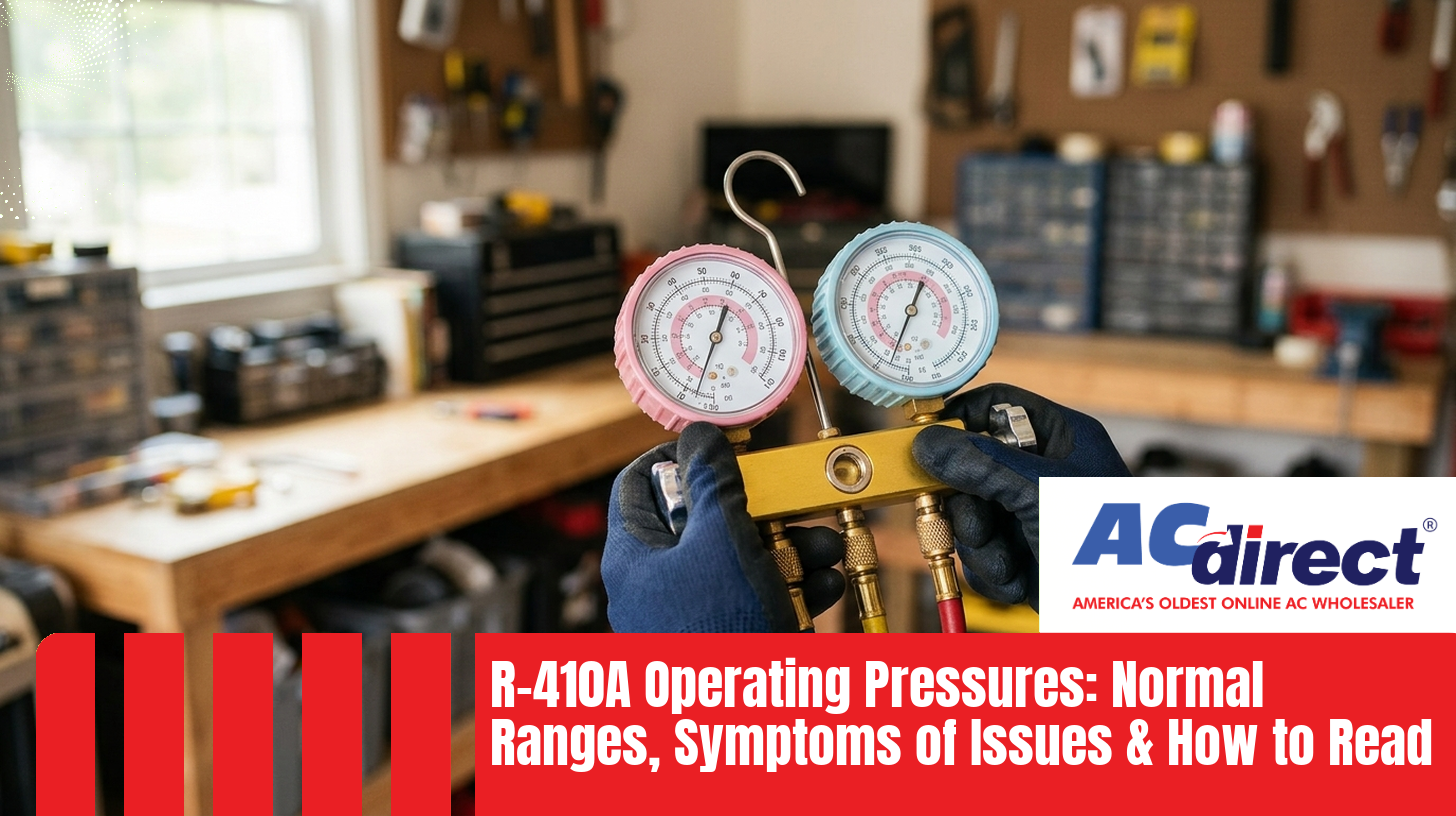
A working technician's reference for suction and discharge pressures across outdoor temperatures, plus what the gauges are telling you when something is off.
Reading R-410A pressures correctly is one of those skills that separates a guess-and-replace service call from an actual diagnosis. The numbers on your manifold gauges, paired with outdoor temperature, return air wet bulb, and a measured superheat or subcooling, tell you almost everything you need to know about a system's health. This article lays out the normal operating ranges, what the gauges read at common outdoor temperatures, and what specific pressure patterns mean when something is wrong.
If you need a full saturation chart with PT values across the spectrum, our R-410A Pressure & Temperature Chart: Complete Technician Reference is the companion piece to this one. This article focuses on what those numbers should look like under load, and how to interpret deviations.
R-410A pressures rise with outdoor ambient. The high side moves the most because the condenser has to reject heat to whatever the outdoor air is doing. A useful rule of thumb from working contractors: saturated condensing temperature typically runs about 20°F over ambient on a properly charged, properly airflowing system. From there, you convert that saturated temp to PSIG using a PT chart.
Here are typical running pressures across common outdoor temperatures, assuming a properly charged system, clean coils, and a return air wet bulb in the 63-67°F range.
| Outdoor Ambient | Low Side (Suction) | High Side (Discharge) | Saturated Condensing |
|---|---|---|---|
| 70°F | 110 - 125 PSIG | 235 - 260 PSIG | ~90°F |
| 85°F | 118 - 132 PSIG | 320 - 345 PSIG | ~105°F |
| 95°F | 115 - 140 PSIG | 400 - 450 PSIG | ~118-120°F |
| 105°F | 125 - 145 PSIG | 445 - 490 PSIG | ~125-128°F |
Numbers are typical ranges, not absolutes. Indoor load, airflow, line set length, and metering device type all shift the picture. Always confirm with superheat and subcooling.
Across most field conditions, R-410A low side runs roughly 102 to 145 PSIG and high side roughly 370 to 450 PSIG. The 95°F design day is the one most technicians benchmark against because it lines up with AHRI rating conditions and most manufacturer charging tables.
Static pressure is what you read with the system off and the refrigerant fully equalized. Both gauges should read the same value, and that value should correspond to the saturation pressure of R-410A at the surrounding temperature.
A few reference points worth memorizing:
- 70°F equipment temperature: roughly 201 PSIG static, both sides equalized
- 80°F equipment temperature: roughly 235 PSIG static
- 90°F equipment temperature: roughly 274 PSIG static
- 100°F equipment temperature: roughly 317 PSIG static
If standing pressure does not match saturation pressure for the temperature of the equipment, you either have non-condensables in the system, the system is undercharged, or there is a refrigerant other than R-410A in there. A static reading well below saturation is one of the earliest indicators of a leak that has been working on the system for a while.
Running pressure is the live picture of a system doing work. The compressor pulls suction down on the low side and pushes discharge up on the high side. The spread between the two, plus how those pressures translate to saturated temperatures, is the diagnostic gold.
On a typical cooling call with indoor return air around 75°F dry bulb and 63°F wet bulb, expect suction in the 115-135 PSIG range, which translates to a saturated suction temperature of roughly 40-46°F. Lower indoor loads pull suction down; higher loads push it up. A 90°F return air on a hot startup will run suction noticeably higher until the space pulls down.
High side tracks closely with outdoor ambient and condenser airflow. At 95°F outdoor with a clean coil, expect 400-450 PSIG. A dirty condenser, restricted airflow, recirculation, or a failing condenser fan motor will all push that number up fast. High side is the first gauge to scream when there is an airflow problem outdoors.
Pressures alone do not confirm a correct charge. You need temperature data on the line:
- Superheat (TXV systems): typically 10-15°F at the suction line near the outdoor unit
- Superheat (fixed orifice systems): use the manufacturer's superheat charging chart based on indoor wet bulb and outdoor dry bulb
- Subcooling (TXV systems): typically 8-12°F at the liquid line, confirmed against the nameplate target
For a step-by-step on adding refrigerant safely, including liquid charging procedure, see our guide on how to recharge an R-410A system. R-410A is a near-azeotropic blend with about 0.3°F of fractionation, which is why it must be charged as a liquid - never as a vapor out of the cylinder.
Once you know what right looks like, wrong becomes a much shorter conversation. Here are the patterns that show up most often in the field, what the gauges tend to do, and what to look at next.
| Pattern | Likely Cause | Confirm With |
|---|---|---|
| Low suction, low discharge | Undercharge or leak | High superheat, low subcooling, leak search |
| High suction, high discharge | Overcharge | Low superheat, high subcooling |
| Normal suction, very high discharge | Dirty condenser, recirculation, weak fan | Condenser air temp split, fan amps |
| Low suction, normal/high discharge | Liquid line restriction or stuck TXV | Temp drop across drier, high superheat |
| High suction, low discharge | Compressor not pumping | Compressor amps vs. RLA, valve test |
| Both pressures low, indoor coil iced | Low indoor airflow | Filter, blower speed, return static |
Both gauges sag. Suction may be 90-100 PSIG when it should be 120, discharge 300 when it should be 400. Superheat rises (system is starving the evaporator), subcooling drops or disappears (no liquid stack in the condenser). This pattern is the most common service call. Find the leak before adding refrigerant - topping off a leaking system is bad practice and increasingly bad economics, with R-410A pricing trending up as virgin supplies tighten.
Both gauges run high. Discharge can climb past 475-500 PSIG on a 95°F day, suction may sit in the high 140s. Superheat is low (sometimes near zero, which risks compressor flooding), and subcooling is high - 15°F, 18°F, more. Recover refrigerant until subcooling lands at the nameplate target.
This is the one that gets blamed on charge most often when it is really an airflow problem. Suction looks normal or slightly high, but discharge is way up - 480, 500, sometimes higher. The condenser cannot reject heat fast enough, so head pressure climbs until the system trips on high pressure. Pull the panel, check the coil, check the fan, check for shrub clearance and recirculation under the unit before touching gauges to refrigerant ports.
Low suction, falling indoor temperatures of the evaporator, eventually ice on the coil. The compressor keeps running, suction drops below 100 PSIG, and the low pressure switch may trip. Filter, blower wheel cleanliness, and return static are the first three checks - not the refrigerant charge.
Low suction with normal or even high discharge is the signature. There is plenty of refrigerant in the system, but it cannot get through the metering device or there is a clog at the drier. A measurable temperature drop across the filter drier (more than 3°F) is a strong indicator the drier is restricted.
For a more focused breakdown of typical high and low side gauge behavior, our R-410A pressure chart for high and low side reference covers each side in detail.
R-410A refrigerant pricing has been climbing as virgin production winds down. Installed cost is running roughly $40-$90 per pound, and for many homeowners that is the difference between a service call that pays for itself and one that triggers a replacement quote. The replacement refrigerant most major brands moved to, R-454B, has seen its own price pressure - cylinder costs reportedly rose more than 300% from 2021 to 2025, climbing from around $345 to over $2,000.
That pricing reality is why getting the diagnosis right on the first call matters. Topping off a system that is actually airflow-restricted wastes refrigerant and money. Replacing a compressor on a system that just needed a TXV cleared is even worse. The gauges, used with the temperature data, give you the right answer.
If a system is past economical repair, our r410a price overstock listings include matched systems that drop into existing R-410A line sets without converting to A2L equipment. For homeowners researching the broader transition, the r32 vs r410a (the comparison they're searching) page lays out the differences across refrigerants currently on the market.
Our team handles R-410A pressure and charging questions every day. Call to talk to an R-410A expert if you want a second set of eyes on a set of readings, or if you are trying to source equipment that matches an existing R-410A system before overstock runs out.
On a properly charged system at 95°F outdoor with typical indoor load, suction pressure runs roughly 115-140 PSIG and discharge pressure runs roughly 400-450 PSIG. Saturated condensing temperature lands around 118-120°F, which is consistent with the "20°F over ambient" rule of thumb. Always confirm with superheat and subcooling rather than relying on pressures alone.
Static pressure should equal the saturation pressure of R-410A at whatever temperature the equipment is sitting at. At 70°F that is about 201 PSIG, at 80°F about 235 PSIG, at 90°F about 274 PSIG. Both gauges should read the same value once the system has equalized. A reading well below saturation usually means the system is low on charge or has been leaking.
Both can drive discharge pressure up, but they look different on the rest of the data. An overcharge raises both suction and discharge, lowers superheat, and raises subcooling well above the nameplate target. A condenser airflow problem usually leaves suction near normal but spikes discharge, and subcooling reads roughly correct. Check the condenser coil, fan, and any obstructions before adjusting charge.
Yes. The EPA AIM Act ended new manufacturing of R-410A residential equipment as of January 1, 2025, but service refrigerant remains legal indefinitely, and the EPA has deprioritized enforcement of the installation deadline for equipment manufactured before the cutoff. That means new R-410A overstock systems are legal to install in 2026 while supplies last, and existing systems can be serviced for the rest of their useful life.
Pressures within normal ranges do not always mean the system is performing. Check temperature split across the evaporator (typically 18-22°F), confirm subcooling matches the nameplate, and verify return air wet bulb. A weak compressor, a partially flooding TXV, or a duct leak can all produce pressures that look acceptable while delivering poor capacity. The gauges are one input, not the whole diagnosis.
No. R-454B is the replacement refrigerant most major brands moved to, but it is an A2L mildly flammable refrigerant with different oil compatibility considerations and a different system safety design. R-410A systems were not built for A2L service. The correct path for an R-410A system is to keep it running with R-410A service refrigerant or replace it with a complete matched system - either an R-410A overstock unit or new A2L equipment.