

R-410A Pressure Chart: High & Low Side (Complete Reference Tool)
-
 By
Michael Haines
By
Michael Haines
- May 7, 2026
Normal operating pressures, what outdoor temperature does to your readings, and a fast diagnostic table for the field.
If you've got a manifold set hooked up to an R-410A system right now and you're trying to figure out whether the numbers in front of you are normal, this page is built for that. We'll walk through what high side and low side actually represent, the pressure ranges you should expect at different outdoor temperatures, and a clean diagnostic table for the most common readings you'll run into.
For a deeper PT-chart treatment with temperature crosswalks, see our parent reference: R-410A Pressure & Temperature Chart: Complete Technician Reference. This article focuses on the high/low side ranges and field diagnostics specifically.
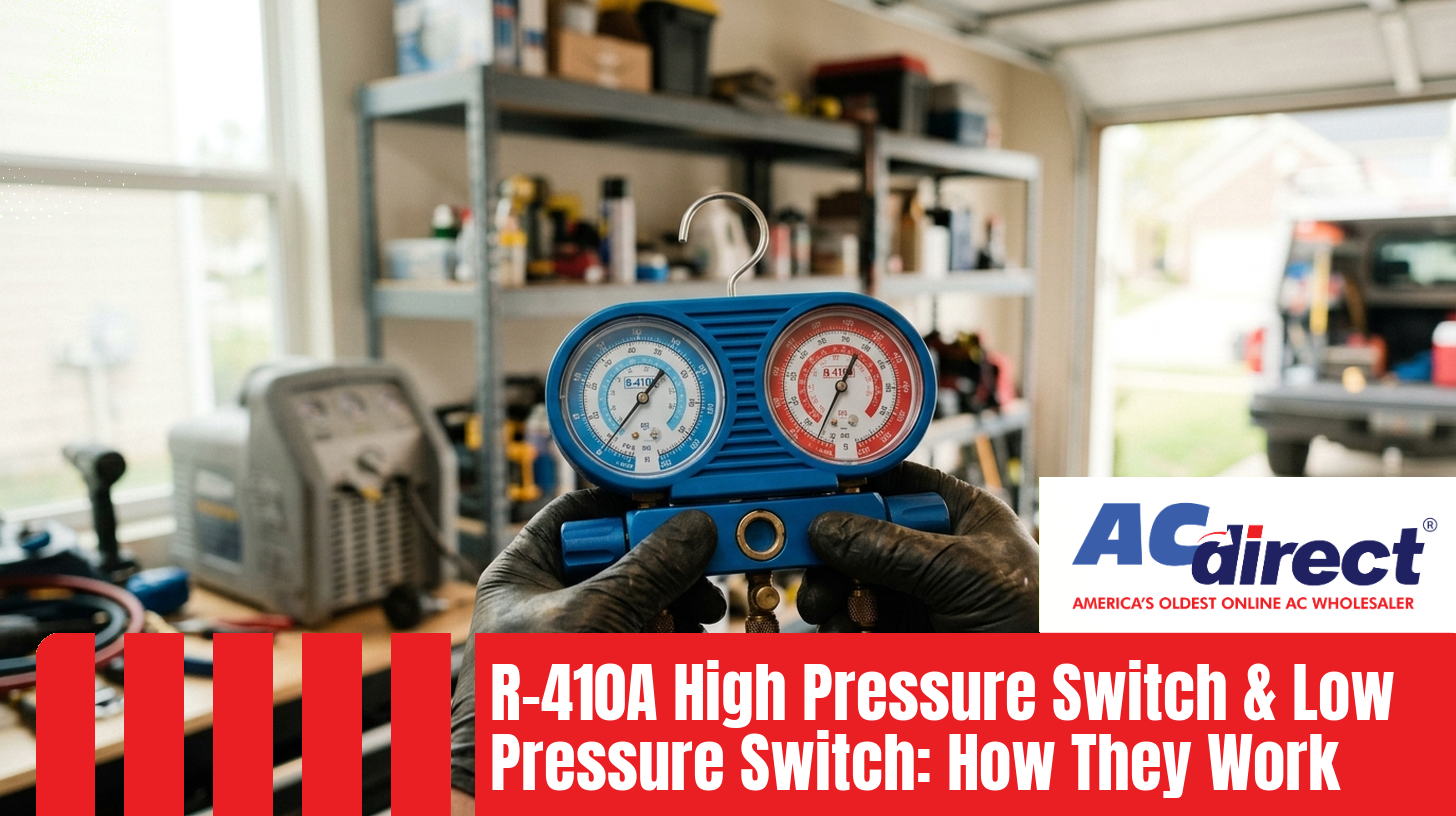
R-410A is an HFC blend of 50% R-32 and 50% R-125. As that refrigerant moves through the system, it operates at two distinct pressures, and your manifold gauges read both simultaneously.
The high side is the pressure of the superheated vapor leaving the compressor, traveling through the condenser coil where it rejects heat and condenses into a high-pressure subcooled liquid, and then heading to the metering device. High side pressure is driven primarily by outdoor ambient temperature and how well the condenser is rejecting heat. A dirty coil, a failing condenser fan, or an overcharge will all push this number up.
The low side is the pressure of the low-pressure superheated vapor returning from the evaporator back to the compressor. It tells you how much heat the evaporator is absorbing from the indoor air. Low side is influenced by indoor temperature, indoor airflow, and the refrigerant charge. Restricted airflow or a low charge will pull this number down.
For a properly charged R-410A system in cooling mode, high side pressure typically falls in a broad 200 to 450 PSIG window. That range is wide because outdoor temperature swings the number significantly. A 70°F morning and a 95°F afternoon will produce very different head pressures on the same healthy system.
Here's how that breaks down at common outdoor ambient conditions:
| Outdoor Ambient | Expected High Side (PSIG) | Notes |
|---|---|---|
| 70°F | ~370-420 | Mild day, low load on condenser |
| 90°F | ~400-450 | Typical summer afternoon |
| 95°F | ~447 | Common design point |
| 100°F+ | ~485+ | Approaching upper limits, watch coil |
Pressures rise sharply as outdoor temperature climbs because the condenser has less temperature differential to reject heat into.
If you're seeing high side numbers above this range at a given outdoor temp, work the obvious suspects first: condenser coil cleanliness, condenser fan operation, and overcharge. If you're below the range, suspect undercharge, a metering device restriction, or a partial blockage on the liquid line.
Suction pressure on a healthy R-410A system in cooling mode generally lands between 105 and 145 PSIG. Unlike high side, low side doesn't swing as dramatically with outdoor ambient, but it does respond to indoor load, airflow, and charge.
| Outdoor Ambient | Expected Low Side (PSIG) | Notes |
|---|---|---|
| 70°F | ~118-135 | Steady evaporator absorption |
| 90°F | ~130-150 | Higher indoor load drives it up |
| 95°F | ~135-145 | Peak summer operating window |
| 100°F+ | ~140-150 | Upper end of normal range |
Pressure alone doesn't confirm a healthy charge - that's what superheat and subcooling are for. For R-410A, expect:
- Superheat: 10°F to 15°F under normal conditions
- Subcooling: 8°F to 12°F at the liquid line
If pressures look reasonable but superheat or subcooling is off, you've usually got a charge issue or a metering device problem dressed up to look like something else. For more detail on operating-pressure interpretation in different scenarios, see our companion guide on R-410A operating pressures and what they mean in the field.
This is the single biggest variable techs misread, especially newer techs who learned a "target" pressure on a 90°F training day and try to apply it on a 75°F service call. R-410A pressures shift meaningfully with outdoor ambient because the condenser's job - rejecting heat into outdoor air - gets harder as the air gets hotter.
Higher outdoor air = less temperature differential between the refrigerant and the air = higher condensing pressure required to reject heat = higher high side reading. The low side moves up too, but more gently, because it's responding mostly to evaporator load.
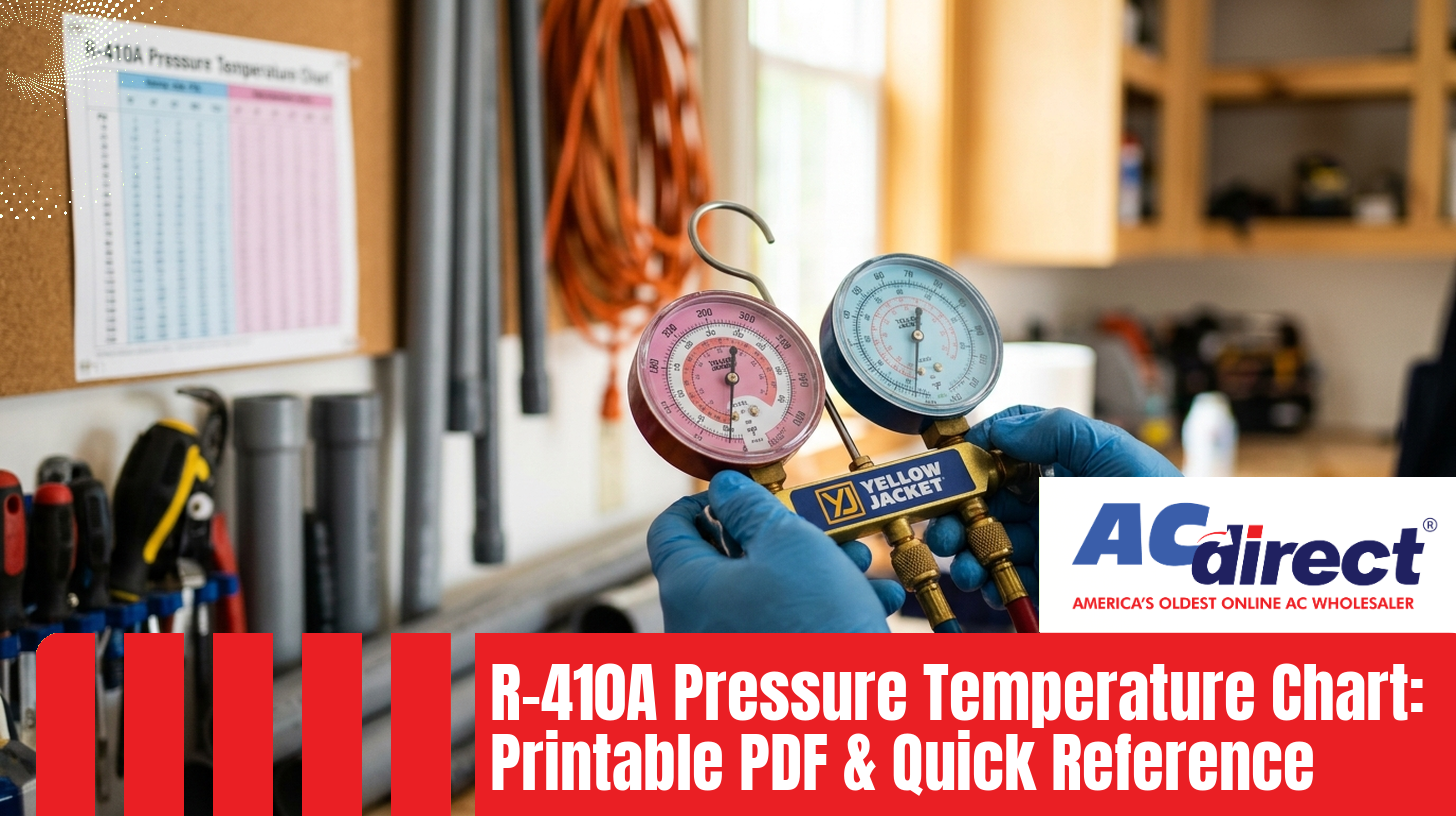
You can't memorize a single "correct" pressure for R-410A. You need to either reference a printed PT chart in the field or use a digital manifold with built-in PT calculations (the Yellow Jacket 42036 series is a common one, typically $250-$400). If you want a printable resource, our downloadable R-410A pressure-temperature chart PDF is sized for a service van clipboard.
This is the quick-reference card. Match what you're seeing on the gauges to the most common cause and start there.
| Reading Pattern | Most Likely Causes | Confirm With |
|---|---|---|
| High head, normal/high suction | Overcharge, dirty condenser coil, restricted condenser airflow, failing condenser fan | Low subcooling = airflow; high subcooling = overcharge |
| Low head, low suction | Undercharge, refrigerant leak | High superheat, low subcooling, frosting at metering device |
| Low head, normal/high suction | Failing compressor, internal valve leak | Low temp split across coil, compressor amp draw |
| High head, low suction | Restricted metering device, restricted liquid line, plugged filter-drier | High superheat with high subcooling, temperature drop across drier |
| Normal head, high suction | Overcharge, low indoor heat load (oversized system or very cool return) | Low superheat, normal-to-high subcooling |
| Normal head, low suction | Restricted indoor airflow, dirty evaporator coil, dirty filter, blower issue | Low temp split, evaporator icing, high static pressure |
If you're servicing R-410A regularly, the regulatory picture matters for parts planning and customer conversations. Here's what's actually in effect:
- New equipment manufacturing stopped January 1, 2025 for residential and light commercial R-410A AC and heat pump equipment under the EPA AIM Act.
- R-410A refrigerant is NOT banned. Reclaimed and recycled supplies will continue to service existing systems for years.
- Pre-2025 manufactured equipment can still be installed under EPA's sell-through provisions. The EPA has indicated it will deprioritize enforcement around the original installation cutoff for that overstock inventory.
- Pricing has climbed sharply. Contractors are paying roughly $400-$500+ per 25 lb cylinder in early 2026 (about $16-$20/lb wholesale), with installed costs to homeowners typically $50-$100/lb. That's a 40-70% increase over 2022 baseline.
If you're crossing over to A2L work, here's the short version: R-454B operates within roughly 2-5% of R-410A pressures, which is why most major manufacturers (Carrier, Trane, Goodman, Rheem, Lennox, Bosch, MRCOOL, York) chose it for the transition. R-32 runs at slightly different pressures and is the path Daikin, Mitsubishi, LG, and others have taken, particularly in ductless. Both are legitimate replacements - just different engineering philosophies, and both require A2L-rated gauges, recovery, and leak detection.
Critical reminder: you cannot retrofit an R-410A system with R-454B or R-32. The EPA explicitly prohibits it, and the oil chemistry, pressure envelope, and A2L safety design wouldn't allow a clean drop-in anyway.
AC Direct is moving overstock r410a air conditioner inventory at phase-out pricing while supplies last. New equipment, full manufacturer warranties, legal to install in 2026. Call to talk to an R-410A expert and we'll match you to the right tonnage and configuration.
For a properly charged R-410A system in cooling mode, high side pressure typically runs 200-450 PSIG and low side runs 105-145 PSIG. The exact numbers depend on outdoor ambient temperature - expect roughly 370-420 PSIG high / 118-135 PSIG low at 70°F outdoors, climbing to around 447 PSIG high / 135-145 PSIG low at 95°F outdoors.
The condenser's job is to reject heat from the refrigerant into outdoor air. As outdoor air gets hotter, there's less temperature differential available, so the system has to operate at a higher condensing pressure to push that heat out. That's why head pressure climbs significantly between a 70°F morning and a 95°F afternoon. Suction pressure rises too, but more gradually, because it's tied more closely to indoor load.
Above roughly 485-500 PSIG, you're outside the normal envelope even on a 100°F day. Start with the obvious: dirty condenser coil, restricted airflow around the outdoor unit, or a failing condenser fan. If those check out, suspect overcharge (confirm with subcooling - high subcooling plus high head usually means too much refrigerant). A non-condensable in the system (air, nitrogen) can also push head pressure up.
No. R-410A is not banned. The EPA AIM Act stopped new manufacturing of residential R-410A equipment as of January 1, 2025, but existing systems are grandfathered, refrigerant remains available for service, and pre-2025 manufactured equipment can still be installed legally under the EPA's sell-through provisions.
No. The EPA explicitly prohibits using A2L refrigerants like R-454B and R-32 as a retrofit in equipment originally designed for R-410A. The oil chemistry, pressure tolerances, and A2L safety design (mildly flammable) all require equipment engineered specifically for those refrigerants. A like-for-like R-410A replacement, or a new A2L system designed for the new refrigerant, are the two legitimate paths.
Under normal operating conditions, target 10-15°F superheat and 8-12°F subcooling for most R-410A systems. Always defer to the manufacturer's charging chart on the unit's data plate when one is available - it accounts for system-specific design points that the general ranges don't.