

R-410A Pressure Temperature Chart: Printable PDF & Quick Reference
-
 By
Michael Haines
By
Michael Haines
- May 7, 2026
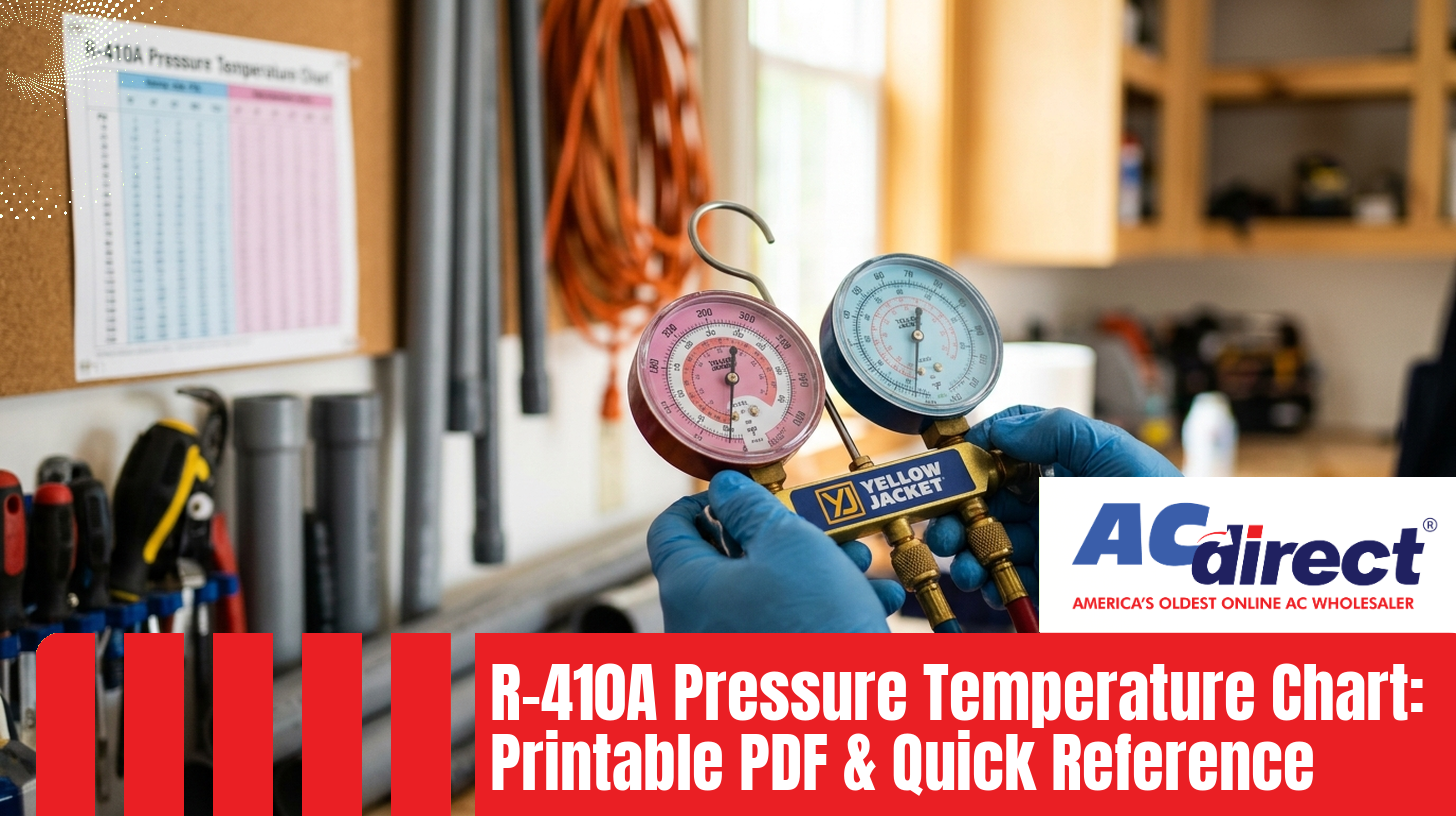
A field-ready PT chart for R-410A, plus the math behind superheat, subcooling, and what those gauge readings actually mean on a service call.
If you charge, troubleshoot, or commission R-410A equipment, the pressure-temperature chart is the single most-used reference on the truck. It tells you the saturation temperature at any given gauge pressure, which is the foundation for measuring superheat at the suction line and subcooling at the liquid line. Get the chart wrong, and every charging decision that follows is wrong with it.
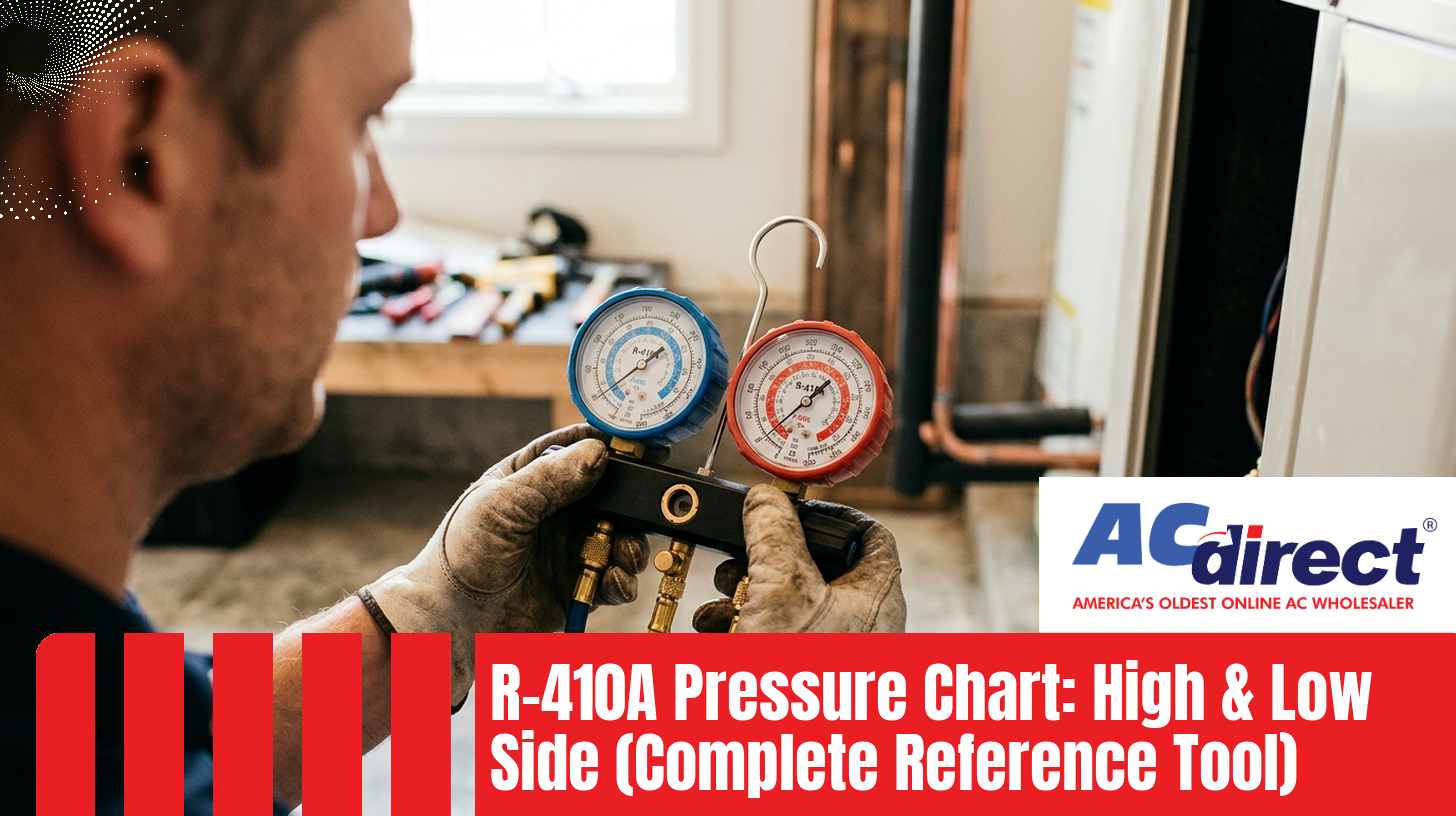
This page gives you the full PT table, a printable version sized for a clipboard or van door, and a clean walkthrough of how to actually use it on a system. For deeper context on operating ranges, our full R-410A Pressure & Temperature Chart technician reference covers high and low side behavior across ambient conditions.
R-410A is a near-azeotropic blend of R-32 and R-125 (50/50). Because the temperature glide is minimal (under 0.3°F), a single column for saturation pressure is accurate enough for field charging work. All pressures below are in PSIG (gauge pressure).
| Temperature (°F) | Pressure (PSIG) | Typical Use |
|---|---|---|
| -10°F | 33 | Refrigeration / deep low |
| 0°F | 49 | Low-temp evap |
| 10°F | 69 | Heat pump in cold |
| 20°F | 92 | Light commercial low |
| 30°F | 119 | Cold climate suction |
| 40°F | 119 | AC evaporator (typical) |
| 45°F | 132 | AC evaporator |
| 50°F | 147 | AC evaporator (warm) |
| 60°F | 178 | Mild day suction line |
| 70°F | 201 | Indoor ambient reference |
| 80°F | 235 | Outdoor mild |
| 90°F | 272 | Outdoor warm |
| 95°F | 290 | AHRI rating point |
| 100°F | 317 | Outdoor hot |
| 105°F | 338 | Hot-day liquid line |
| 110°F | 365 | Liquid line typical |
| 115°F | 390 | Hot-day discharge |
| 120°F | 418 | High-side typical |
| 125°F | 445 | Elevated discharge |
| 130°F | 475 | High discharge - investigate |
| 140°F | 540 | Overcharged or restricted |
| 150°F | 608 | Critical - shut down |
Anchor points referenced from manufacturer literature and field-validated values. Use as a reference; always cross-check against the data plate for the specific equipment you're servicing.
Most techs we talk to keep a laminated copy in the truck and a second one taped inside the equipment cabinet at the shop. A few pointers if you're printing your own:
- Print landscape on letter (8.5 x 11). The two-column format above scales cleanly without losing the temperature increments.
- Laminate it. Refrigerant oil, dust, and sweaty summer hands destroy paper charts in a season.
- Highlight your typical operating range. For residential AC work, that's the 40°F to 50°F suction band and the 100°F to 125°F liquid band. Highlighting those rows speeds up reads on hot rooftops.
- Add your target superheat and subcooling on the back. Most TXV systems aim for 8°F to 12°F subcooling. Fixed-orifice systems use a charging chart based on indoor wet bulb and outdoor dry bulb.
The chart by itself doesn't tell you whether the system is over, under, or correctly charged. It only converts pressure to saturation temperature. The diagnostic value comes from comparing that saturation temperature against the actual line temperature.
Blue (low side) on the suction service port, red (high side) on the liquid line service port. Let the system stabilize for at least 10 to 15 minutes of run time before trusting the reading.
Pull the gauge value, look up the matching row on the PT chart. A 132 PSIG suction reading means a 45°F saturation temperature inside the evaporator. A 365 PSIG liquid reading means 110°F saturation in the condenser.
Clamp a pipe-clamp thermometer 6 to 8 inches from the service port. Insulate the clamp from ambient air for an accurate read. Suction line for superheat, liquid line for subcooling.
Superheat = suction line temp - suction saturation temp. Subcooling = liquid saturation temp - liquid line temp. Compare to manufacturer targets, adjust charge if needed.
For specific operating-range troubleshooting, our breakdown of R-410A high and low side pressures walks through what's normal versus what points to airflow restriction, undercharge, or a failing compressor.
This trips up a lot of newer technicians, so it's worth being precise. At any saturation pressure, refrigerant exists as a mixture of liquid and vapor at the same temperature. That's the saturation temperature - the temperature at which the phase change is happening.
Refrigerant enters as a low-pressure liquid-vapor mix and leaves as a slightly superheated vapor. Anywhere along that coil where liquid still exists, the temperature equals the saturation temperature for the suction pressure. Once the last droplet boils off, the vapor starts gaining sensible heat, and that's your superheat region.
Refrigerant enters as a high-pressure superheated vapor, gives up heat, and condenses. Anywhere along that coil where vapor still exists, the temperature equals the saturation temperature for the discharge pressure. Once it's fully condensed, additional cooling drops it below saturation - that's your subcooling region.
This is where the chart earns its keep. Two short formulas, applied correctly, tell you almost everything about a system's charge state.
| Measurement | Reading | Calculation |
|---|---|---|
| Suction pressure | 132 PSIG | = 45°F saturation |
| Suction line temp | 57°F | 57 - 45 = 12°F superheat |
| Liquid pressure | 365 PSIG | = 110°F saturation |
| Liquid line temp | 100°F | 110 - 100 = 10°F subcooling |
Both values fall within the typical R-410A ranges of 8°F to 15°F superheat and 8°F to 12°F subcooling. This system is charged correctly.
- Low superheat (under 5°F): Risk of liquid floodback to the compressor. Often indicates overcharge or a stuck-open metering device.
- High superheat (over 20°F): Evaporator is starving for refrigerant. Points to undercharge, a restriction, or a failed TXV.
- Low subcooling (under 5°F): Not enough liquid in the condenser. Usually undercharge or non-condensables in the system.
- High subcooling (over 15°F): Too much liquid backing up in the condenser. Typically overcharge or condenser airflow restriction.
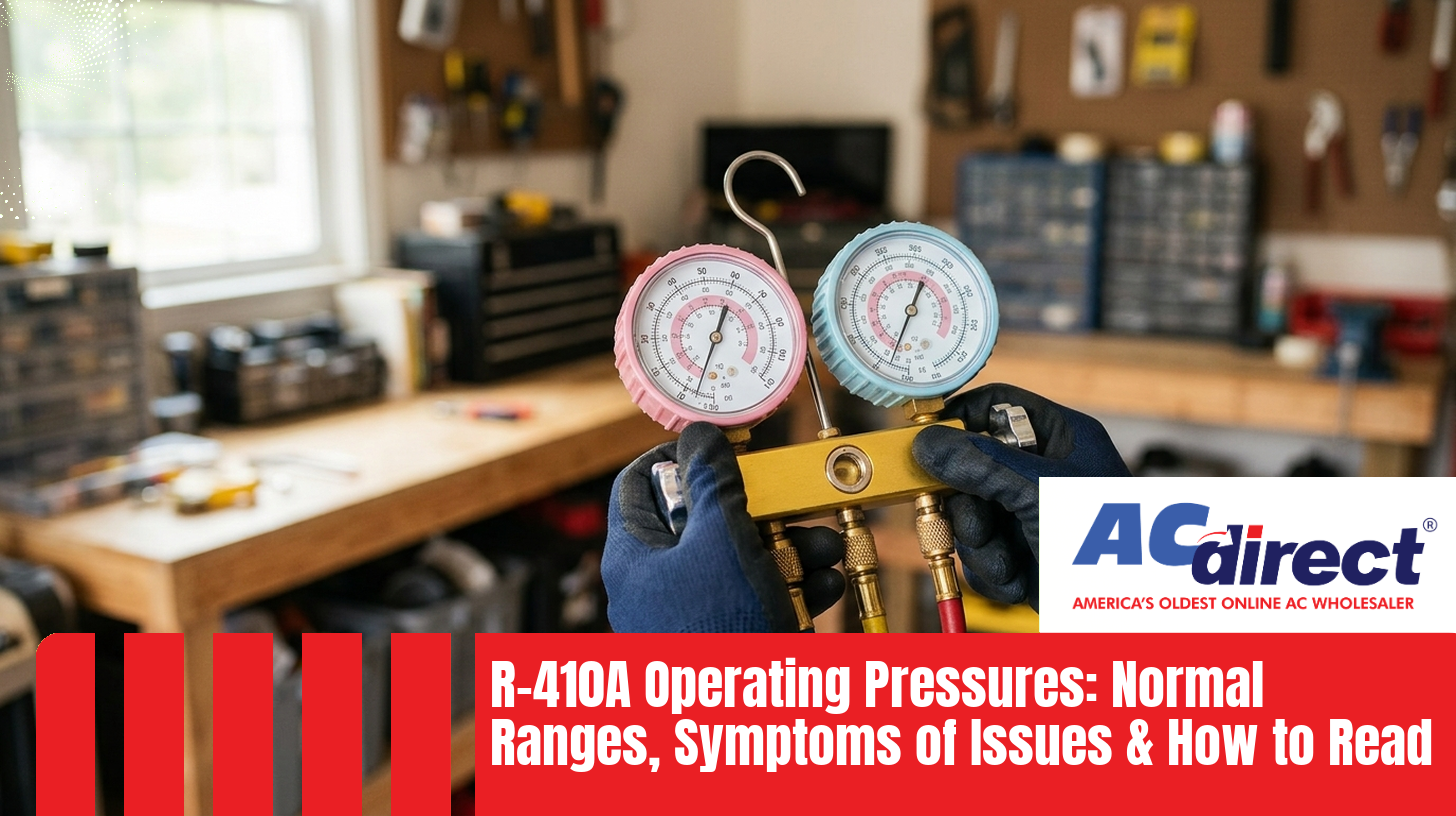
For a deeper look at how these numbers shift across ambient temperature ranges, see our reference on R-410A operating pressures.
If you're servicing R-410A systems in 2026, you've already noticed the price pressure. Wholesale R-410A is running roughly $16 to $20 per pound, with installed costs in the $50 to $90 per pound range depending on market. EPA virgin refrigerant allowances were cut materially for 2026, and prices are expected to keep climbing as supply shifts toward reclaimed product.
The flip side: equipment legally manufactured before January 1, 2025 can still be installed. AC Direct is sitting on overstock R-410A inventory at attractive pricing while supplies last - useful when a homeowner needs a same-week replacement and the A2L equivalent is back-ordered, or when matching an existing R-410A indoor coil makes more economic sense than a full system swap. Browse our R-410A air conditioning system overstock for current availability.
What is the saturation pressure of R-410A at 70°F?
About 201 PSIG. This is a useful indoor-ambient reference point, since a properly recovered or shut-down system sitting at 70°F should show roughly 201 PSIG on both gauges. A significant deviation suggests refrigerant loss or contamination.
What suction pressure should I see on an R-410A AC system?
On a system running in cooling mode at typical conditions, suction pressure usually falls between 102 and 145 PSIG, which corresponds to a 35°F to 50°F saturation temperature in the evaporator. The exact target depends on indoor return air temperature and humidity. For comparison against high-side readings, see our high and low side pressure chart.
What's the target superheat and subcooling for R-410A?
For TXV systems, target subcooling typically runs 8°F to 12°F per the manufacturer's data plate. Superheat on TXV systems should land between 10°F and 15°F. Fixed-orifice (piston) systems use a manufacturer charging chart based on indoor wet bulb and outdoor dry bulb temperatures rather than a fixed superheat target.
Can I use this PT chart for R-454B or R-32?
No. Each refrigerant has its own pressure-temperature relationship. R-454B operates at meaningfully lower pressures than R-410A at the same saturation temperature, and R-32 operates closer to R-410A but is not identical. Always use the chart printed for the refrigerant you're charging - cross-using charts is a common cause of misdiagnosed charge issues and damaged equipment.
Is R-410A still legal to install in 2026?
Yes, with conditions. The EPA's AIM Act stopped manufacturing of new R-410A residential equipment as of January 1, 2025, and an installation deadline was originally set for December 31, 2025. The EPA has since deprioritized enforcement of that installation deadline, meaning legally manufactured pre-2025 R-410A equipment can still be installed without penalty in 2026 while a formal rule change is finalized. Service refrigerant remains legal indefinitely.
How long will R-410A refrigerant be available for service?
Industry estimates put reliable R-410A service availability at 10 years or more, with some projections reaching 2036. Once virgin allocations dry up, servicing will rely on reclaimed and recycled refrigerant - the same model R-22 followed during its phase-out. Existing systems do not need to be replaced.
AC Direct has overstock R-410A condensers, coils, and complete split systems at phase-out pricing. Legally manufactured pre-2025 inventory, ready to ship. Limited stock, no restocks once it's gone.