

R-410A Piston Size Chart: Sizing Guide for HVAC Installers
-
 By
Michael Haines
By
Michael Haines
- May 8, 2026
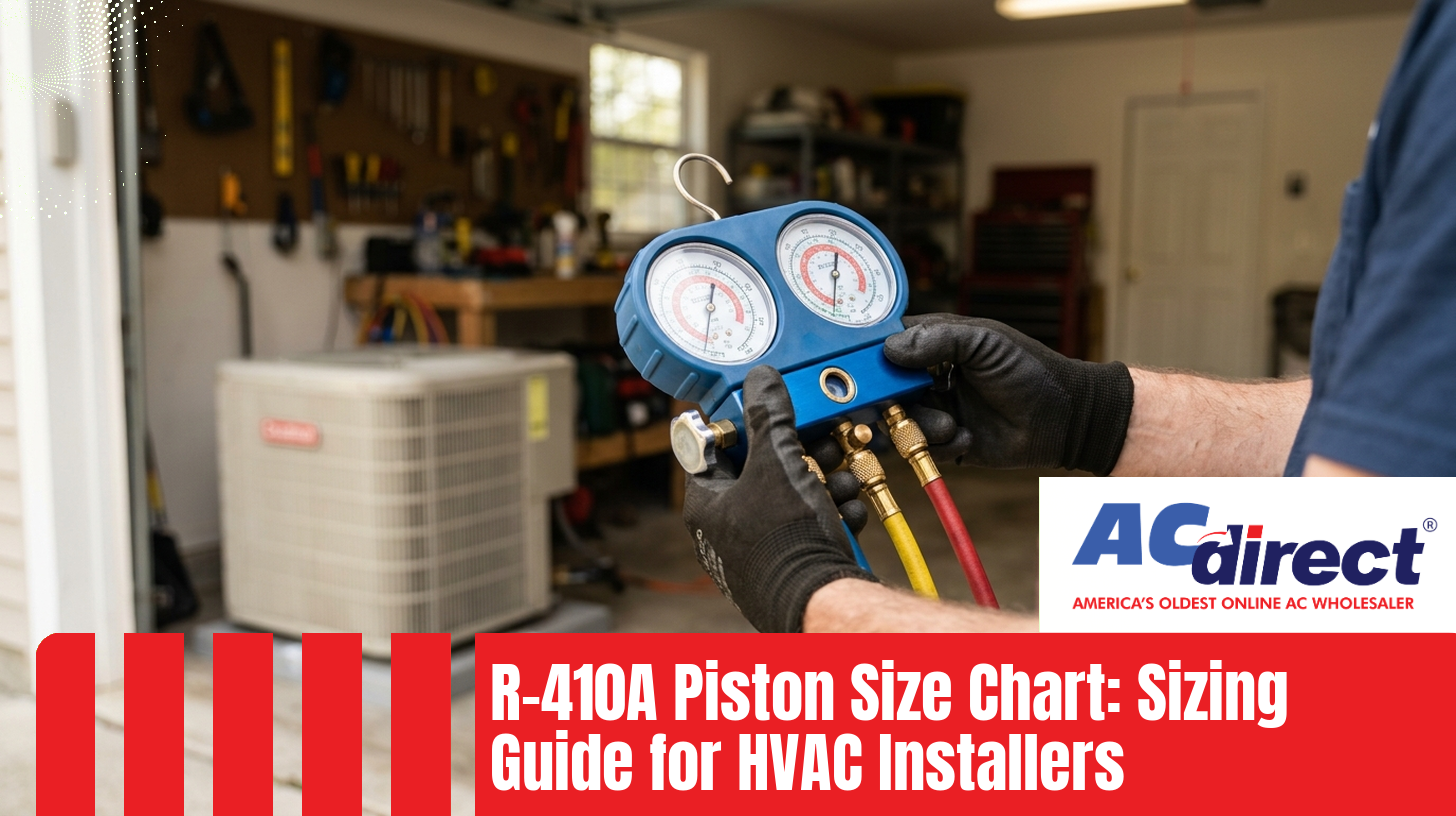
A working installer's reference for matching pistons (fixed orifices) to R-410A condensers and coils, plus the regulatory and pricing context shaping the job in 2026.
If you've installed a fixed-orifice R-410A system in the last decade, you already know the truth: get the piston wrong and the rest of the install goes sideways. Superheat drifts, subcooling goes flat, capacity falls short of nameplate, and the homeowner calls you back in July wondering why their new system can't hold setpoint. The piston is a tiny brass part. The consequences when it's mismatched aren't tiny at all.
This guide pulls together how pistons actually work, how to size them by tonnage and matched coil, how the major manufacturers publish their charts, and how to handle replacements correctly. It pairs naturally with our R-410A Pressure & Temperature Chart: Complete Technician Reference for verifying your charge once the piston is in place.
A piston, also called a fixed orifice or flowrator, is a precision-drilled brass restriction inserted at the metering point of an evaporator coil. Liquid refrigerant arrives at high pressure and temperature from the condenser, hits the orifice, and drops to evaporator pressure on the other side. That pressure drop is what allows the refrigerant to boil and absorb heat from indoor air.
Unlike a TXV (thermostatic expansion valve), a piston does not modulate. It has a single, fixed bore size, typically expressed in thousandths of an inch (for example, .067" or "67"). That number is the diameter of the metering hole. Bigger bore equals more refrigerant flow. Smaller bore equals less flow.
Pistons are popular because they're cheap, they have no moving parts, and they tolerate dirty refrigerant better than a TXV. The trade-off is that they require correct sizing up front. There is no "close enough."
The starting point for any R-410A piston selection is the matched system tonnage. R-410A operates at higher pressures than the legacy R-22 it replaced, so R-410A pistons are smaller bore for the same tonnage. Never substitute an R-22 piston into an R-410A system, even "just for the day." The pressure differential is roughly 50-60% higher, and your superheat will be wrong before the gauges settle.
The table below shows the typical R-410A piston bore range by nominal tonnage for a standard cooling-only or heat pump split system at AHRI-rated conditions. These are general industry ranges. Always cross-check against the OEM chart for your specific outdoor unit and indoor coil match.
| System Tonnage | Nominal BTU | Typical R-410A Piston Bore (inches) | Common Designation |
|---|---|---|---|
| 1.5 Ton | 18,000 | .049" - .055" | 49 - 55 |
| 2.0 Ton | 24,000 | .057" - .063" | 57 - 63 |
| 2.5 Ton | 30,000 | .063" - .070" | 63 - 70 |
| 3.0 Ton | 36,000 | .067" - .074" | 67 - 74 |
| 3.5 Ton | 42,000 | .073" - .080" | 73 - 80 |
| 4.0 Ton | 48,000 | .078" - .086" | 78 - 86 |
| 5.0 Ton | 60,000 | .087" - .096" | 87 - 96 |
Bore variations within a tonnage reflect different coil models, airflow ratings (350 vs 400 CFM/ton), and condenser efficiencies. The OEM chart accounts for those variables.
Two factors shift bore size within a tonnage band. First, indoor coil airflow: a coil rated at 400 CFM per ton typically calls for a slightly larger orifice than the same tonnage at 350 CFM per ton. Second, condenser efficiency: a higher-SEER unit with a larger condenser coil and more refrigerant charge often pairs with a different piston than a base-SEER condenser of identical tonnage.
Every major OEM publishes piston (or "flow check") charts in their installation manuals and matched-system documentation. Here's how to find and read them for the brands installers most often work with.
Goodman piston sizing is published in two places: the outdoor unit installation manual (under "Refrigerant Metering Devices") and the matched-coil documentation. Goodman lists pistons by part number, with the bore size on the brass body itself. For a Goodman R-410A heat pump, you'll typically find a separate piston for cooling mode (in the indoor coil) and one for heating mode (in the outdoor section). Always confirm the AHRI match number, then look up the piston for that exact pairing — substituting "any 3-ton piston" across coil families is exactly the mistake that produces callbacks.
Carrier publishes piston (Carrier calls them "AccuRater" or "flow control" pistons on older lines) data in the Product Data sheet for each outdoor unit. The chart lists the matched indoor coil model on one axis and shipped piston size on the other. Carrier ships most fixed-orifice systems with the piston already installed in the indoor coil distributor; verify it before charging, because a previous service tech may have swapped it.
Rheem documents piston sizes in the matched-system AHRI ratings sheet and in the indoor coil installation instructions. Rheem typically packages the correct piston in a small bag taped to the coil access panel. If the bag is missing or the coil has been reused, pull the AHRI certificate for that specific match-up and confirm against Rheem's published flow control chart before proceeding.
Most piston replacements happen in three scenarios: a coil swap, a condenser swap, or a misdiagnosed superheat/subcooling problem that traces back to a wrong-bore piston installed by someone else.
Pull model and serial numbers from the condenser, indoor coil, and air handler. Look up the AHRI certificate for that match-up. The piston bore is referenced on or alongside that certificate.
R-410A operates at high pressure. Recover to manufacturer specs, then break the flare or sweat connection at the distributor. R-410A is now $400-$500+ per 25 lb cylinder and $40-$90 per pound installed; venting it is both illegal and expensive.
The brass piston sits inside a body assembly with a Teflon seal. Replace the seal every time. Reusing an old seal is the single most common cause of post-repair leaks at the metering device.
Evacuate to 500 microns or better, weigh in the factory charge plus line-set adjustment, then verify with superheat (target 10-15°F) or subcooling (target 8-12°F) per the manufacturer's spec. See our R-410A operating pressures reference for the full pressure window by ambient.
If you're servicing or replacing an older R-410A system in 2026, here's the regulatory reality: R-410A equipment manufactured before January 1, 2025 remains legal to install, and the EPA has signaled enforcement discretion on the original January 1, 2026 install deadline. Existing R-410A systems remain legal to own, operate, and service indefinitely with reclaimed and stockpiled refrigerant. AC Direct stocks overstock R-410A condensers and matched coils manufactured before the cutoff — see our r410a air conditioning system inventory for current availability, or read the full R-410A condenser buying guide if you're sourcing for a specific job.
Have a tricky match-up or hunting for a piston that's no longer cataloged? Call to talk to an R-410A expert — our team works with overstock R-410A inventory daily and can usually cross-reference a match in a few minutes. For broader pricing context on refrigerant and equipment, our r410a price overview lays out where the market sits in 2026.
No. R-410A operates at roughly 50-60% higher pressure than R-22, and the piston bore must be smaller to deliver the correct mass flow. An R-22 piston in an R-410A system will over-feed the evaporator, producing low superheat, possible flooding, and poor capacity. Always use the R-410A piston specified for your matched system.
Charge the system to spec, then check superheat and subcooling at AHRI-rated indoor and outdoor conditions. If superheat is chronically low (under 5°F) with subcooling on target, the piston is likely too large. If superheat is high (over 20°F) and subcooling is also high, the piston is likely too small. Always rule out airflow, charge, and restriction issues before condemning the piston.
On a cooling-only system, the piston sits inside the distributor at the inlet of the indoor coil. On a heat pump, there is typically one piston at the indoor coil (used in cooling mode) and one in the outdoor section (used in heating mode), with check valves directing flow. Some heat pumps use a single bi-flow TXV instead.
Most new A2L equipment from major manufacturers ships with TXVs or electronic expansion valves rather than fixed-orifice pistons, since modulating metering pairs better with variable-speed compressors and tighter charge tolerances. Some entry-tier R-454B units still use pistons, but the bore sizes are not interchangeable with R-410A. Always use the metering device specified by the OEM for that specific refrigerant and match-up.
The authoritative source is the AHRI certificate for that specific outdoor + indoor + air handler combination, cross-referenced with the OEM's installation manual or matched-system chart. Manufacturer technical support lines can confirm a part number if the documentation is missing. Avoid guessing from tonnage alone — coil airflow and SEER rating both shift the correct bore.