

R-32 vs R-410A vs R-454B vs R-22: The Complete Refrigerant Comparison Guide
-
 By
Michael Haines
By
Michael Haines
- May 1, 2026
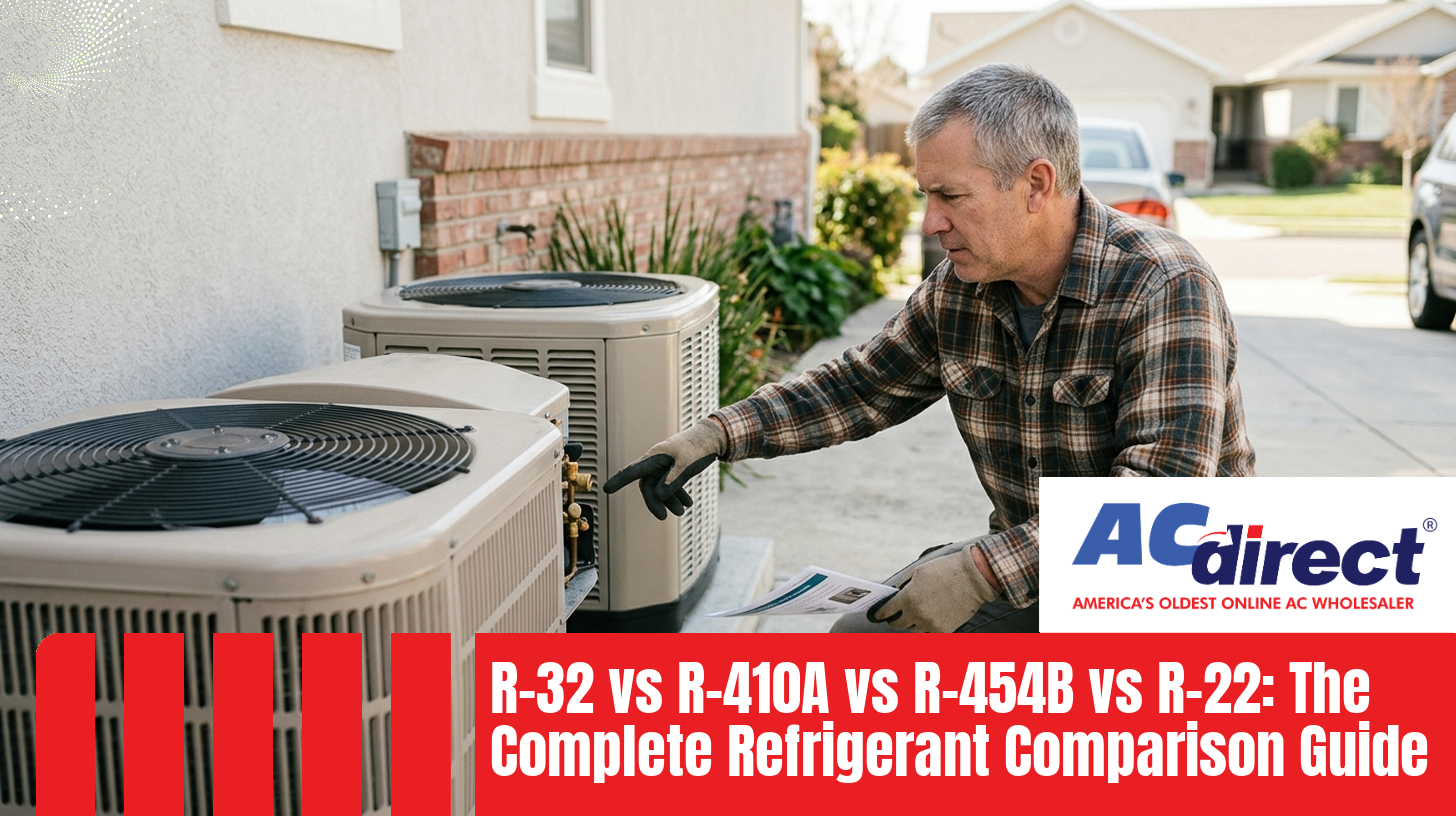
Pressures, GWP, efficiency, cost, and applications for the four refrigerants every homeowner and contractor needs to understand in 2026.
If you have shopped for an air conditioner in the last 18 months, you have probably been hit with an alphabet soup of refrigerant names: R-410A, R-454B, R-32, R-22, even R-134A. They all do roughly the same job, which is moving heat out of your house. But they are not interchangeable, they are not priced the same, and the rules around them changed dramatically on January 1, 2025.
This guide compares the four refrigerants you actually need to know about, with real pressures, real GWP numbers, real 2026 pricing, and a clear answer to the question most homeowners are asking: which one should be in my next system, and what about the one I already have?
Here is the short version, in case you only have 30 seconds:
- R-22 is gone for new manufacturing and getting harder to service. If you still have an R-22 system, it is on borrowed time.
- R-410A can no longer be used in newly manufactured residential AC equipment as of January 1, 2025. But existing R-410A systems are fully legal to operate and service indefinitely, and pre-2025 manufactured equipment (overstock) remains legal to install in 2026 under EPA sell-through provisions.
- R-454B is the replacement that most major U.S. brands chose for ducted systems: Carrier, Trane, Lennox, Goodman, Rheem, York, American Standard.
- R-32 is the replacement Daikin and several ductless-focused manufacturers chose. It is also dominant in mini-splits.
Both R-454B and R-32 are A2L mildly flammable refrigerants with much lower global warming potential than R-410A. Neither is a drop-in replacement for an existing R-410A system. For more on what those installation deadlines actually mean, see the full R-410A phase-out timeline.
This is the comparison most people are searching for, because R-32 has become the second-most-discussed replacement refrigerant after R-454B. R-32 is a single-component HFC (difluoromethane). R-410A is actually a 50/50 blend of R-32 and R-125. So in a sense, R-32 is "half" of R-410A, just used by itself.
Operating pressures between R-32 and R-410A are very similar. That is why R-32 was an attractive candidate in the first place: equipment design did not have to be reinvented from the ground up to handle wildly different pressures. But "similar pressures" does not mean "drop-in compatible." A2L flammability classification, oil compatibility, and component listings all differ.
| Spec | R-32 | R-410A |
|---|---|---|
| GWP (Global Warming Potential) | 675 | 2,088 |
| ODP (Ozone Depletion Potential) | 0 | 0 |
| ASHRAE Safety Class | A2L (mildly flammable) | A1 (non-flammable) |
| Composition | Single component HFC | HFC blend (R-32 + R-125) |
| Operating Pressure | Similar to R-410A | High pressure |
| Efficiency | Up to 12% more efficient | Standard baseline |
| Lubricant | POE / PVE (A2L specific) | POE |
| Primary Applications (US) | Ductless mini-splits, Daikin ducted lines, Lennox ductless | Existing residential systems and overstock new equipment |
The 12% efficiency edge that R-32 offers comes mostly from equipment redesign rather than the molecule itself doing magic. Manufacturers building new R-32 systems took the opportunity to optimize coils, compressors, and electronics, and the result is generally a higher SEER2 rating compared to older R-410A platforms at the same tonnage.
R-32 is the practical choice if you are buying a new ductless mini-split, a new Daikin ducted system, or a Lennox ductless option. It carries lower GWP than R-454B (675 vs. 466 - wait, R-454B is actually lower), uses fewer components (single-molecule simplicity for recovery and recycling), and benefits from a mature global supply chain since it has been used in Asia and Europe for years.
R-410A still has a real role through 2026 and beyond. If your existing system uses R-410A, keep it running. Service is fully legal and refrigerant remains available. And if you are buying replacement equipment from pre-2025 overstock inventory, you can take advantage of phase-out pricing on a proven, A1 non-flammable platform that your contractor already knows inside and out.
For a deeper side-by-side, see R-32 vs R-410A: Performance, Cost, Efficiency & Which Wins in 2026.
R-22 is the refrigerant most homeowners over 40 grew up with. If your AC was installed before 2010, there is a strong chance it ran on R-22, also known by the trade name Freon. The story of R-22 is the dress rehearsal for what is happening with R-410A right now, and it is worth understanding because the playbook repeats.
R-22 is an HCFC, hydrochlorofluorocarbon. The "chloro" part is the problem. Chlorine atoms released into the atmosphere damage the ozone layer. Under the Montreal Protocol, R-22 production was phased out globally, and as of 2020 in the U.S., no new R-22 can be produced or imported. Existing stockpiles and reclaimed refrigerant are the only legal supply.
R-22 has an Ozone Depletion Potential of 0.055 and a GWP of 1,810. R-410A has an ODP of zero (no chlorine) but a GWP of 2,088, which is why it is now being phased down too.
| Spec | R-22 | R-410A |
|---|---|---|
| Type | HCFC | HFC blend |
| GWP | 1,810 | 2,088 |
| ODP | 0.055 (ozone depleting) | 0 |
| ASHRAE Class | A1 | A1 |
| Operating Pressure | Lower than R-410A | High pressure |
| Original Lubricant | Mineral oil | POE |
| New Manufacturing | Banned since 2010 | Banned for new equipment as of Jan 1, 2025 |
| Service Refrigerant | Reclaimed only, very expensive | Available, prices rising |
"Can I just convert my old R-22 system to R-410A?" The short answer is no, not really, and almost never economically. R-410A operates at substantially higher pressures than R-22. The compressor, line set, expansion device, and lubricant in an R-22 system were not designed to handle those pressures or to be compatible with POE oil. A true conversion would mean replacing the compressor, the coils, and effectively the entire system, at which point you have just bought a new system anyway.
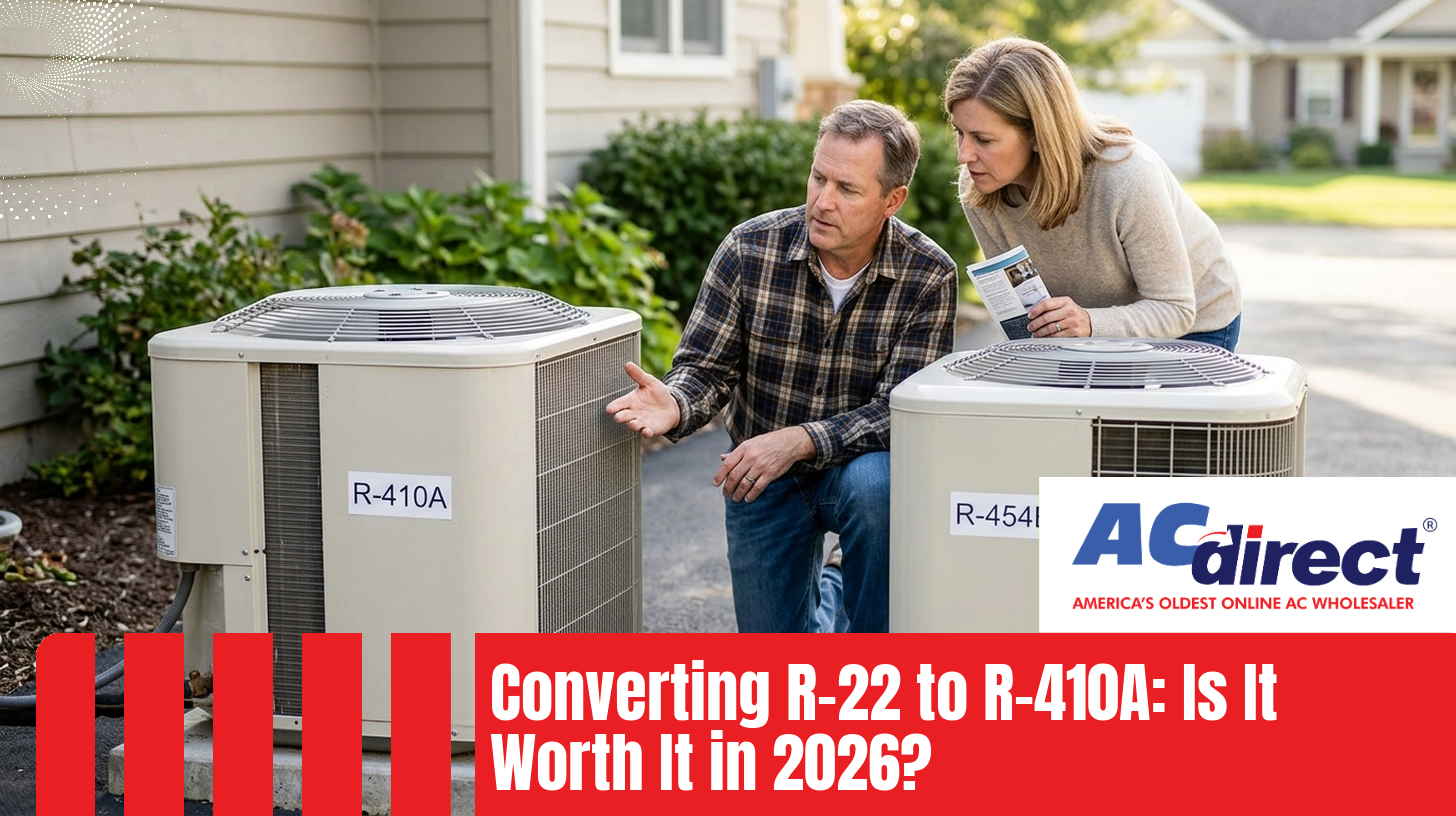
For the full breakdown including realistic cost numbers, see Converting R-22 to R-410A: Is It Worth It in 2026? and the companion piece R-22 vs R-410A: Differences, Conversion & What Old AC Owners Need to Know.
If you have a working R-22 system, you have three options:
- Keep running it until it fails, accepting that any leak repair will be expensive (reclaimed R-22 can run several hundred dollars per pound in a service call).
- Replace it now with a new R-454B or R-32 system, taking advantage of current federal tax credits where applicable.
- Replace it with overstock R-410A equipment from pre-2025 manufacturing. This is a legal install in 2026, comes at phase-out pricing, and uses a refrigerant your local contractor has 20 years of experience with.
The "convert it" option is essentially never the right answer for residential equipment older than the R-22 cutoff. Browse our r410a air conditioning system overstock if option three sounds appealing.
R-454B (sold under trade names Opteon XL41 and Puron Advance) is the refrigerant most U.S. ducted residential systems are now using. It is a blend of 68.9% R-32 and 31.1% R-1234yf, an HFO (hydrofluoroolefin) with extremely low GWP. The blend was specifically engineered to behave thermodynamically close to R-410A while drastically lowering the global warming impact.
This question comes up constantly: can I take the R-410A out of my existing system and put R-454B in instead? The answer is no, and this is important. R-454B is classified A2L. R-410A is A1. Existing R-410A equipment was not designed, listed, or safety-certified for a mildly flammable refrigerant. Beyond the safety classification, oil compatibility and component listings differ. A drop-in retrofit is not a real option.
What you can do is service your existing R-410A system with R-410A refrigerant for as long as it makes economic sense, then replace the system with new equipment when the time comes. New equipment will be R-454B or R-32 from the factory.
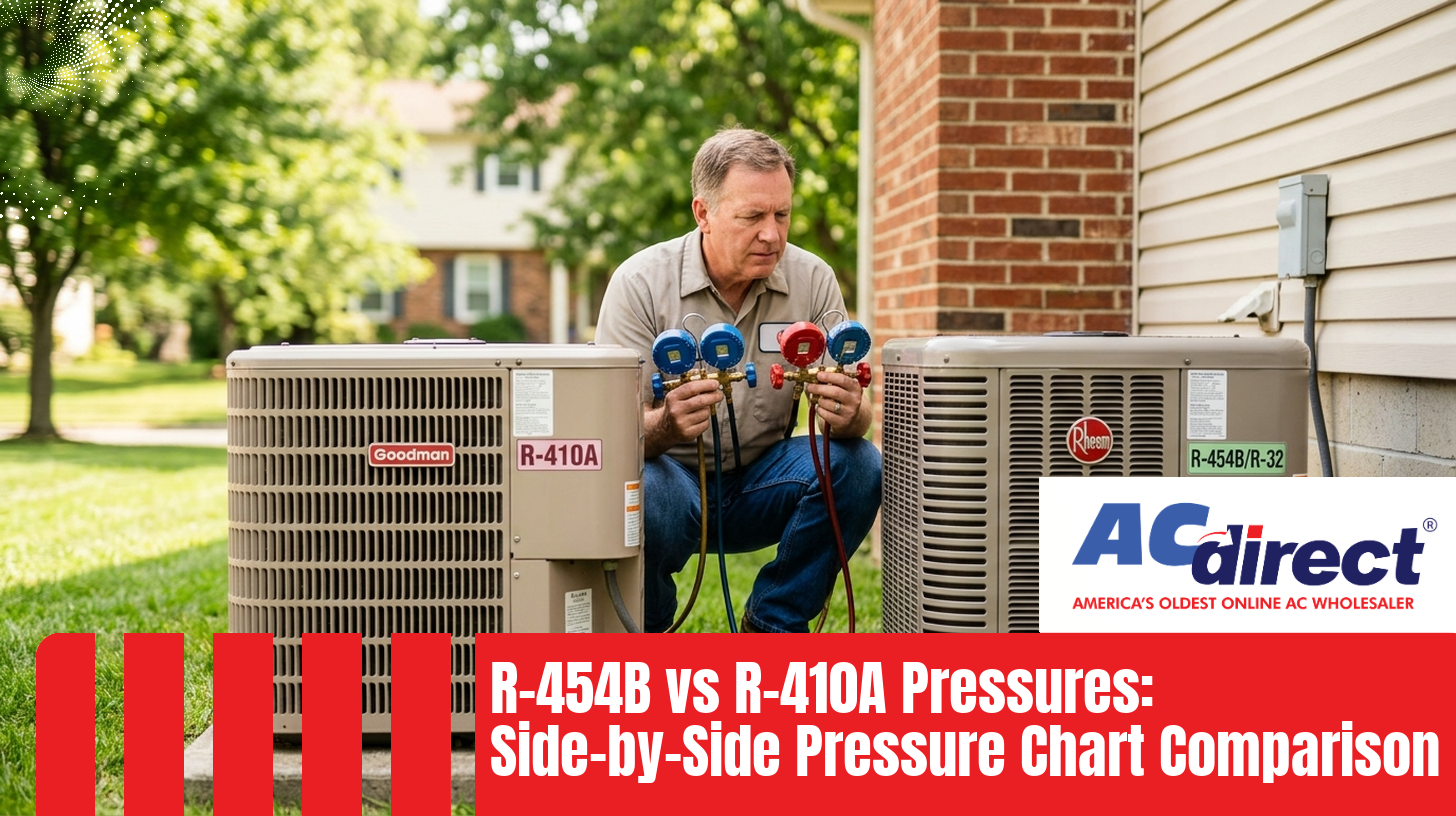
R-454B pressures track R-410A closely, with R-454B running slightly lower at most ambient conditions. This is not "interchangeable" close, but it is "we did not have to redesign every component" close. For an actual side-by-side pressure chart, see R-454B vs R-410A Pressures: Side-by-Side Pressure Chart Comparison.
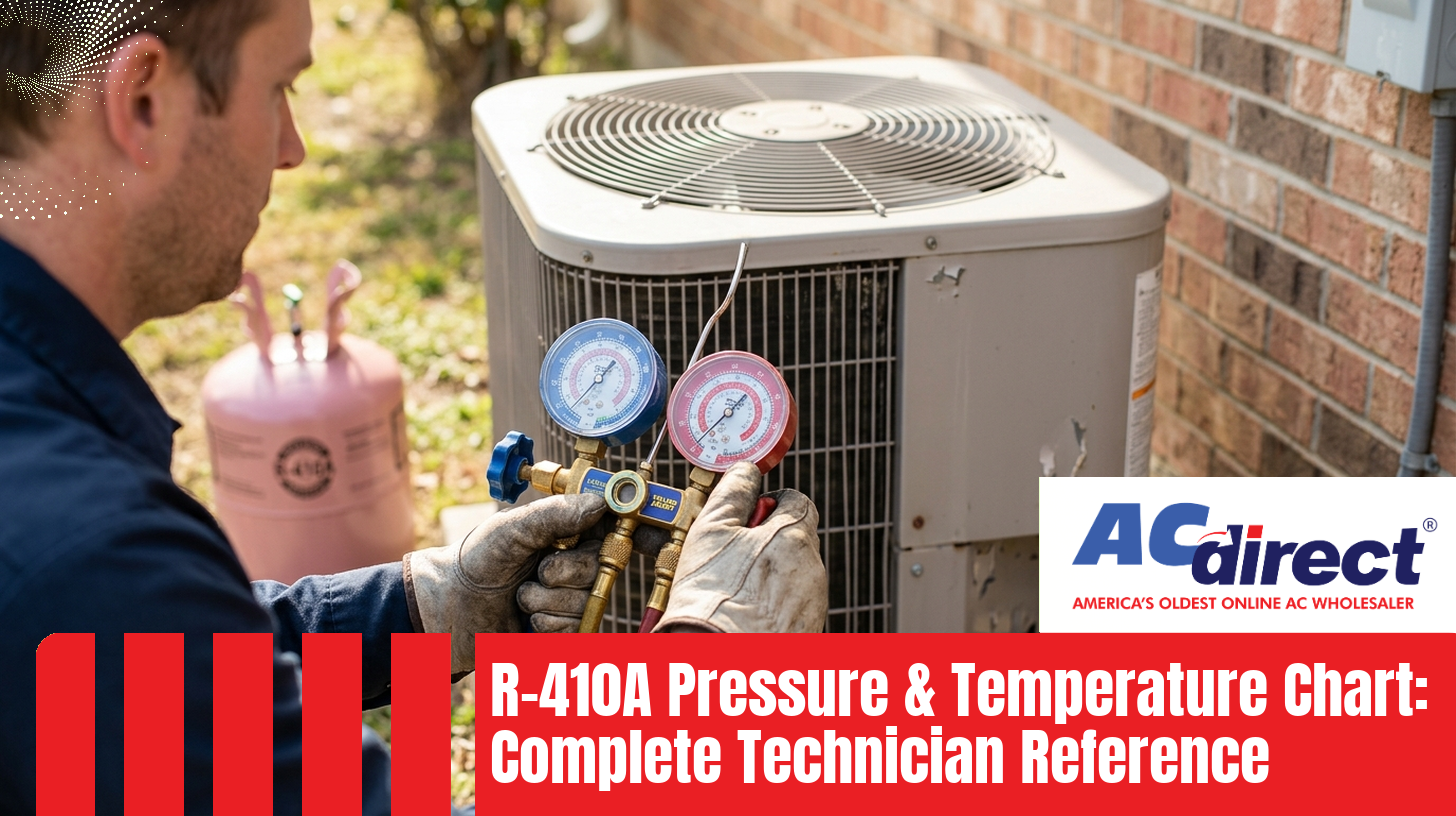
For technicians, the practical takeaway is that PT charts are different. You cannot use an R-410A PT chart to charge an R-454B system. Manifold gauges need updated stickers, and digital gauges need the R-454B refrigerant profile loaded.
Reference R-410A operating values for context:
| Parameter | R-410A Typical | Notes |
|---|---|---|
| Suction (low side) pressure | 118 to 135 psi | 70°F ambient |
| Discharge (high side) pressure | 370 to 420 psi | Warm day, ~90°F outdoor |
| Subcooling | 8°F to 12°F | Standard target range |
| Superheat | 10°F to 15°F | Typical normal operation |
Refrigerant cost is one of the most-watched metrics in 2026 because both R-410A and R-454B are seeing significant price movement, just in opposite directions over time.
| Refrigerant | 2026 Wholesale | 2026 Installed (Service Call) | Direction |
|---|---|---|---|
| R-410A | ~$16 to $20 per lb (25-lb cylinder ~$400 to $500) | $50 to $90 per lb | Rising over time as supply tightens |
| R-454B | Cylinder prices have moved from ~$345 (2021) to over $2,000 (2025) | Variable; sourcing challenges in peak season | Currently volatile |
| R-22 | Reclaimed only | Several hundred per lb | Continues climbing |
Following the R-22 precedent, R-410A could eventually reach $150 to $250 per pound or higher at the consumer level. That is not happening this year, but it is the trajectory. R-454B prices are expected to stabilize as production ramps up and the A2L cylinder shortage resolves, but in 2026 contractors are still reporting sourcing difficulty during peak cooling season.
This comparison shows up in search results because people sometimes confuse their car's AC refrigerant with their home's. They are completely different systems, designed for completely different applications, and the refrigerants are not interchangeable.
R-134A is a single-component HFC used primarily in mobile air conditioning (cars, trucks) and some commercial chillers. It operates at much lower pressures than R-410A. A typical R-134A automotive system runs suction pressures around 25 to 45 psi and discharge pressures around 200 to 250 psi, compared to R-410A's 118 to 135 psi suction and 370 to 420 psi discharge.
You cannot put R-134A in a home AC system. The pressures are too low to deliver the cooling capacity the system was designed for, and the equipment will not function correctly. You also cannot put R-410A in a car for the opposite reason: the automotive components would be destroyed by the higher pressures.
If you are seeing R-134A in conversations about your home AC, something is being miscommunicated. For the full breakdown, see R-134A vs R-410A: When Each Refrigerant Is Used (Auto vs Home AC).
One side note: R-134A is itself being phased out in automotive applications globally in favor of R-1234yf, the same HFO that makes up part of the R-454B blend. The refrigerant world is rationalizing around a smaller set of low-GWP molecules.
The full side-by-side, all four refrigerants, all the specs that actually matter for buying and servicing decisions:
| Specification | R-22 | R-410A | R-454B | R-32 |
|---|---|---|---|---|
| Type | HCFC | HFC blend | HFC/HFO blend | HFC (single) |
| GWP | 1,810 | 2,088 | 466 | 675 |
| ODP | 0.055 | 0 | 0 | 0 |
| ASHRAE Class | A1 | A1 | A2L | A2L |
| Operating Pressure | Low | High | High (similar to R-410A) | High (similar to R-410A) |
| Lubricant | Mineral | POE | POE / PVE | POE / PVE |
| Efficiency | Lowest | Standard | Higher SEER2 in new equipment | Up to 12% more efficient than R-410A |
| New Manufacturing | Banned | Banned in new residential AC since Jan 1, 2025 | Active | Active |
| Service Legal in 2026 | Yes (reclaimed) | Yes (indefinitely) | Yes | Yes |
| Drop-In for R-410A? | No | — | No | No |
| Primary Use | Legacy residential | Existing systems + overstock new equipment | New ducted residential (Carrier, Trane, Lennox, Goodman, Rheem, York) | New ductless mini-splits, Daikin ducted, Lennox ductless |
"Wins" is the wrong word. The right refrigerant depends entirely on what you are trying to accomplish. Here is a clean breakdown by scenario.
R-454B for ducted central systems from Carrier, Trane, Lennox, Goodman, Rheem, York, and American Standard. R-32 for ductless mini-splits and for Daikin ducted equipment. Both are A2L, both are low GWP, both meet the EPA's new requirements, and both run on equipment specifically designed for them.
The early R-454B price premium (10 to 15% over equivalent R-410A systems) has largely evaporated in 2026 as production has scaled up. New A2L equipment from reputable manufacturers carries standard warranties and is supported by every major distributor.
Pre-2025 manufactured R-410A overstock equipment, where it is legally available to install. This is the play AC Direct has been emphasizing through 2026: the equipment is brand-new, fully warrantied, manufactured by the same brands you would buy in any other year, and priced to move because the manufacturers are working through inventory built before the cutoff date.
Your contractor knows R-410A inside and out. Service refrigerant is available. The system itself is identical in performance to anything sold in 2024. The only difference is that future service calls 10 or 15 years from now will cost more per pound for top-off refrigerant, which is a small line item compared to the upfront savings on equipment.
R-410A. Period. If your home has an R-410A system installed any time from roughly 2006 onward, keep using it. Have it serviced normally. Replace the refrigerant when there is a leak that needs topping off. There is no rule that says you have to throw out a working system. Servicing R-410A is fully legal and refrigerant will remain available for many years to support the millions of units in operation.
Replace, do not convert. The economics of converting an R-22 system to R-410A or to a new A2L refrigerant simply do not work. The compressor, coils, and lubricant all need to change. By the time you have done that, you have spent more than the cost of a new system without getting the warranty or efficiency of new equipment.
Best path: replace the entire system. If you want the latest A2L technology, go R-454B or R-32. If you want a proven, lower-cost option, look at r410a air conditioner overstock inventory.
AC Direct has limited inventory of pre-2025 manufactured R-410A residential systems available at phase-out pricing. Legal to install. Full manufacturer warranty. The same brands you trust, priced to move.
Global Warming Potential is the unit regulators use to compare the climate impact of different gases. The reference is carbon dioxide, which has a GWP of 1. A refrigerant with a GWP of 2,088 (R-410A) means that one pound of it released into the atmosphere has roughly the same warming effect as 2,088 pounds of CO₂ over 100 years.
That is the entire reason R-410A is being phased down. ODP (ozone depletion) is zero, so it does not damage the ozone layer the way R-22 did. But the climate math is rough enough that regulators put it on the same kind of phase-down trajectory.
R-454B at GWP 466 represents a 78% reduction compared to R-410A. R-32 at GWP 675 is a 68% reduction. Both qualify under the EPA AIM Act's requirement for new residential AC equipment to use refrigerant with a GWP under 700.
If you zoom out far enough, the trajectory of refrigerants over the last 50 years tells a clear story: each generation has lower environmental impact than the one before, and each generation lasts about 20 to 30 years before the next phase-down begins.
- 1930s to 1990s: CFCs (R-12). Ozone-depleting. Phased out under the Montreal Protocol.
- 1990s to 2020s: HCFCs (R-22). Lower ODP but still ozone-depleting. Phased out 2010 onward.
- 2000s to 2025: HFCs (R-410A, R-134A). Zero ODP but high GWP. Now being phased down under the AIM Act.
- 2025 forward: Low-GWP HFCs and HFO blends (R-454B, R-32, R-1234yf). A2L mildly flammable. Significantly lower climate impact.
What comes next? CO₂ (R-744) is already used in some commercial refrigeration. Hydrocarbons (R-290 propane, R-600a isobutane) are common in small appliances and increasingly in some heat pumps in Europe. None of these are likely to replace R-454B and R-32 in U.S. residential AC anytime soon, but they are real, in-use options that will probably grow over the next decade.
For homeowners, the practical takeaway is this: whatever system you install in 2026 will likely be serviceable for its full 15-to-20 year life, regardless of which refrigerant it uses. Replacement equipment a generation from now will use whatever the next standard is, and the cycle will repeat. Don't lose sleep over future-proofing the molecule. Focus on getting a well-installed, properly sized system from a manufacturer with strong warranty support.
No. New manufacturing of R-410A residential AC equipment ended on January 1, 2025, but eligible pre-2025 equipment can still be installed in 2026. Service of existing R-410A systems remains fully legal indefinitely, and refrigerant will be available for many years to support the millions of units already in operation.
Neither is universally better. They are different products designed for different applications. R-454B is what most major U.S. ducted residential brands chose: Carrier, Trane, Lennox, Goodman, Rheem, York. R-32 is what Daikin chose for ducted systems and what most ductless mini-splits use. Both are A2L, both are low GWP, both meet EPA requirements. The choice usually comes down to which manufacturer and product line fits your home.
Functionally, no. R-410A operates at much higher pressures than R-22 and uses different lubricant (POE vs. mineral oil). A real conversion requires replacing the compressor, coils, expansion device, and effectively the entire system, at which point you have just bought a new system. Replace, do not convert.
No. R-454B is A2L (mildly flammable) and your existing R-410A equipment was not designed, listed, or certified for an A2L refrigerant. Oil compatibility, component listings, and safety classifications all differ. Continue servicing your R-410A system with R-410A. When the system is replaced, the new equipment will come from the factory with R-454B or R-32.
Wholesale contractor pricing is roughly $16 to $20 per pound (about $400 to $500 for a 25-lb cylinder). Installed cost on a service call typically runs $50 to $90 per pound depending on the market. Prices are projected to continue rising over the next several years as supply tightens, following the same pattern R-22 did, potentially reaching $150 to $250 per pound or higher long-term.
Yes. The AIM Act phases down R-410A production over time, but does not ban service. Refrigerant and parts will remain available for many years to support existing equipment. Service will become more expensive over time as supply tightens, but the system will be fully repairable through its normal service life.
R-22 production and import has been banned in the U.S. since 2020. The only legal supply is reclaimed and recycled refrigerant, which has driven prices up substantially. This is the same trajectory R-410A is now starting to follow under the AIM Act phase-down.
Yes, when used in equipment designed for them. A2L means "mildly flammable, low toxicity." The lower flammability limit and burning velocity are much lower than common A3 hydrocarbons. R-454B has a burning velocity below 10 cm/s. New equipment is designed with leak detection, refrigerant charge limits, and component listings specifically for A2L use. The transition has required updated installation procedures and tools, but the refrigerants themselves have been used safely in millions of installations globally.