 and now, NASCAR Racing Sponsor


R-410A Pressure & Temperature Chart: Complete Technician Reference
-
 By
Michael Haines
By
Michael Haines
- May 1, 2026
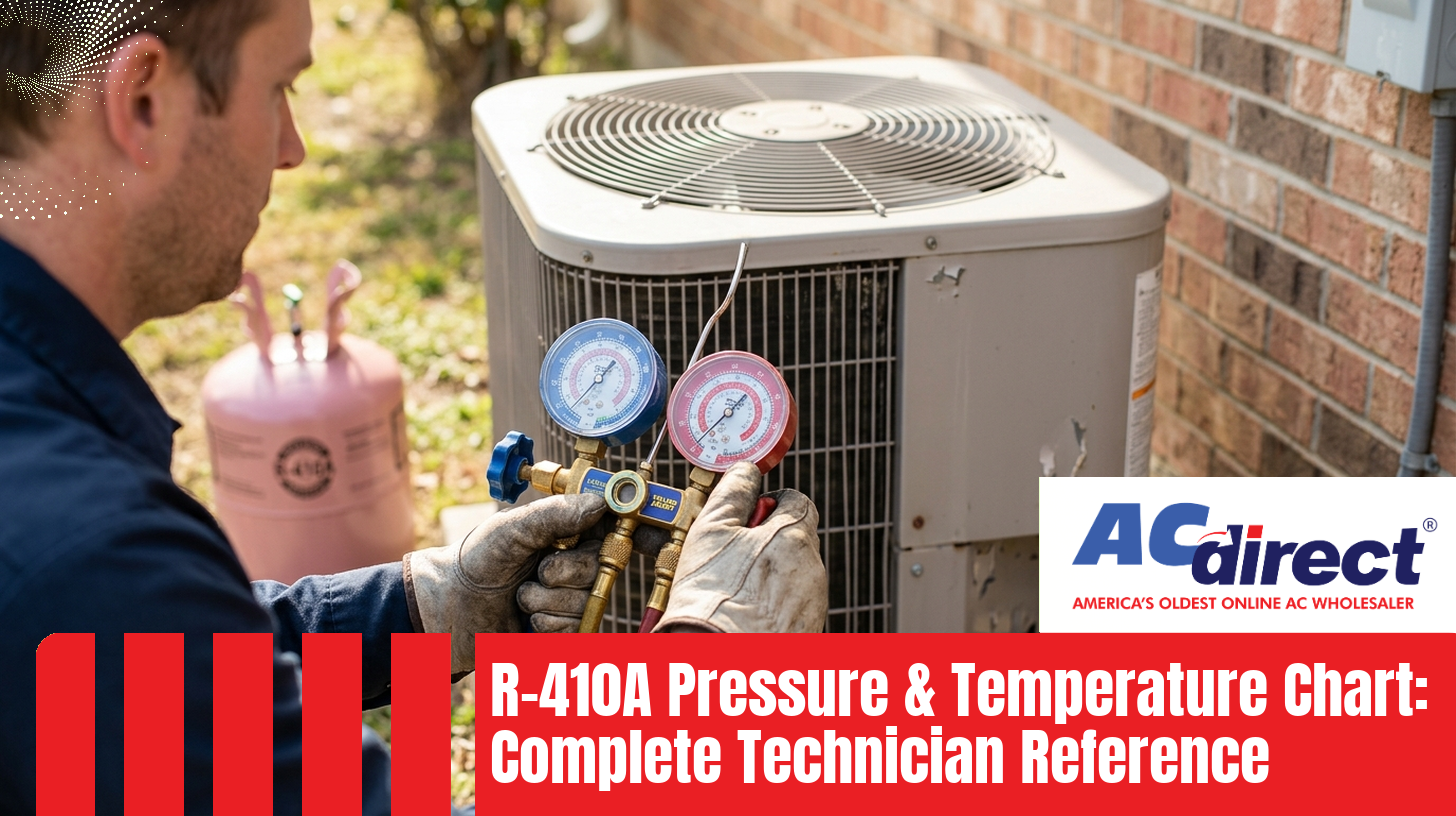
High side, low side, saturated pressures by outdoor temperature, and the diagnostic patterns that actually tell you what is wrong with the system.
A pressure-temperature chart is the single most useful piece of paper a refrigeration technician carries. For R-410A, the numbers run high - higher than what most techs grew up reading on R-22 - and a single misread gauge can lead to an overcharge, a burned compressor, or a callback at 2 a.m. This reference is built to live in your truck, on your bench, or open on your phone while you are at the unit.
Before getting to the chart itself, a quick clarification on what is actually happening with R-410A in 2026: the refrigerant is not banned. The EPA AIM Act stopped manufacturing of new R-410A residential AC equipment as of January 1, 2025, but service refrigerant remains legal, existing systems are grandfathered for life, and pre-cutoff inventory is still legal to install. If you are looking at the supply side of this market, AC Direct still has r410a air conditioning system overstock available at attractive pricing while supplies last.
A pressure-temperature chart works on one core idea: at any given saturated temperature, a refrigerant has exactly one corresponding pressure. If you know the pressure, you know the saturated temperature inside the coil. If you know the saturated temperature, you can compare it to the actual line temperature and calculate superheat (on the suction side) or subcooling (on the liquid side).
Three terms you need locked in:
- PSIG - pounds per square inch, gauge. This is what your manifold reads. Atmospheric pressure equals 0 PSIG.
- Saturated temperature - the temperature at which the refrigerant is changing state (boiling or condensing) at a given pressure.
- Superheat / Subcooling - the temperature difference between the actual refrigerant line and the saturated value from the chart. These are how you charge and diagnose almost every modern split system.
This is the working table. Find the temperature in the left column, read the corresponding saturated pressure in PSIG. Use this against your suction line saturation (low side) and liquid line saturation (high side) to calculate superheat and subcooling.
| Temp (°F) | PSIG | Temp (°F) | PSIG | Temp (°F) | PSIG |
|---|---|---|---|---|---|
| 0 | 48.2 | 45 | 130.9 | 90 | 274.1 |
| 5 | 55.7 | 50 | 142.6 | 95 | 295.0 |
| 10 | 63.9 | 55 | 155.0 | 100 | 317.0 |
| 15 | 72.7 | 60 | 168.2 | 105 | 340.2 |
| 20 | 82.3 | 65 | 182.2 | 110 | 364.7 |
| 25 | 92.6 | 70 | 201.5 | 115 | 390.4 |
| 30 | 103.6 | 75 | 213.0 | 120 | 417.5 |
| 35 | 109.9 | 80 | 229.7 | 125 | 446.0 |
| 40 | 118.8 | 85 | 254.6 | 130 | 475.9 |
Saturation values cross-referenced against published R-410A property tables. R-410A is a near-azeotropic blend of 50% R-32 and 50% R-125, so glide is minimal and these figures are usable as both bubble and dew approximations for field work.
For a more compact version meant to live laminated in your toolbox, see our R-410A Pressure Temperature Chart: Printable PDF & Quick Reference.
The high side, also called the discharge or liquid line, is what your red gauge reads. It tracks condensing temperature, which on an air-cooled condenser runs roughly 20°F to 30°F above ambient outdoor temperature on a healthy system.
For routine R-410A field work, expect discharge pressures in the 325 to 445 PSIG range across normal summer ambients, with most systems operating between 370 and 420 PSIG under moderate conditions. The 525 PSIG mark is the minimum rupture disk threshold (about 138°F saturation) - well above any healthy field reading.
For a deeper breakdown of high side and low side behavior across operating conditions, see R-410A Pressure Chart: High & Low Side (Complete Reference Tool).
The low side, suction line, is your blue gauge. It tracks evaporator saturation temperature, which on a typical residential system should sit somewhere in the high 30s to mid 40s °F at design indoor load.
Expected suction pressures fall in the 115 to 145 PSIG band on a properly charged system at normal indoor loads. The most commonly cited working range is 118 to 135 PSIG, which corresponds to roughly 40°F to 47°F saturation - exactly where you want a residential evaporator running.
This is the part most techs use daily. These are typical, healthy R-410A pressures at the listed outdoor ambients with normal indoor load (around 75°F return air at 50% RH). Use them as expected ranges, not absolute targets - always charge by manufacturer specification using superheat or subcooling.
Suction pressure typically lands at 118 to 135 PSIG. Discharge pressure runs in the 225 to 250 PSIG range on most residential systems. If you are seeing 370+ PSIG on the high side at 70°F ambient, you have an overcharge, condenser airflow restriction, or non-condensables in the system.
Suction pressures should land in the 125 to 140 PSIG range. Discharge pressures climb to roughly 275 to 320 PSIG. Saturated condensing temperature should be running around 105°F to 115°F (about 20-30°F above ambient).
This is design day for most of the southern U.S. Healthy suction pressures: 130 to 145 PSIG. Discharge pressures: 325 to 380 PSIG. Saturated condensing temperature around 115°F to 125°F. This is also where R-454B replacement systems run remarkably similar pressures - typically 2 to 5% higher than R-410A.
Suction pressures climb to 140 to 155 PSIG. Discharge pressures push 380 to 445 PSIG. At this ambient, condenser airflow problems show up dramatically - a slightly dirty coil that ran fine at 85°F outdoor will trip a high pressure switch at 105°F.
For the full operating-pressure deep reference and how to read symptoms off the gauges, see R-410A Operating Pressures: Normal Ranges, Symptoms of Issues & How to Read.
R-410A operates at substantially higher pressures than R-22, which means your gauge set has to be rated for it. A standard R-22 manifold will read inaccurately at the high end of the R-410A range, and the hoses may not be rated to the working pressures involved.
R-410A service ports use a 5/16" SAE flare fitting, smaller than the 1/4" used on R-22. This is intentional - it prevents accidental cross-charging. Always use hoses rated for at least 800 PSIG working pressure with R-410A. Connect blue to the suction (low side) Schrader, red to the liquid line service port (high side), and yellow to your refrigerant cylinder or recovery machine.
Use a manifold with the R-410A scale printed on the dial face. Read PSIG on the outer scale and saturated temperature on the inner scale. For superheat: measure suction line temperature with a clamp-on thermocouple about 6 inches before the compressor, subtract the saturated temperature from your low side gauge. For subcooling: measure liquid line temperature near the condenser outlet, subtract that from the saturated temperature on the high side gauge.
Per EPA Section 608, R-410A must be recovered to vacuum levels specified by certification rules. Use a recovery machine rated for high-pressure HFC blends, and recover into a pink/rose-colored DOT cylinder labeled for R-410A. Cross-contaminating cylinders is one of the fastest ways to destroy a tank's resale and reclaim value.
Full breakdown of gauge selection, port adapters, and reading technique: R-410A Manifold Gauges: Buying Guide & How to Read Them. For more on interpreting the readings themselves, see R-410A PT Chart Explained: How to Use It (For Technicians).
The PT chart turns into a real diagnostic tool when you start reading patterns instead of single numbers. Three of the most common patterns you will see in the field:
An undercharged R-410A system shows a low suction pressure, low discharge pressure, and high superheat. Subcooling will be low or zero. The compressor may run hot because suction gas is not bringing back enough mass to cool the motor windings. On a TXV system, look for hunting (oscillating) suction pressure. On a fixed-orifice system, low charge is more obvious because superheat climbs quickly.
An overcharged R-410A system shows a high discharge pressure, slightly elevated suction pressure, and high subcooling (often above 15°F). Superheat drops, sometimes to zero, which is dangerous - liquid floodback to the compressor will destroy it. Discharge line temperatures drop, and amperage climbs because the compressor is doing more work against a higher head pressure.
A restriction - a kinked liquid line, a clogged filter-drier, a stuck TXV - shows up as low suction pressure, normal-to-high discharge pressure, and abnormally high subcooling. The classic tell is a temperature drop across the filter-drier or TXV inlet that is well above what manufacturer specs allow. Frost forming downstream of a restriction is a dead giveaway.
Do not start adjusting anything until you have a baseline. Note ambient temperature, return air temperature and humidity, and both pressures simultaneously.
Use the PT chart to convert your saturation pressures to temperatures. Compare against manufacturer's charging chart for the specific unit - never charge by "feel".
Use the three patterns above as a starting filter. The combination of all four readings (suction, discharge, SH, SC) almost always points to a single cause.
Check airflow on both coils, condenser cleanliness, indoor filter, and metering device behavior before adding or removing refrigerant. Many "low charge" calls are actually restricted indoor coils or dirty filters.
Knowing how R-410A pressures compare to neighboring refrigerants is useful when you are working a mixed fleet or transitioning customers to newer systems.
| Refrigerant | Typical Suction | Typical Discharge | GWP | Safety Class |
|---|---|---|---|---|
| R-22 (legacy) | 65-80 PSIG | 225-275 PSIG | 1,810 | A1 |
| R-410A | 130-145 PSIG | 325-380 PSIG | 2,088 | A1 |
| R-454B | 120-135 PSIG | 360-460 PSIG | 466 | A2L |
| R-32 | 140-160 PSIG | 375-435 PSIG | 675 | A2L |
R-454B and R-32 both replace R-410A in new equipment. They are different paths chosen by different manufacturers - R-454B by Carrier, Trane, Lennox, Rheem, Goodman, MRCOOL and others, R-32 by Daikin and many international brands. Both are A2L mildly flammable and require updated training, recovery, and tooling.
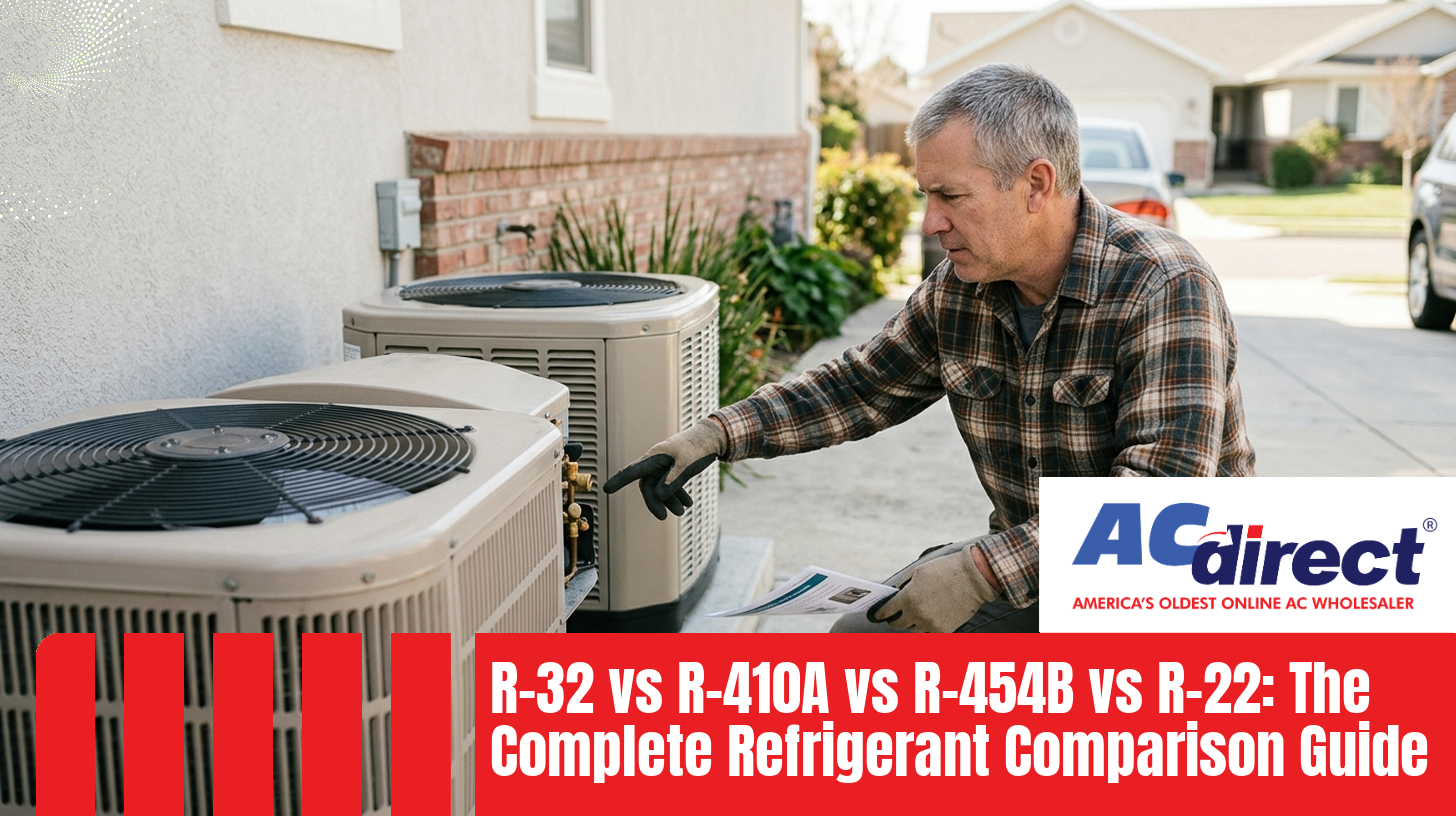
Critically: R-410A systems cannot be retrofitted with R-454B or R-32. Different oils, different pressure design margins, different safety requirements. Existing R-410A equipment stays on R-410A for life. For the bigger picture on what each refrigerant means for your customers, see our complete R-410A refrigerant guide and the r32 vs r410a (the comparison they're searching) breakdown.
For field use, a single laminated card beats pulling out a phone every time. The full printable version is available here: R-410A Pressure Temperature Chart: Printable PDF & Quick Reference. It includes the full 0°F to 140°F range, suction/discharge target ranges by ambient, and a superheat/subcooling worksheet on the back.
Most R-410A misdiagnoses fall into one of a handful of categories. Worth running through these before you commit to a charge adjustment:
- Reading the wrong scale on the manifold. R-410A gauges have multiple PT scales printed (R-22, R-404A, R-410A). Confirm you are tracking the correct curve before converting pressure to saturation temperature.
- Ignoring indoor load. Suction pressure varies with indoor return air temperature and humidity. Charging a system with the indoor unit cold-soaked from overnight will give a falsely low reading.
- Charging without measuring line temperatures. Pressures alone do not tell you superheat or subcooling. A digital probe on the suction line is non-negotiable for accurate work.
- Forgetting to allow run time. Give the system 10 to 15 minutes of stable runtime before trusting any reading. Pressures swing wildly during the first few minutes.
- Adding refrigerant to a system that is "low" without checking restrictions. A low suction with high subcool is a restriction, not a low charge. Adding refrigerant makes it worse.
- Mistaking non-condensables for an overcharge. Air or moisture trapped in the system raises high side pressures dramatically. The fix is recovery and evacuation, not pulling refrigerant.
- Using R-22 hoses on R-410A. Working pressure ratings matter. R-410A can spike well above what older hose assemblies are rated for.
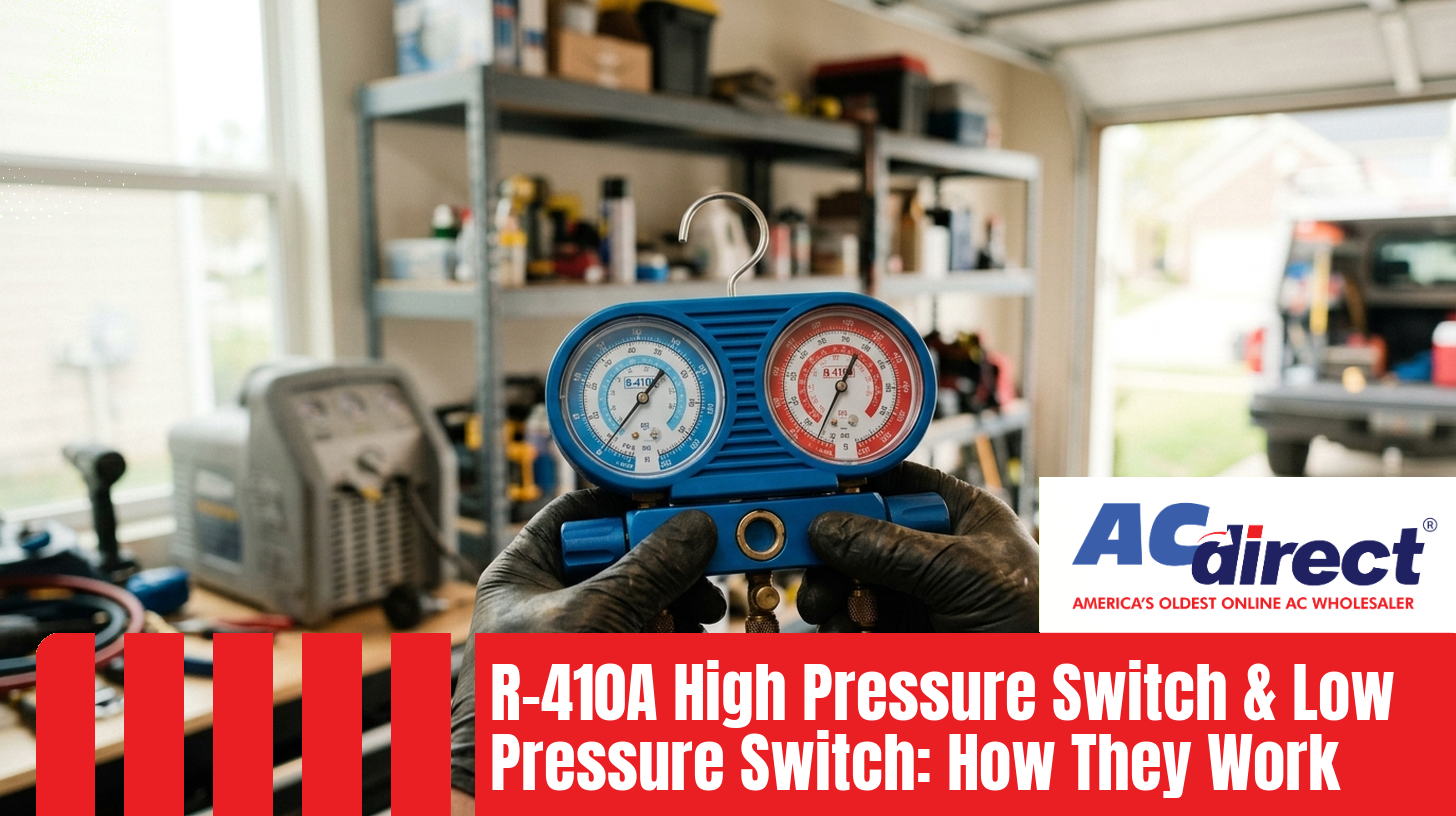
Reading pressure switch behavior fits in here too - if a high pressure switch is tripping intermittently, the cause is almost always condenser airflow or charge, not the switch itself. See R-410A High Pressure Switch & Low Pressure Switch: How They Work for the wiring and trip-point details.
For homeowners reading this: handling R-410A legally requires EPA Section 608 certification. That is not a soft rule, it is federal law. Anything that involves opening the refrigerant circuit - adding refrigerant, recovering refrigerant, changing a filter-drier, replacing a TXV, brazing a leak - is service work that must be done by a certified technician.
What homeowners can do safely:
- Replace return air filters monthly during cooling season
- Clear the area around the outdoor condenser (2 feet minimum on all sides)
- Gently rinse the outdoor coil with a garden hose, top down, fins straight
- Verify the indoor blower is moving air and the thermostat is calling correctly
- Note unusual sounds, smells, or short cycling and report them to your tech
If you are seeing reduced cooling, ice on the suction line, or short cycling, those are pressure-circuit problems. Call a certified pro. Need help finding the right replacement equipment or matching components? You can also call AC Direct to talk to an R-410A expert about overstock systems still legal to install.
For a homeowner-focused breakdown of repair costs, replacement timing, and when to keep an R-410A system running versus replace it, the dedicated guide on R-410A air conditioning systems is the next stop.
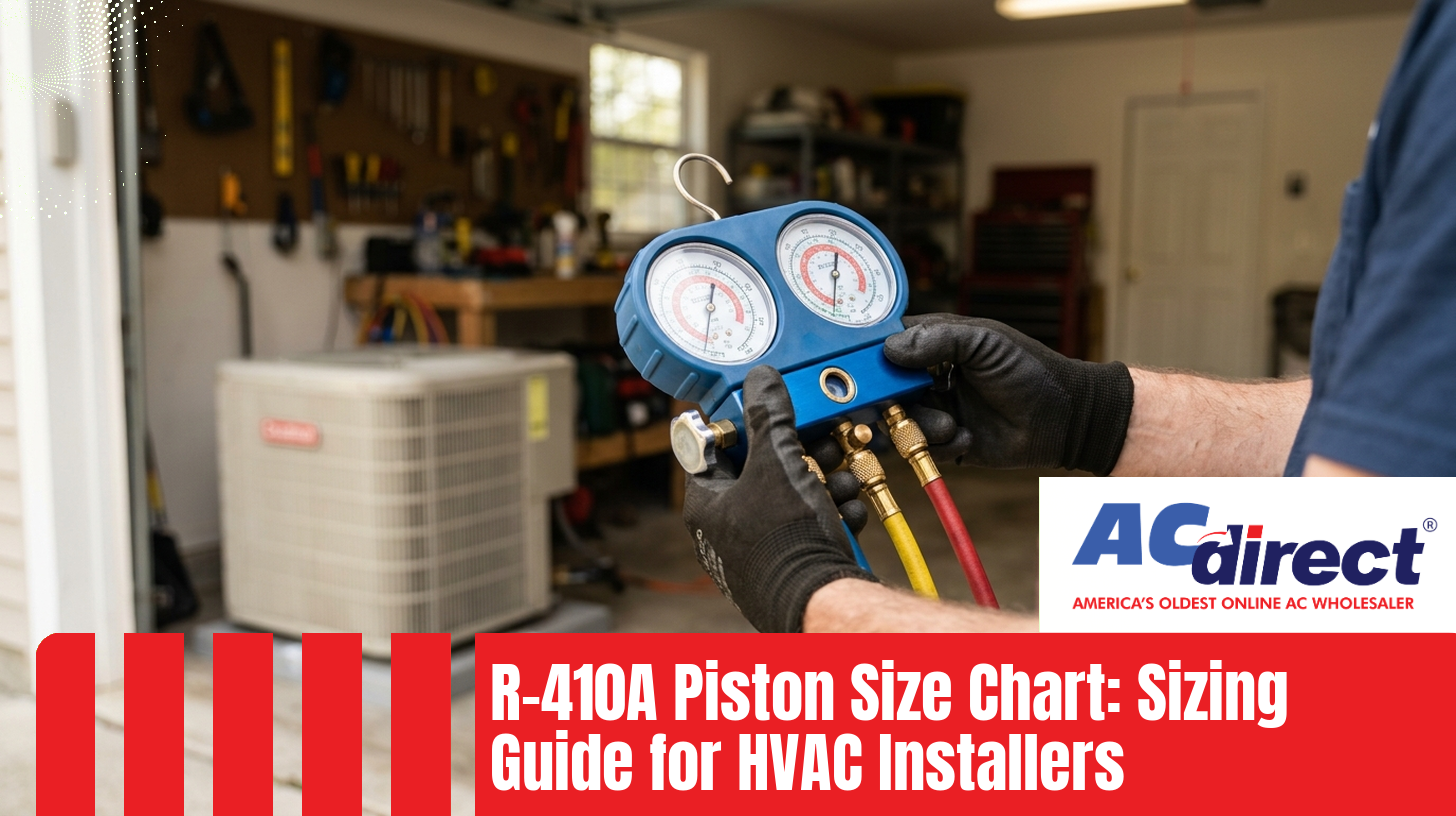
Pressure readings are only meaningful if the metering device is correctly sized. A piston (fixed orifice) that is undersized will starve the evaporator and read low suction even on a properly charged system. Oversized pistons flood the evaporator and drop superheat to dangerous levels. If you are matching an R-410A condenser to an existing or new air handler, run the numbers through the R-410A Piston Size Chart: Sizing Guide for HVAC Installers before you start charging.
The PT chart is your decoder ring for R-410A. The numbers above are field-tested and match what published refrigerant data tables provide. Read both gauges, calculate superheat and subcooling against the chart, match the pattern, and verify airflow before you ever crack a cylinder.
R-410A is not going away in 2026. Existing systems are grandfathered, service refrigerant is legal, and pre-cutoff inventory is still available - just less of it every month. Knowing the numbers cold is more valuable now than it was five years ago, not less.
AC Direct carries pre-cutoff overstock R-410A condensers, air handlers, and complete systems from major manufacturers, all legal to install under current EPA rules. Wholesale pricing, ships nationwide.
On a 95°F outdoor day with a healthy residential system, expect suction pressures in the 130 to 145 PSIG range and discharge pressures in the 325 to 380 PSIG range. At 105°F outdoor, suction climbs to 140 to 155 PSIG and discharge to 380 to 445 PSIG. Always verify against the manufacturer's charging chart for the specific unit.
No. R-410A is not banned. The EPA AIM Act stopped manufacturing and importing of new R-410A residential AC equipment as of January 1, 2025, but service refrigerant remains legal indefinitely, existing systems are grandfathered, and equipment manufactured before the cutoff is currently scheduled to remain legal to install. The EPA has also published a proposed rule that would eliminate the installation deadline entirely.
No. R-410A, R-454B, and R-32 use different oils, different pressure design margins, and the A2L refrigerants (R-454B and R-32) carry mild flammability requirements that R-410A equipment was never designed for. Existing R-410A systems must be serviced with R-410A only. There is no drop-in replacement.
High discharge pressures above 450 PSIG point to one of four causes: overcharge, dirty or restricted condenser coil, condenser fan problem, or non-condensables (air or moisture) in the system. Do not add refrigerant. Verify outdoor airflow first, then check subcooling. If subcooling is high, you have an overcharge or non-condensables. Recovery and evacuation may be needed.
Read suction pressure on your manifold, convert it to saturation temperature using the PT chart (for example, 130 PSIG ≈ 45°F saturation). Measure suction line temperature with a clamp-on thermocouple about 6 inches before the compressor. Superheat = suction line temperature minus saturation temperature. Compare against the manufacturer's charging chart for the specific operating conditions.
R-410A retails for roughly $40 to $80 per pound for the refrigerant alone, with installed recharge costs commonly cited at $199 to $250 per pound depending on region and contractor. A 25 lb wholesale cylinder runs $75 to $200. Prices are expected to continue climbing as supply tightens through the phase-out window.
R-454B was specifically engineered as a near-replacement for R-410A. Its operating pressures run only 2 to 5% higher than R-410A across normal operating ranges, which let manufacturers redesign equipment without dramatically changing component pressure ratings. The big differences are GWP (466 vs 2,088), safety class (A2L vs A1), and oil compatibility - not pressure behavior.